The Largest Empires In The History Of India
At its peak in the 3rd century BCE, the Maurya Empire covered roughly 5 million square kilometers, a territory larger than the entire modern Republic of India. Two thousand years of Indian imperial history separate that opening chapter and the British exile of the last Mughal emperor in 1857. The seven empires that follow are the ones that pushed the borders furthest, ranked by maximum geographic extent. Some lasted centuries. Some collapsed within a generation. Each one left India a different country than the one it found.

Maurya Empire (322 BCE - 185 BCE)
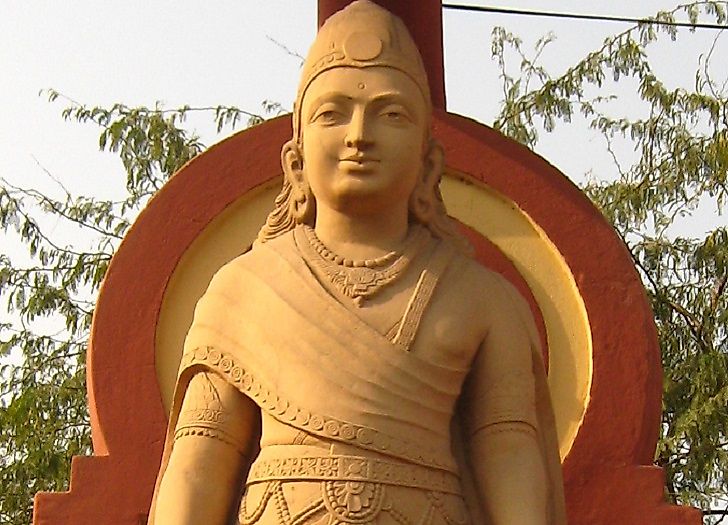
Chandragupta Maurya founded the empire in 322 BCE by overthrowing the Nanda dynasty in Magadha, exploiting the power vacuum left by Alexander the Great's retreat from northwestern India two years earlier. His advisor Chanakya (also known as Kautilya), the political theorist behind the Sanskrit treatise Arthashastra, supplied the strategy. By 305 BCE Chandragupta had defeated Seleucus I Nicator, one of Alexander's generals, and gained territory west of the Indus through a treaty that included a dynastic marriage alliance.
The empire peaked under Chandragupta's grandson Ashoka (c. 268-232 BCE), who controlled most of the subcontinent from his capital at Pataliputra (modern Patna). The turning point was the Kalinga War around 260 BCE, in which Ashoka conquered the east coast kingdom of Kalinga (modern Odisha) at a cost of roughly 100,000 to 150,000 lives. The scale of the killing changed him. He converted to Buddhism, renounced military conquest, and spent the rest of his reign building stupas, planting roadside trees, and inscribing edicts on stone pillars across the empire.
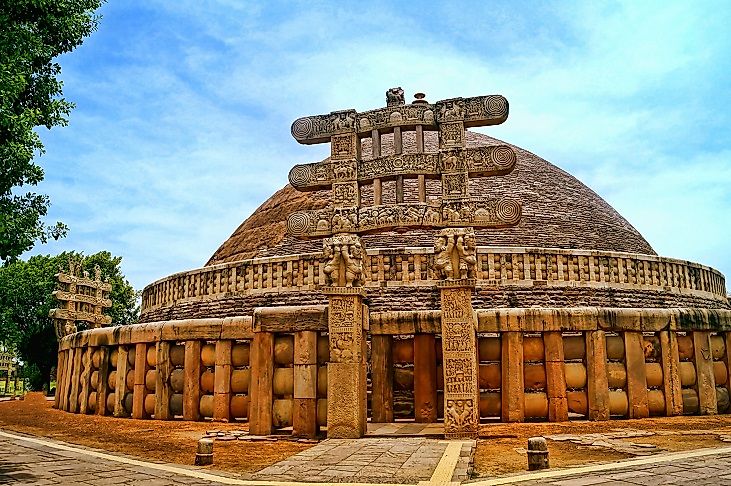
Ashoka's legacy outlived his dynasty. The Lion Capital of Ashoka, carved for one of his pillars at Sarnath around 250 BCE, was adopted as the national emblem of the Republic of India in 1950 and appears on every Indian banknote. The empire itself dissolved in 185 BCE when the last Maurya emperor, Brihadratha, was assassinated by his Brahmin commander Pushyamitra Shunga, who then founded the Shunga dynasty.
Mughal Empire (1526 - 1857)
The Mughal Empire began with a single battle. On April 21, 1526, at the First Battle of Panipat, a Timurid prince named Babur led around 12,000 men against the 100,000-strong army of Ibrahim Lodi, the Sultan of Delhi and last ruler of the Delhi Sultanate. Babur won by deploying field artillery and mobile cavalry tactics that Lodi's forces had no answer to. Within hours he held Delhi and Agra. Within four years he held northern India.
Babur was no Mongol ruler in the sense the word implies today, although the name "Mughal" is the Persian form of "Mongol." He was a Chagatai Turkic prince descended from Timur (Tamerlane) on his father's side and from Genghis Khan on his mother's. He inherited the small principality of Fergana at age 12 and spent most of his early career failing to hold Samarkand, before turning toward India for an empire he could actually keep.
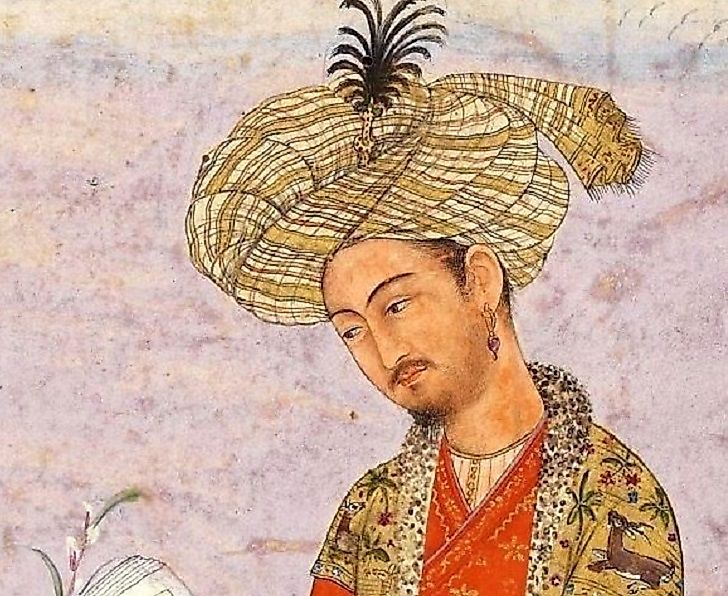
The empire's high points came under three emperors. Akbar (1556-1605) built the administrative machinery, abolished the jizya tax on non-Muslims in 1564, and put Hindu Rajputs into senior military and civil posts. Shah Jahan (1628-1658) built the Taj Mahal between 1631 and 1648 as a tomb for his wife Mumtaz Mahal, along with the Red Fort in Delhi and the Jama Masjid. Aurangzeb (1658-1707) pushed the empire to its maximum extent of roughly 4 million square kilometers by 1690, ruling a population estimated at 150 million, but his reimposition of the jizya in 1679 and decades of war in the Deccan drained the treasury and alienated Hindu and Sikh subjects.
After Aurangzeb's death the empire fractured. Regional governors broke away. The Marathas took the Deccan, the Sikhs took the Punjab, and the British East India Company took everything else through a combination of bribery, treaty, and direct military action. The last Mughal emperor, Bahadur Shah II, was exiled to Rangoon in 1858 after the failed Indian Rebellion of 1857.
Gupta Empire (c. 320 CE - c. 550 CE)
The Gupta Empire is the one most Indians mean when they say "Golden Age." It was founded around 320 CE by Chandragupta I (a different person from Chandragupta Maurya, six centuries earlier), who consolidated power in the Ganges valley through a strategic marriage alliance with the Licchavi clan. His son Samudragupta (c. 335-380 CE) earned the nickname "Indian Napoleon" for conquering or subjugating roughly 35 kings across northern, central, and southern India. The empire reached its peak under Chandragupta II Vikramaditya (380-415 CE), covering around 3.5 million square kilometers.
What makes the period extraordinary is what happened in science, mathematics, and the arts. Aryabhata published the Aryabhatiya in 499 CE, in which he stated that the Earth rotates on its axis, calculated pi to four decimal places, and laid out the sine table that became the foundation of trigonometry. Kalidasa wrote the Sanskrit plays and poetry that scholars still rank alongside Shakespeare. The Iron Pillar of Delhi was forged around 400 CE from 98 percent wrought iron and has resisted rust for more than 1,600 years. The decimal system of notation and the use of zero as a number both spread out of Gupta India through Arab mathematicians and into medieval Europe.
The empire's decline came from outside. The Huna (a branch of the Central Asian Huns) invaded in waves through the late 5th and early 6th centuries. The Gupta emperor Skandagupta beat them back in the 450s, but the cost weakened the central treasury, and the empire fragmented into regional successor states by around 550 CE.
Delhi Sultanate (1206 - 1526)
The Delhi Sultanate was not one dynasty but five in succession: the Mamluk (or Slave) dynasty, Khalji, Tughluq, Sayyid, and Lodi. Together they ruled large parts of northern India for 320 years, from the establishment of the sultanate by Qutb-ud-din Aibak in 1206 until Babur's victory at Panipat in 1526. The sultanate reached its largest extent of about 3.2 million square kilometers under Muhammad bin Tughluq around 1330, when Tughluq briefly extended control into the deep south of the subcontinent.
Two figures stand out. Razia Sultana ruled the sultanate from 1236 to 1240 as one of the first female Muslim rulers in the medieval Islamic world; she dropped the veil, dressed in the tunic and hat of a male sovereign, and led her armies in person before being deposed and killed by Turkic nobles who could not accept her authority. The Qutub Minar in Delhi, started by Qutb-ud-din Aibak in 1192 and completed by his successor Iltutmish, still stands at 73 meters as the tallest brick minaret in the world.
Maratha Empire (1674 - 1818)
The Maratha Empire is the only entry on this list that overlaps with the British East India Company on the subcontinent. Shivaji Maharaj founded it in 1674 with his coronation as Chhatrapati at Raigad Fort, after two decades of guerrilla warfare against the Bijapur Sultanate and the Mughals. The empire was built on a network of more than 300 hill forts across the Western Ghats, designed to be defensible by small garrisons against much larger armies. Twelve of these forts were inscribed as a UNESCO World Heritage Site in July 2025 under the title "Maratha Military Landscapes of India."
After Shivaji's death in 1680, the empire evolved into a confederacy under hereditary prime ministers known as Peshwas. It hit its maximum extent of around 2.5 million square kilometers in 1760, controlling territory across the Deccan northward into Delhi and eastward into Bengal. The end came quickly and in two acts. The first was the Third Battle of Panipat in January 1761, in which an Afghan invasion under Ahmad Shah Durrani killed an estimated 40,000 to 60,000 Maratha soldiers in a single day and ended Maratha northward expansion. The second was the Third Anglo-Maratha War of 1817-1818, after which the British East India Company dissolved the confederacy.
Kushan Empire (c. 30 CE - c. 375 CE)
The Kushan Empire ran the Silk Road. At its peak around 127 CE under Kanishka the Great, it covered roughly 2 million square kilometers from modern Tajikistan through Afghanistan and Pakistan into northern India, controlling the trade routes that connected Han China, Parthian Persia, and the Roman Empire. The Kushans were originally a branch of the Yuezhi, a nomadic Indo-European people pushed west out of what is now the Gansu corridor by the Xiongnu. By the 1st century CE they had settled in Bactria and crossed the Hindu Kush.
Kanishka's patronage produced the Gandhara school of art, which gave the world its first human depictions of the Buddha (earlier Buddhist art had represented him only through symbols, such as an empty throne or a Bodhi tree). The Kushans also minted some of the most beautiful gold coinage of the ancient world, with portraits of their kings on the obverse and gods drawn from Greek, Persian, Buddhist, and Hindu pantheons on the reverse.
Empire of Harsha (606 - 647 CE)
Harsha's empire was brief and largely the work of one man. Harshavardhana came to the throne of Thanesar in 606 CE at age 16, after his older brother was assassinated. Over the next four decades he extended his rule across most of northern India from his capital at Kannauj, covering roughly 1 million square kilometers at his peak. He was the last major North Indian emperor before the Islamic conquests that would begin three centuries later.
Most of what is known about Harsha comes from two sources: his court poet Bana, who wrote the biography Harshacharita, and the Chinese Buddhist pilgrim Xuanzang, who spent eight years traveling through India during Harsha's reign and recorded his observations in detail. Harsha himself wrote three Sanskrit plays that survive. He died without an heir in 647 CE, and the empire dissolved within a year.
At a Glance
| Rank | Empire | Maximum extent (km²) | Date of maximum extent |
|---|---|---|---|
| 1 | Maurya Empire | 5,000,000 | c. 250 BCE |
| 2 | Mughal Empire | 4,000,000 | c. 1690 CE |
| 3 | Gupta Empire | 3,500,000 | c. 400 CE |
| - | Republic of India (for comparison) | 3,287,263 | Present |
| 4 | Delhi Sultanate | 3,200,000 | c. 1330 CE |
| 5 | Maratha Empire | 2,500,000 | c. 1760 CE |
| 6 | Kushan Empire | 2,000,000 | c. 127 CE |
| 7 | Empire of Harsha | 1,000,000 | c. 640 CE |
What They Left Behind
The borders of these empires are gone, but most of what they built is still visible. The Mauryan template of a centralized bureaucracy collecting land revenue from a network of provincial governors became the operating system that every later Indian empire borrowed from. The Gupta-era decimal system and the use of zero traveled out of India through Arab mathematicians and became the number system the entire world now uses. The Mughal stamp on Hindustani music, Mughlai cuisine, Urdu poetry, and red sandstone architecture is so deeply embedded in modern North Indian culture that most of it is no longer recognized as foreign. The Lion Capital of Ashoka, carved roughly 2,275 years ago, is on the cover of every Indian passport issued today.