6 Of The Most Snake Infested Rivers In Texas
Rivers span the entire state of Texas, passing through distinct geographical zones. Eastern rivers move slowly through dense vegetation, central rivers cross hilly terrain, and western rivers flow through drier regions with canyons and high bluffs. Some rivers also mark state borders, including the Red River along much of the boundary with Oklahoma and the Sabine River along the border with Louisiana.
These waterways support outdoor activities, plant life, and wildlife, including many of the state's 105 or more native snake species. These are six Texas rivers where snakes are commonly encountered.
Brazos River

The Brazos River is the longest river flowing entirely in Texas. It is formed by the confluence of two of its three forks, the Double Mountain Fork and the Salt Fork. The Brazos flows southwest toward Waco, then across the Texas coastal plain, and finally empties into the Gulf of Mexico after a total course of 1,280 miles.

The Brazos Water Snake (Nerodia harteri) is endemic to the Brazos River, specifically the upper parts of its drainage. This snake’s preferred habitat differs between juveniles and adults. Younger snakes shelter under large flat rocks on unshaded shores and hunt in shallow water. Adults occupy faster water and hunt in open areas, including ponds and lakes.
Trinity River

The Trinity River rises on the North Central Plains, where the Elm Fork and West Fork merge near downtown Dallas. It flows for 423 miles into Trinity Bay, which empties into the Gulf of Mexico. It is the longest river in Texas whose drainage basin lies entirely within the state.

The Yellow Bellied Watersnake (Nerodia erythrogaster flavigaster) is a subspecies of the Plain Bellied Watersnake (Nerodia erythrogaster). Unlike many watersnakes, it may move farther from water, with records of individuals several hundred meters away from the nearest source. Its broad range includes forests, grasslands, scrublands, lakes, ponds, swamps, bogs, marshes, and rivers.
Sabine River

The Sabine River forms the border between Texas and Louisiana. It rises in northeast Texas and follows a 578 mile course through the state. Near the end of its route, the river widens to form Sabine Lake, passes Port Arthur, and then moves through Sabine Pass into the Gulf of Mexico.

The Mississippi Green Watersnake (Nerodia cyclopion) inhabits the lower parts of the Sabine River, especially where the river runs close to the Texas-Louisiana border. This species is one of the few in Texas that may occur in brackish water, although it is more often found in freshwater. Sightings are more common in quiet bodies of water along the river and in nearby wetlands.
Neches River

The Neches River originates in East Texas and flows 416 miles into Sabine Lake, eventually emptying into the Gulf of Mexico. For most of its course, the river passes through pine forests. It acts as a boundary for several counties across the region and drains a total area of 10,011 square miles.

The wooded areas along the Neches River create suitable habitat for the Timber Rattlesnake (Crotalus horridus). These snakes favor wet bottomland areas near rivers, ponds, and other permanent bodies of water. They use tree stumps, logs, and fallen branches for cover. Timber Rattlesnakes are the second largest venomous snake in Texas, reaching lengths of about 40 inches and weighing up to two pounds.
Guadalupe River

The Guadalupe River rises in Kerr County and flows 230 miles past several counties, moving through limestone bluffs and over small waterfalls before emptying into San Antonio Bay. The river supports a wide range of plant and animal life, including the Water Moccasin (Agkistrodon piscivorus), a semi-aquatic pit viper.

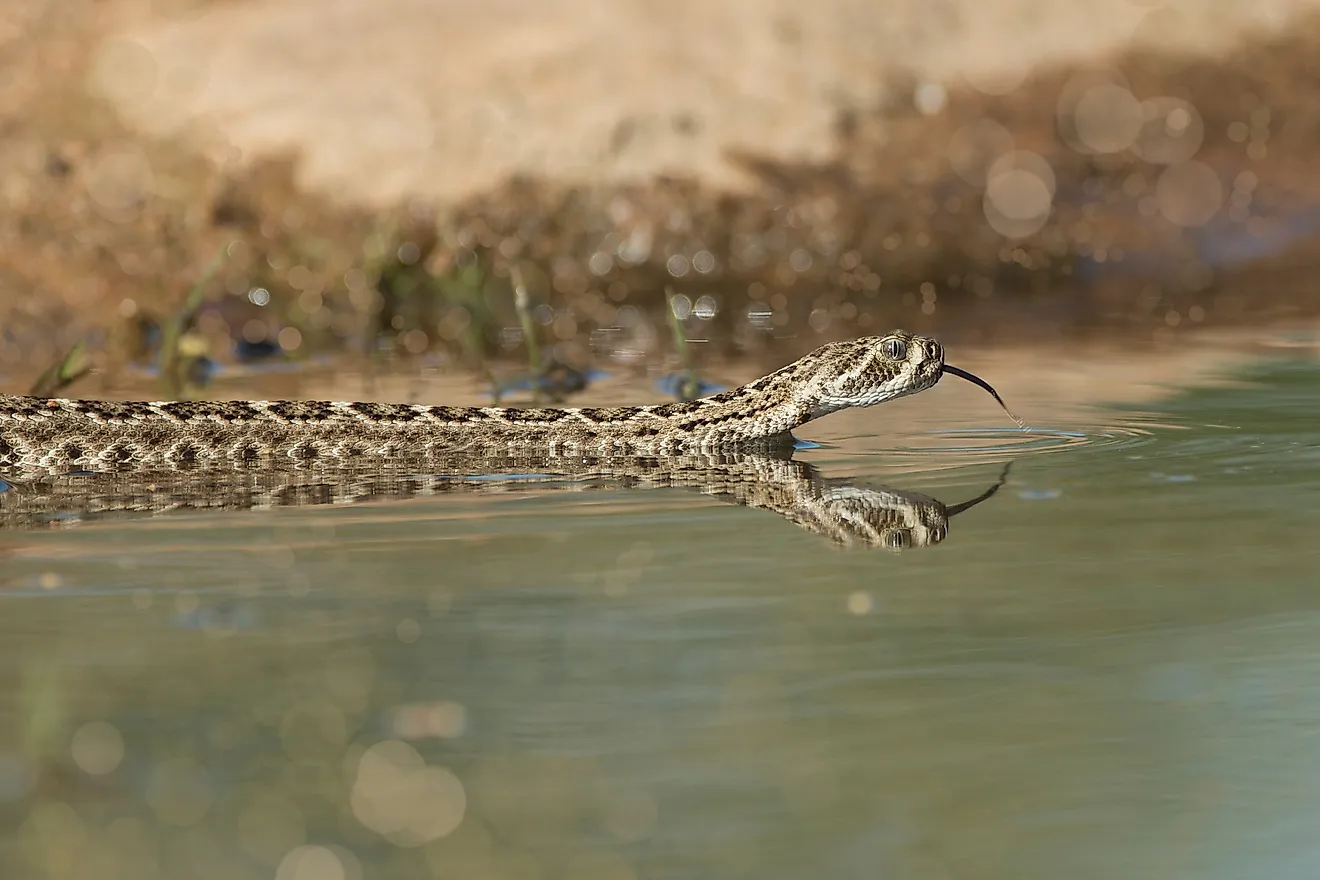
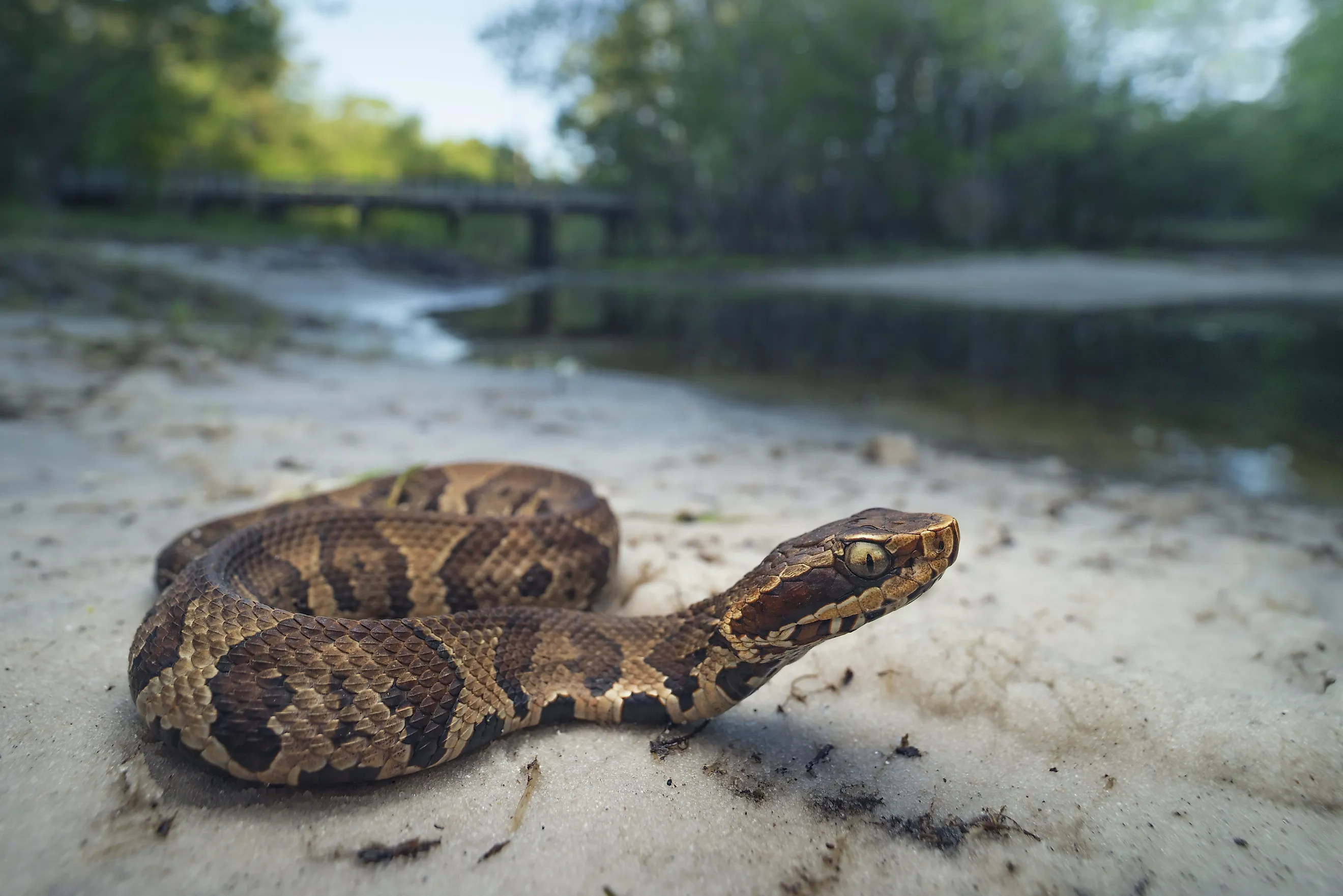
Water Moccasins occur in the eastern half of Texas and favor swamps, slow-moving water, ponds, and coastal marshes as their primary habitat. They are sometimes called Cottonmouths because of the white lining inside the mouth, which they display when threatened. This behavior is used to deter predators and reduce direct conflict.
Colorado River

The Colorado River begins in northwest Texas and flows southeast for more than 800 miles, passing through Austin before emptying into the Gulf of Mexico at Matagorda Bay. The river supports many communities and ecosystems throughout its length, including more than 7,500 miles of creeks, streams, and rivers within its basin.

Snakes occur along the banks and in the water of the Colorado River, including two species of watersnake, the Diamondback Watersnake (Nerodia rhombifer) and the Blotched Watersnake (Nerodia erythrogaster blotched), a subspecies of the Plain Bellied Watersnake. Diamondback Watersnakes are often active at night, though they may be more active during the day in spring and fall. Both species prefer quiet, slow-moving water. The Blotched Watersnake favors areas with shoreline vegetation or overhanging limbs, which allow quick entry into the water if threatened.
Snake Activity Along Texas Rivers
Anyone with a fear of snakes, known as ophidiophobia, may hesitate to spend time on the water in Texas, as the state is home to about 105 snake species. Fifteen of these species and subspecies are venomous. Most snakes seen in or near rivers are harmless watersnakes like those described in this list. To an untrained observer, watersnakes can resemble the venomous Water Moccasin. If there is uncertainty, giving the snake space allows it to leave the area on its own.