The Oldest Concert Venues Still Operating In America
Live music in America predates the arena era by well over a century, staged in ornate opera houses, plain brick tabernacles, and open canyons cut into western sandstone. The venues below are ordered by the year each opened as a performance space, counting only halls that still book live music today. Continuous operation is not part of the test, so a room that sat dark for decades before reopening still qualifies. That standard makes Boston's Orpheum Theatre the oldest entry here at 1852, ahead of Philadelphia's Academy of Music in 1857 and Carnegie Hall, which opened in 1891 with Pyotr Ilyich Tchaikovsky appearing during its first week. These seven iconic concert venues have become bucket-list destinations as much for their own legacies as for the artists who grace the stage.
Orpheum Theatre, Boston

Built in 1852 as the Boston Music Hall, the venue quickly became one of the most prestigious concert halls in the country and the center of musical life in Boston, Massachusetts. It was the founding home of the New England Conservatory of Music in 1867, when Eben Tourjée opened the school in seven rented rooms above the hall. The theater was known for its sharp acoustics, which attracted many respected classical performers, and it served as the original home of the Boston Symphony Orchestra from its founding in 1880.
Although the Music Hall closed in 1900, the structure found new life as a vaudeville house and officially became the Orpheum Theatre in 1906. Architect Thomas W. Lamb gutted and rebuilt the interior in 1915, so the room audiences sit in today dates to that reconstruction rather than to 1852. Live rock returned in 1971 with a James Brown performance. The 2,700-seat theater has since hosted U2, The Police, and Aerosmith.
Academy of Music, Philadelphia

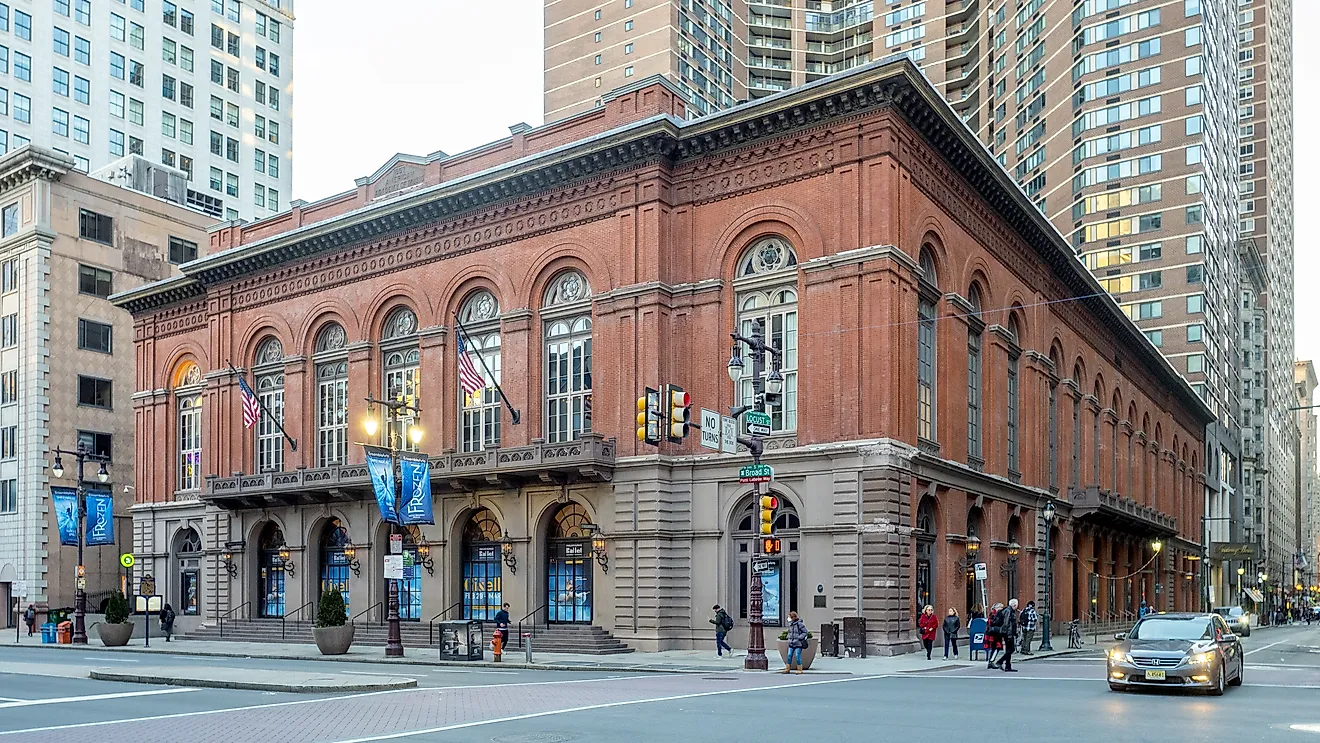
Opened in January 1857, the Academy of Music in Philadelphia is the oldest continuously operating opera house and musical venue in the United States, still entertaining up to 2,509 guests a night. Located downtown on the corner of South Broad and Locust Street, the ornate building earned the nickname "the Grand Old Lady of Locust Street" for its majestic presence and remains an important part of Pennsylvania's performing arts scene today.
Designed by the firm of Napoleon LeBrun and Gustavus Runge, the theater was modeled after Milan's famous La Scala opera house and became a National Historic Landmark in 1962. The interiors feature elaborate scarlet-and-gold decorations and a massive crystal chandelier that creates a sense of grandeur. Interestingly, it was never a music school despite its name. Today, the theater hosts Broadway productions, ballet, and opera. Orchestral concerts and comedy shows fill out the calendar. Opera Philadelphia and the Philadelphia Ballet use the theater as their primary home, while the Philadelphia Orchestra has owned it since purchasing it in 1957.
Carnegie Hall, New York City

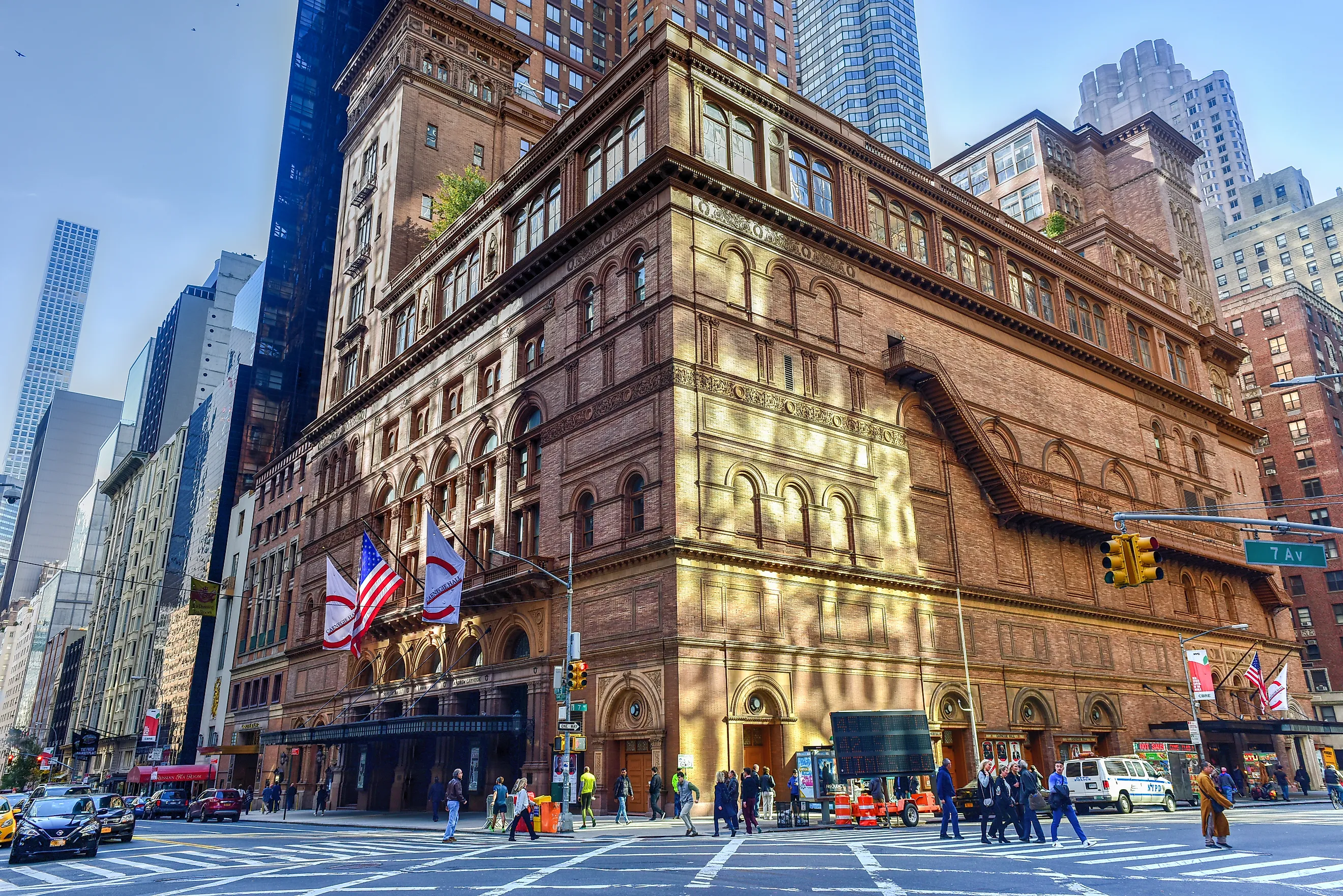
When Carnegie Hall opened in 1891, it quickly became one of America's most important music stages. Financed by industrialist and philanthropist Andrew Carnegie and designed by architect William Tuthill, the New York City landmark seats up to 3,657 attendees across its three combined spaces. The Hall is widely known for one of the most famous jokes in the music world, "How do you get to Carnegie Hall?" The answer is, "Practice."
During its opening week in 1891, the building featured the guest Russian composer Pyotr Ilyich Tchaikovsky, helping establish the Hall's reputation from the start. Its Neo-Italian Renaissance architecture and elaborate exterior style with reddish-brown Roman brick, arches, and terra cotta trim have made it one of New York's most recognizable cultural landmarks.
The building actually contains three performance spaces. The Stern Auditorium/Perelman Stage, Zankel Hall, and Weill Recital Hall accommodate large orchestral programs as well as intimate recitals. Over the years, they have welcomed classical musicians, jazz legends like Billie Holiday, and popular acts including the Beatles.
Ryman Auditorium, Nashville

Built in 1892 by riverboat captain Thomas Ryman, the Ryman Auditorium originally served as the Union Gospel Tabernacle, hosting religious revivals rather than concerts. Architect Hugh Cathcart Thompson designed the Gothic Revival building, which seats 2,362 people today. After Ryman's death, the building was renamed the Ryman Auditorium in 1904. Decades later, it became home to the Grand Ole Opry, which broadcast from the venue between 1943 and 1974. This helped eventually bring country music into homes across the country.
Today, the Ryman is known as the Mother Church of Country Music, but its stage extends far beyond just that. Rock, pop, and other music acts regularly perform beneath the historic arches of the Tennessee landmark. The Nashville auditorium is celebrated for its great acoustics, which give performances a distinctive clarity. During the day, it also operates as a museum, allowing visitors to explore its unique origins before returning to a concert venue after dark. Its importance earned it a National Historic Landmark designation in 2001 and recognition as a Rock & Roll Landmark by the Rock & Roll Hall of Fame in 2022.
Thalia Hall, Chicago

Saloonkeeper and community advocate John Dusek commissioned Thalia Hall in 1892, the same year the Ryman opened in Nashville, effectively tying the two here. Architects Frederick Faber and William Pagels modeled its design after the Old Opera House in Prague. The hall became a piece of Prague reflecting the Pilsen neighborhood of Chicago, Illinois, and served as a gathering place for the area's Czech and Bohemian immigrant population. Its name comes from Thalia, the Greek muse associated with comedy and pastoral poetry.
Thalia Hall was designated a Chicago Landmark in 1989. Closed to the public in the 1960s, the building underwent a restoration and reopened in 2013. Today, it holds around 800 people for a concert, most of them standing on the general-admission floor, with reserved seating and opera boxes on the balcony above. The space also includes restaurants, bars, and cocktail lounges downstairs, adding modern energy while preserving its 19th-century character.
Hollywood Bowl, Los Angeles

When the Hollywood Bowl opened in July 1922 with a performance by the Los Angeles Philharmonic, it brought live music into an entirely different setting beneath the California sky. Instead of surrounding the audience with walls and balconies, this Los Angeles venue placed performers in an open amphitheater carved into the Hollywood Hills. The Bowl was developed in a natural bowl-shaped area once known as Daisy Dell and accommodates 17,500 people, which makes it the largest natural amphitheater in the United States.
The Bowl serves as the summer home of the Los Angeles Philharmonic and the Hollywood Bowl Orchestra. Its history also includes performances by the Beatles, Bob Dylan, and Barbra Streisand, along with countless other artists since. One of the Bowl's most beloved traditions is allowing visitors to bring their own food and drinks during the summer concert series, picnic-style, along with a bottle of wine. It makes attending the concert feel less conventional and more like spending an evening outdoors with friends and family.
Red Rocks Amphitheatre, Morrison

Red Rocks Amphitheatre is the natural concert hall with perhaps the most dramatic backdrop on this list. Located about 15 miles west of Denver, Colorado, the venue is built directly into massive sandstone formations that are millions of years old. It was dedicated in June 1941, after five years of construction by Civilian Conservation Corps and Works Progress Administration crews. Promoter John Brisben Walker had already staged concerts on a temporary platform at the site decades earlier, beginning in 1906.
Two enormous rocks known as Ship Rock and Creation Rock rise along the sides of the stage, creating the amphitheater's remarkable natural acoustics. It sits at an elevation of about 6,450 feet and accommodates approximately 9,525 people. Red Rocks has become famous for hosting major rock, pop, and country performers, but the concerts are only part of the appeal. During downtime between shows, visitors use the surrounding park for hiking, biking, and workouts on the venue's steep stairs. The space also hosts movie screenings, yoga sessions, weddings, and graduations.
The American Stages That Outlasted Their Eras
These buildings outlasted the eras that produced them, which is a harder trick than it sounds. Thalia Hall sat closed to the public for roughly half a century before its restoration, and Red Rocks was a Depression-era public works project long before it became one of the most sought-after stages in the country. Their legacies still stand, and their histories echo with each note.