7 Most Rattlesnake Infested Areas in the Colorado Plateau
Anyone who knows even a little about snakes would guess that the Colorado Plateau is optimal rattlesnake habitat. The expansive desert landscape across Arizona, Utah, Colorado, and New Mexico contains volcanic mountains, plateaus, buttes, and canyons. These features allow rattlesnakes to find shelter, get warmth, and blend into the rocks when waiting for prey. Between the dense concentration of species found in the Grand Canyon and the Great Basin rattlesnake, which has adapted to the desert life of Zion National Park, these seven areas in the Colorado Plateau are where most rattlesnakes are likely to be found.
Grand Canyon

The Grand Canyon is the largest stream valley that dissects the tablelands of the Colorado Plateau, and its layered walls give rattlesnakes almost everything they need. Rock crevices, talus slopes, and burrows provide cover from predators and hiding spots to ambush prey. While rattlesnakes are occasionally found on the rim, they are primarily observed within the canyon itself, and most sightings occur near springs, streams, and the Colorado River, where prey concentrates.

Nine species of rattlesnake are found in the general vicinity of the canyon, and five occur within the boundary of Grand Canyon National Park. That group includes the Grand Canyon rattlesnake (Crotalus oreganus abyssus), a subspecies found nowhere else in the world, whose distinct pink coloration blends into the varied rock layers. It is commonly observed below the rim between Lees Ferry and the vicinity of National Canyon. The Great Basin rattlesnake occupies the North Rim, the speckled and black-tailed rattlesnakes turn up in the western reaches of the park, and the prairie rattlesnake has been documented only above the rim.
Lake Mead National Recreation Area

Lake Mead National Recreation Area straddles the boundary between two physiographic provinces, and the Grand Wash Cliffs mark the line. Most of the recreation area sits west of those cliffs in the Basin and Range, both reservoirs included. The stretch that belongs on this list is the detached Arizona backcountry beyond them. There, the ground takes on the character of the Grand Canyon rather than the lake basin, all Paleozoic sedimentary benches and broken rimrock. Hardly anyone sees it, since access means miles of dirt road across the Shivwits Plateau. What that country offers a rattlesnake is what the plateau offers everywhere: rocky slopes and dry washes where boulders and brush supply shelter and shade. Reptiles across the recreation area hibernate through the cold months, generally November through February.

The speckled rattlesnake (Crotalus pyrrhus) is commonly observed below the rim around Pearce Ferry, where the Colorado River leaves the Grand Canyon and enters the lake. The black-tailed rattlesnake (Crotalus molossus) turns up in the same stretch, above the rim as well as below it. The western diamondback rattlesnake (Crotalus atrox) is common in the vicinity of Lake Mead itself, though it is rarely observed below the rim. Higher up, in the Shivwits Plateau country, the recreation area shares with Grand Canyon-Parashant National Monument, the western rattlesnake (Crotalus oreganus) takes over. It hunts using the heat-sensing pits on its head, which detect the infrared signature of warm prey well enough to operate in complete darkness.
El Malpais National Monument
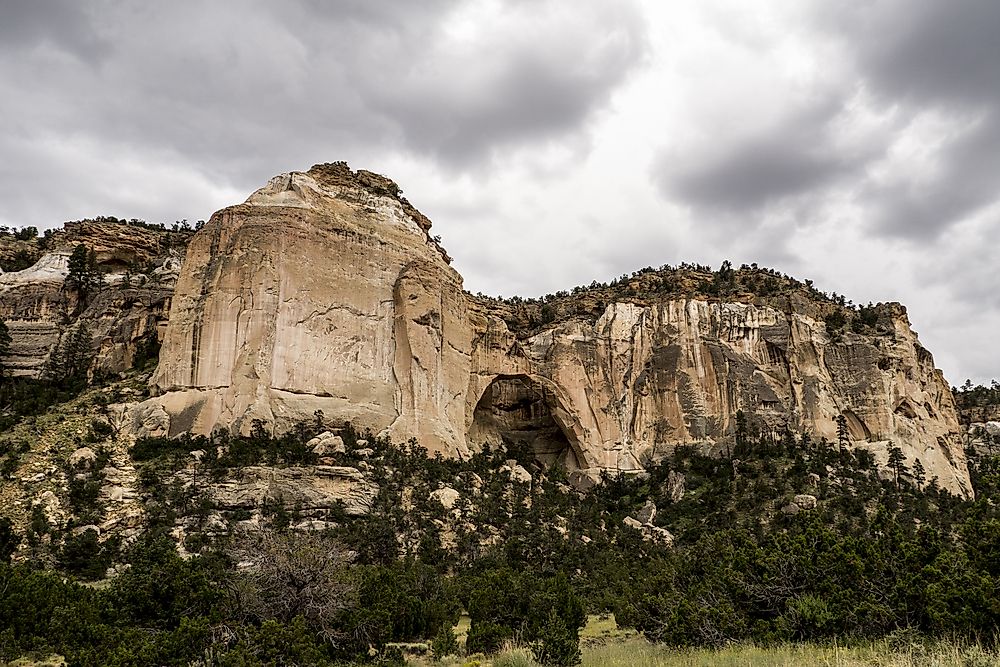
The terrain of El Malpais National Monument comprises volcanic formations, sandstone bluffs, and mesas, and the monument lies near the southern edge of the Colorado Plateau. Dark basalt absorbs heat throughout the day and releases it slowly, providing snakes with a warm surface long after the air has cooled. The broken lava also creates endless crevices for denning, and that jumbled black rock makes a coiled snake far harder to pick out than it would be on open sand.

Two species of rattlesnake are found there. The western diamondback rattlesnake is most active in the early mornings and evenings during summer, when it hunts rodents, and it spends most daytime hours hidden in the shade of fallen trees, rocks, or shrubs. It will stand its ground if threatened. Although prairie rattlesnakes (Crotalus viridis) look similar, they are smaller and often attempt to escape when encountered.
Little Colorado River

The Little Colorado River flows through eastern Arizona for a total distance of almost 340 miles before it enters the Colorado River. Along its course, it carves a deep, narrow gorge reaching a maximum depth of approximately 3,200 feet. Only the headwaters and the lowermost reaches hold water year-round. Along the middle of its course, the river is often just a wide, sandy bed. In those permanent stretches, water attracts a concentration of rodents and lizards in a landscape that otherwise offers very little of either.

Both the midget faded rattlesnake (Crotalus oreganus concolor) and the Grand Canyon rattlesnake occupy the gorge. The two species have even been observed crossing the water, particularly in the lower reaches near the confluence, where the canyon walls narrow and the snakes have less room to move around an obstacle than through it.
Mesa Verde National Park

Mesa Verde National Park preserves the Ancestral Puebloan cliff dwellings of southwestern Colorado. The park covers 52,485 acres of the Colorado Plateau and contains more than 5,000 known archaeological sites, including some 600 cliff dwellings, with occupation of the area beginning around A.D. 550. The cuesta itself climbs past 8,500 feet, and its sunny sandstone ledges and canyon rims are where snakes are most often seen, usually basking in the morning as the sun rises.

The prairie rattlesnake is the only venomous snake found in the park. It is generally less confrontational than other species of rattlesnake, though it will coil when pressed and is capable of striking a distance of about half its total body length. Its prey list matches what the mesa supports, mainly mice, voles, and chipmunks.
Colorado National Monument

Most of Colorado National Monument rises more than 2,000 feet above the Grand Valley of the Colorado River, at the edge of the Uncompahgre Uplift. This is a semi-desert country of pinyon pine and juniper, and the towering monoliths and red rock canyons supply the shade, shelter, and ambush spots that let rattlesnakes thrive. Reptiles in the monument are most active during the warm months, roughly early spring through mid-autumn.

The midget faded rattlesnake is the only venomous snake in the monument, and it is rarely seen. The subspecies occurs below 7,000 feet in elevation in Colorado, and its pale, washed-out markings almost completely disappear against the sandstone. Adults reach only about two feet, which makes them easier to step on than to spot. Its diet consists of lizards, small rodents, chipmunks, and toads.
Zion National Park

Zion National Park sits on the western edge of the Colorado Plateau, where the plateau meets the Great Basin and the Mojave Desert. Rattlesnakes here favor dry, rocky areas with moderate vegetation. Because they depend on external heat sources, they are more active when the air is warm, but midsummer flips that pattern entirely: once daytime temperatures climb too high, they become nocturnal and spend the hot hours underground or in shade, which is why an evening encounter in July is more likely than a midday one.

The Great Basin rattlesnake (Crotalus oreganus lutosus) is the only venomous snake found in the park. In Zion, they are usually light brown with darker brown blotches down the middle of the back, though their coloration varies across a range of shades that helps them blend into their surroundings. They eat squirrels, mice, rats, and small rabbits, and occasionally small amphibians, reptiles, and even birds. Their rattles are not always present, since a rattle can break off, and a young snake may not have grown one yet.
Rattlesnakes of the Colorado Plateau
What separates these seven areas is mostly elevation. The Little Colorado meets the Colorado River at about 2,700 feet, and Mesa Verde tops out at above 8,500 feet, a vertical spread that sorts the species into bands. Western diamondbacks and speckled rattlesnakes hold the low, hot desert around Lake Mead and the inner canyon; prairie rattlesnakes take the higher mesas and rims; the midget faded rattlesnake occupies the sandstone canyon country of the Green and Colorado river basins and goes no higher than about 7,000 feet. Rock is the common requirement across all of them, since crevices serve as winter dens and warm ledges serve as ambush platforms, and the plateau has more of both than almost any landscape of its size.