How Many Types of Lizards Are There?
Ask how many types of lizards there are and the honest answer is that it depends on where you draw the lines. Lizards are not a single tidy branch of the family tree. They are the leftover majority of the order Squamata once snakes are set aside, which makes "lizard" more a convenient label than a clean scientific category. By the current count there are more than 7,000 living lizard species, spread across roughly 40 families and every continent except Antarctica. They range in size between the 13.5-millimeter (0.5-inch) Brookesia nano-chameleon of Madagascar, small enough to perch on a fingertip, and the Komodo dragon of Indonesia, which reaches about 3 meters (10 feet). Rather than memorize thousands of species, it helps to learn the handful of major groups they fall into, and the families that sit inside each one.
Iguania: Iguanas, Anoles, Agamas, and Chameleons

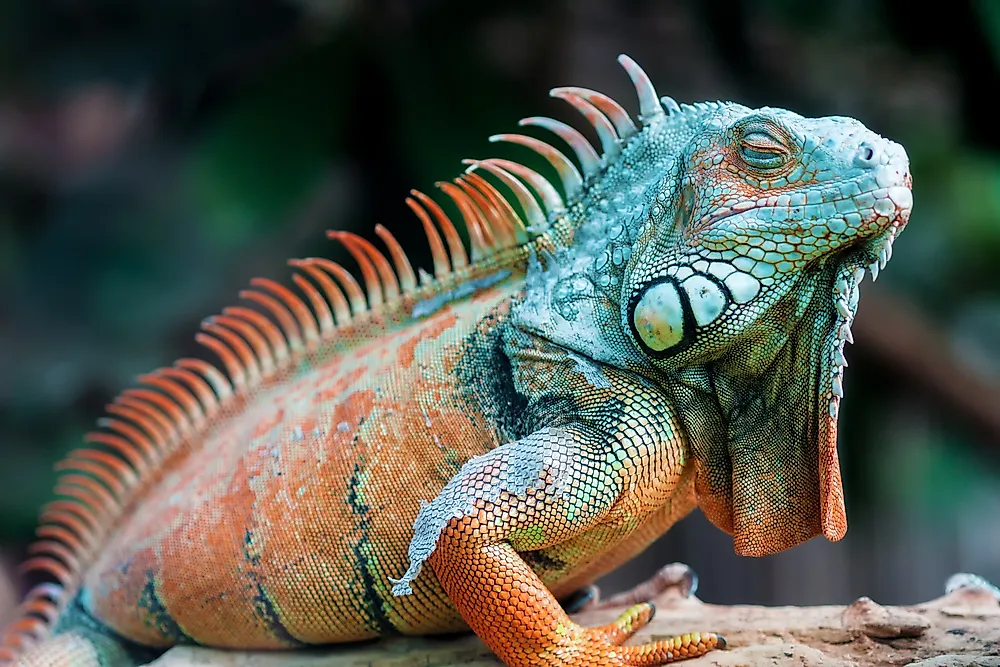
Iguania is one of the largest of these groups and one of the most varied in shape and habit. Older books split it into just three families, but most current classifications recognize more than a dozen, holding close to 2,000 species between them. The divide is an old one in how these lizards feed: the agamas and chameleons (the acrodonts, named for teeth fused to the edge of the jaw) sit on one side, and the New World iguanas, anoles, and their relatives (the pleurodonts) on the other. Familiar families include Iguanidae (the green iguana and the chuckwallas), Dactyloidae (the anoles), Phrynosomatidae (the spiny and horned lizards), Agamidae (the agamas and bearded dragons), and Chamaeleonidae (the chameleons).
It is a mistake to picture the whole group in the trees. Chameleons and anoles are indeed climbers that grip branches with specialized feet, but plenty of iguanians live on the ground or among rocks, and the horned lizards of North American deserts are flat, squat, and thoroughly terrestrial. What most share is a fleshy, non-grasping tongue used in feeding, a feature heavily rebuilt in the chameleons, whose tongue can shoot out past their own body length to snatch insects. The roughly 200 chameleon species, concentrated in Africa and especially Madagascar, are also the group's best-known color-changers, shifting hue to signal mood and regulate temperature rather than simply to match a background.
Gekkota: Geckos and the Legless Pygopods

Gekkota is the second-largest group, with something over 2,000 species sorted into seven families. Most are geckos, and the family Gekkonidae alone accounts for more than 1,000 of them, which makes it one of the largest lizard families anywhere. Geckos are best known for the adhesive toe pads that let many species cross ceilings and glass, and for being among the few lizards that vocalize, chirping and clicking to defend territory and attract mates. Most also lack movable eyelids, so they keep their eyes clean with a long tongue rather than a blink. The leopard gecko shown here is a telling exception: it belongs to Eublepharidae, the eyelid geckos, which kept their lids and lost the toe pads.
The group is not all geckos, though. The seventh family, Pygopodidae, contains the flap-footed lizards of Australia and New Guinea, which have lost their forelimbs entirely and reduced their hind limbs to small scaly flaps. With their long bodies and flicking tongues they are easily mistaken for snakes, but their fixed eyelids, fleshy unforked tongues, and external ear openings give them away. They also hear higher-pitched sounds than most reptiles, a gecko trait carried over into a snake-shaped body.
Scincoidea: Skinks and Their Armored Relatives

If any group can claim the title of most species-rich, it is this one. Scincoidea gathers four families, and one of them, Scincidae, is the single largest family of lizards, with more than 1,700 species, close to a fifth of all lizards alive. Skinks tend to share a compact build: smooth overlapping scales, short or reduced limbs, and little visible neck, with a body that often moves in a side-to-side glide. Many can shed a wriggling tail to distract a predator and then regrow it. Limb reduction runs to extremes in some lineages, and a number of skinks have lost their legs entirely and taken up burrowing.
The other three families share a heavier, more armored design. Cordylidae, the girdled lizards of eastern and southern Africa, are ringed with bony plates beneath their scales and bristle with spiny tail rings; the armadillo girdled lizard can bite its own tail and roll into a defensive ball. Gerrhosauridae, the plated lizards of Africa and Madagascar, carry similar bony armor, and some have traded full legs for tiny vestigial ones. Xantusiidae, the night lizards of the Americas, are small, secretive, and unusual among lizards for giving birth to live young.
Lacertoidea: Wall Lizards, Whiptails, and Worm Lizards

Lacertoidea brings together several families that were once scattered across older schemes. Lacertidae, the wall lizards and their kin, are the quick, alert, often striped lizards of Europe, Africa, and Asia, the ones seen darting across sun-warmed stone walls. Across the Atlantic, their ecological counterparts are the Teiidae, the tegus and whiptails of the Americas, which include some large, active, ground-hunting species. A third family, Gymnophthalmidae, the spectacled or microteiid lizards, fills out the group with mostly small, secretive species of Central and South America.
The surprise members are the worm lizards, or amphisbaenians, which molecular evidence now nests firmly inside this group, next to the wall lizards. These are specialized burrowers with cylindrical, ringed bodies that really do look like large earthworms, blunt heads built for pushing through soil, and skin so loosely attached that it seems to slide over the body as the animal moves. Most have lost their limbs completely, though the three species of Bipes keep a pair of strong front legs for digging. They span six families across Africa, the Mediterranean, the Caribbean, and the Americas, and their powerful interlocking teeth let them tear chunks from prey larger than their narrow bodies would suggest. Their inclusion here is a good reminder of why "lizard" resists a neat definition.
Anguimorpha: Monitors, Gila Monsters, and Glass Lizards

Anguimorpha is the group of the heavyweights and the venom-bearers. Its best-known family by far is Varanidae, the monitor lizards, a single genus of more than 80 species whose members range between tiny dwarf monitors and the Komodo dragon, the largest living lizard. Monitors stand out among reptiles for their stamina, muscular limbs, and problem-solving intelligence; several species have been shown to count and to learn by watching one another. Alongside them sit the Helodermatidae, the Gila monster and the beaded lizards of North and Central America, a small family notable for being among the very few lizards that are genuinely venomous, delivering toxins through grooved teeth in a slow, chewing bite.

The rest of the group is built on a different theme: long bodies, bony armor under the scales, and a strong tendency toward reduced limbs. Anguidae, the largest of these families, includes the alligator lizards, the glass lizards, and the slow worm. The animal pictured here is one of them, the sheltopusik or European glass lizard, a limbless anguid given away by its eyelids, its ear openings, and the deep groove running along each side, all features no true worm lizard has. Smaller families round out the group, among them Anniellidae (the burrowing American legless lizards), Xenosauridae (the knob-scaled lizards), and Shinisauridae, whose only living member is the Chinese crocodile lizard of southern China and northern Vietnam.
So, How Many Types Are There?
That leaves one last piece. Down at the base of the lizard tree sits Dibamidae, a small, easily missed family of blind, limbless, burrowing lizards from Mexico and Southeast Asia that most molecular studies place as the earliest offshoot of the whole group. Add it in and the major categories come to roughly half a dozen: Iguania, Gekkota, Scincoidea, Lacertoidea, Anguimorpha, and the odd little Dibamidae.
So the count depends on how you slice it. There are more than 7,000 species and about 40 families, which gather into a handful of broad clades. The arrangement is still moving, too. DNA evidence has reshuffled the older categories, pulled the worm lizards in beside the wall lizards, and revealed an unexpected alliance called Toxicofera that unites the iguanians, the anguimorphs, and the snakes around a shared origin of venom. By that same logic, snakes themselves are nested deep within the lizard family tree, which means the cleanest answer to how many types of lizards there are may be that the question has no single number, only a shape: a wide, ancient branch of the reptile tree that never settled on one body plan.