Why Box Jellyfish Are Deadlier Than Sharks
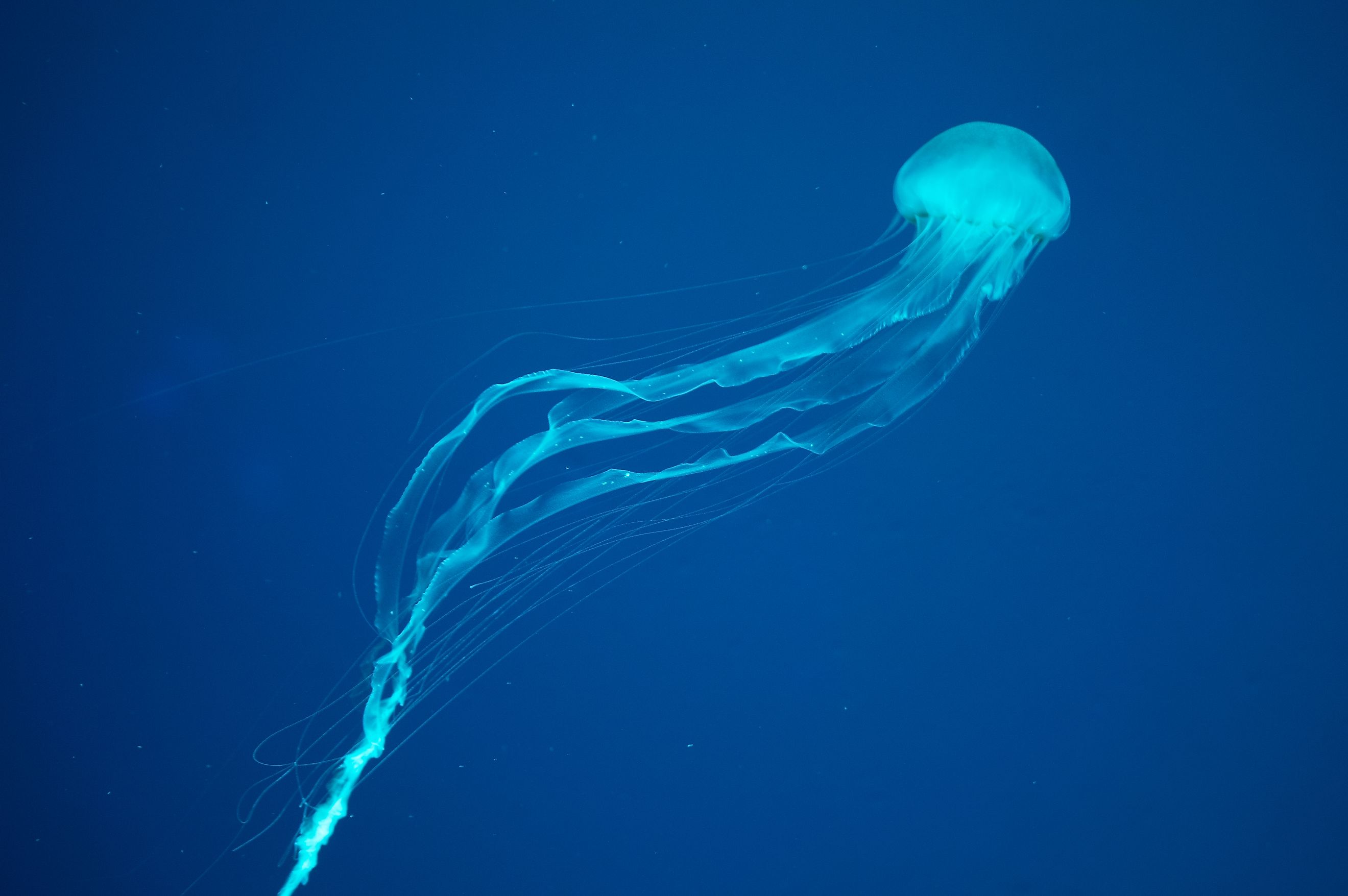
Sharks dominate the headlines whenever someone is bitten off the coast of Florida or California. Yet the ocean's deadliest animal is not a shark at all. It is a transparent jellyfish no bigger than a basketball. Box jellyfish have caused dozens of confirmed deaths and carry one of the fastest-acting venoms in the animal kingdom. Sharks, by comparison, injure far more people than they kill. Fatal attacks in the United States remain extraordinarily rare. Understanding why scientists still call the jellyfish the more dangerous animal reveals how different these two predators really are.
Box Jellyfish And Sharks Attack Differently

The comparison between sharks and box jellyfish (class Cubozoa) ultimately comes down to how they cause harm. Sharks rely on size, teeth, and bite force. Their attacks usually involve a single bite, and fatalities generally result from catastrophic injuries and blood loss before medical treatment can be provided. Box jellyfish rely entirely on venom. A swimmer does not have to provoke the animal or even see it. Simply brushing against a drifting tentacle can trigger thousands of microscopic nematocysts, each injecting venom almost instantly.
Sharks, despite their fearsome reputation, rarely display this level of efficiency. Millions of Americans swim, surf, snorkel, and dive in shark habitat every year without incident. Additionally, shark attacks are among the world's most heavily reported wildlife incidents. A single bite often becomes international news. Box jellyfish stings rarely attract the same attention despite occurring far more frequently in parts of northern Australia and Hawaii, partly because they are viewed as seasonal public health events rather than isolated predator attacks.
Box Jellyfish Possess One Of The World's Strongest Toxins

No shark species that is likely to attack humans is venomous. The same can't be said for the box jellyfish. Scientists recognize around 50 known species of box jellyfish, yet only a small number are considered capable of causing life-threatening envenomation in humans. The world's deadliest box jellyfish, the Australian box jellyfish (Chironex fleckeri), does not naturally occur along the continental United States. Found primarily in northern Australia and parts of the Indo-Pacific, it is responsible for at least 70 confirmed deaths in Australia since the late 1800s, with researchers believing the true number across the Indo-Pacific is considerably higher because many historical fatalities were never formally documented. NOAA describes it as one of the most venomous marine animals known.
An adult Australian box jellyfish can have up to 15 tentacles extending from each corner of its bell, each reaching nearly 10 feet in length. Together, those tentacles contain millions of microscopic stinging cells known as nematocysts. Rather than injecting venom through a bite, each nematocyst fires a tiny harpoon into the skin almost instantly upon contact. A single tentacle can discharge thousands of these harpoons in a fraction of a second. Its venom contains powerful pore-forming toxins capable of attacking the cardiovascular system so rapidly that cardiac arrest can occur within minutes after a severe sting. The toxins produced by American species can still cause debilitating pain and systemic illness, but they have not demonstrated the same consistent ability to cause rapid cardiovascular collapse or the documented fatality record associated with Australia's giant box jellyfish.
Box Jellyfish In The U.S.

Several species of box jellyfish inhabit U.S. waters, although their medical risk varies considerably. The most frequently encountered is Alatina alata (formerly Carybdea alata), which appears around Hawaii roughly 8 to 10 days after each full moon during predictable monthly spawning aggregations. It is also found in the Caribbean, Puerto Rico, and the Gulf of Mexico. This species typically produces extremely painful stings and has been linked to Irukandji syndrome, a potentially serious condition marked by severe back pain, muscle cramps, and dangerously high blood pressure. Despite its potent venom, there are no confirmed human deaths attributed solely to Alatina alata in the medical literature.
The other box jellyfish Americans are most likely to encounter is Chiropsalmus quadrumanus, commonly called the four-handed box jellyfish. It inhabits the Atlantic and Gulf coasts of the southeastern United States, including Florida, and ranges south to Brazil. Its sting is intensely painful and can leave long, whip-like welts, but it is generally considered far less venomous than the Australian box jellyfish. Medical reviews have not linked the species to confirmed human fatalities, although severe allergic reactions remain possible, as with many venomous marine animals.
Box Jellyfish Can Harm Multiple People At Once

Shark attacks attract international headlines, but they remain remarkably uncommon. According to the International Shark Attack File, there were 65 confirmed unprovoked shark bites worldwide in 2025, including 25 in the United States. Nine of those bites worldwide proved fatal, only one in the United States, while Florida continued to lead the nation with 11 unprovoked bites, nearly half of the U.S. total. Volusia County alone recorded six incidents, reinforcing its reputation as the "Shark Bite Capital of the World."
Box jellyfish present a very different kind of risk. Unlike sharks, they do not hunt humans or mistake swimmers for prey. Most stings happen when people unknowingly swim into nearly invisible tentacles drifting beneath the surface. Although fatal encounters are rare, the speed at which the venom acts leaves far less time for rescue than most shark attacks.
The difference becomes even clearer when comparing the injuries themselves. A shark bite usually affects one person at a time. Box jellyfish can injure dozens, or even hundreds, of swimmers during a single coastal event. In January 2023, lifeguards in Waikiki treated more than 100 people for box jellyfish stings after large numbers of jellyfish washed onto Oahu's south shore during the species' predictable post-full-moon arrival. Similar mass-sting events occur in Hawaii several times each year, prompting officials to issue public advisories warning swimmers before the jellyfish arrive. While nearly all victims recovered, the incident demonstrated how quickly one bloom can overwhelm beachgoers and emergency responders.
In contrast, all of Hawaii typically sees fewer than 10 shark attacks per year, according to the Division of Aquatic Resources, Hawaii Department of Land and Natural Resources. For most Americans, the statistical likelihood of encountering either animal remains extremely small. However, sharks typically injure individuals one encounter at a time, while a single influx of box jellyfish can simultaneously expose dozens of unsuspecting swimmers to painful and occasionally medically serious stings.
How Shark Bites And Box Jellyfish Stings Are Treated

Another major difference between the two marine species is how the injuries are treated. A severe shark bite requires immediate bleeding control and trauma care. A suspected Australian box jellyfish sting requires emergency medical treatment as well, but first aid begins by carefully removing the victim from the water, applying vinegar to deactivate unfired nematocysts, and starting CPR if necessary. Because the venom can trigger cardiac arrest so quickly, every minute counts.
Which Sharks Are Most Dangerous To Humans?

Most of the roughly 540 known shark species pose little or no threat to people. According to the Florida Museum's International Shark Attack File, just three species account for the majority of serious unprovoked attacks worldwide:
- The great white shark (Carcharodon carcharias) is responsible for the highest number of recorded unprovoked attacks globally.
- The tiger shark (Galeocerdo cuvier) is second only to the great white in confirmed attacks and fatalities.
- The bull shark (Carcharhinus leucas) frequently enters rivers and estuaries, bringing it into closer contact with people than most sharks.
Even these species rarely attack humans intentionally, and millions of people enter waters inhabited by all three every year without incident.
The Greater Threat
Sharks have earned their reputation through dramatic, highly publicized attacks, but danger isn't measured by headlines alone. The Australian box jellyfish combines one of the world's most potent venoms with nearly invisible tentacles capable of inflicting life-threatening stings within minutes. While Americans are far more likely to encounter sharks than the deadliest box jellyfish, scientists continue to regard Chironex fleckeri as the greater biological threat because of its speed, venom, and ability to incapacitate without ever taking a bite.