Where Great Lakes Freighters Spend The Winter
A Great Lakes freighter's winter address depends mostly on what needs fixing. Once the Soo Locks close in mid-January, the lakers that haul iron ore and limestone all year have about ten weeks with nowhere to be, and each one spends them wherever its repair list can be handled.
A few are due for major hull work that only a couple of yards on the lakes are big enough to take on; most have shorter lists and tie up at a shipyard berth or a cargo dock until spring. Where any given boat ends up can change from one winter to the next. Here is how the fleet sorts itself out across the lakes once the ore stops moving, and where you can go to see it.
Sturgeon Bay, Wisconsin

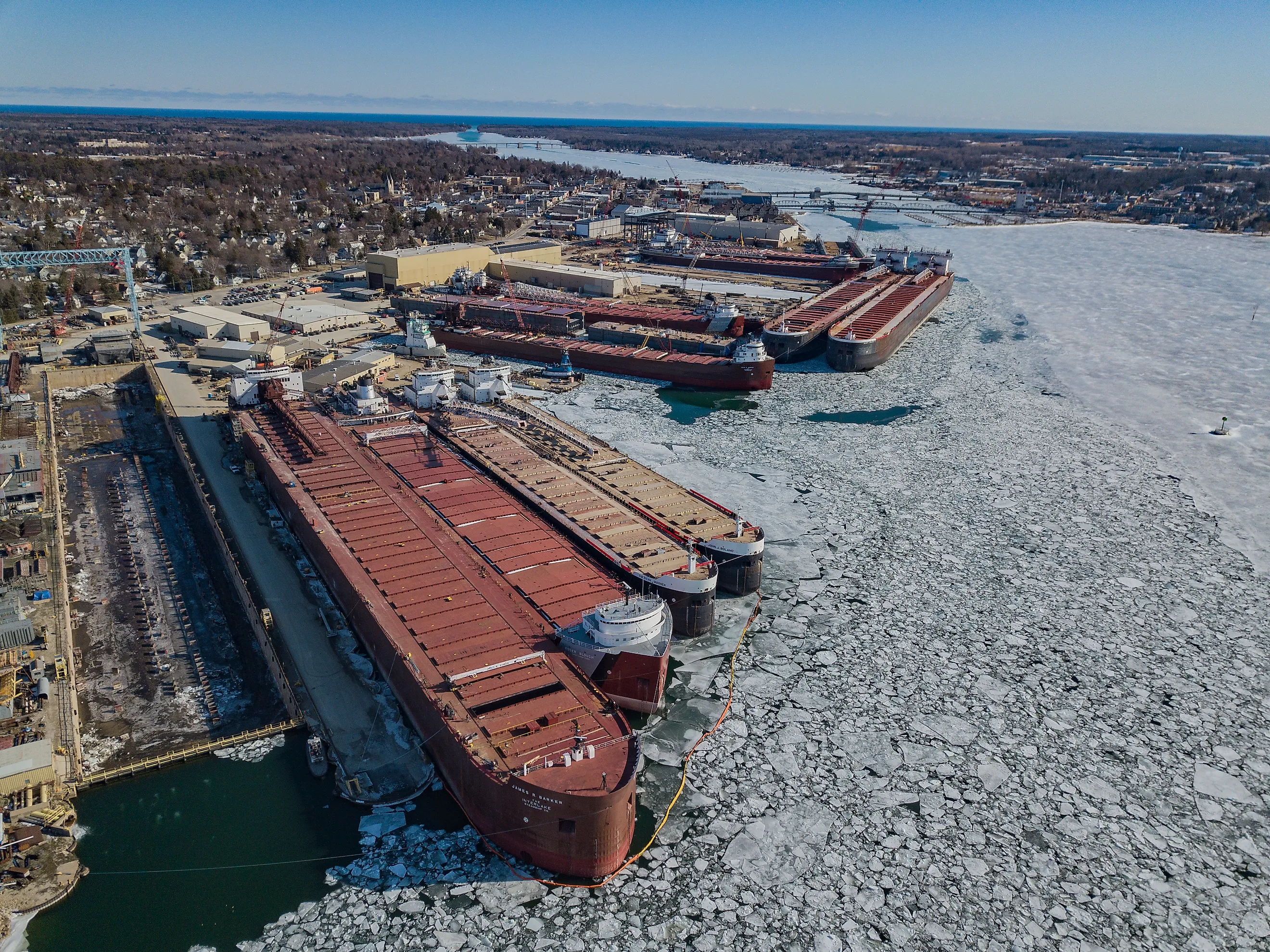
When a freighter arrives at Fincantieri Bay Shipbuilding in January, tugs break a path through the ice and both downtown bridges open so the boat can pass through the channel, which ties up traffic in town. Watchers gather at Bullhead Point, across the channel from the yard, and the members of the Sturgeon Bay Ship-Watchers Facebook group, just over 4,000 of them in early 2025, post arrival times and photos. In January 2024, Sam Perlman, deputy director of the Door County Maritime Museum, expected 12 to 16 boats at the yard, which he put at two to three miles of boat.
Many of the biggest boats come here for the graving dock, which measures 1,154 feet long and 141 feet wide. Nine ships were expected for the 2024-25 winter, including the Mesabi Miner and the Burns Harbor along with the Tregurtha. The first boat into the dock in January 2026 was expected to spend about three weeks there for routine maintenance and inspections, and the five-year surveys done at the yard can include new hull plating and machinery repairs.
Erie, Pennsylvania

Erie's bayfront shipyard has the other big dry dock, 1,250 feet long and 120 feet wide. The yard is owned by the Erie-Western Pennsylvania Port Authority and has been run by Donjon Shipbuilding and Repair since 2009. Four or five vessels usually come in between January and March for routine winter repairs or five-year dry-docking surveys, and Pennsylvania drew $25 million of the fleet's winter work in 2024-25. During a heavier winter in 2018, when nine boats were expected, about 70 contractors and seasonal workers were hired on top of roughly 100 core employees. In January 2022, the Kaye E. Barker and the Saginaw were among the lakers in the yard for winter work.
Superior and Duluth at the Head of Lake Superior

Drivers crossing the Blatnik Bridge between Duluth and Superior can look down on Fraser Shipyards, on Connor's Point in Superior, where lakers lay up every winter. Seven or eight ships were booked into Fraser for the 2024-25 winter, and its full-time and contract crews more than tripled in size for the season. Much of the work is structural, including new steel in cargo holds and unloading gates and replacement shell plating. The yard's parent company, Fraser Industries, is being sold to Wildcat Defense under a deal announced on October 21, 2026, that includes a planned $350 million investment in the shipyard.
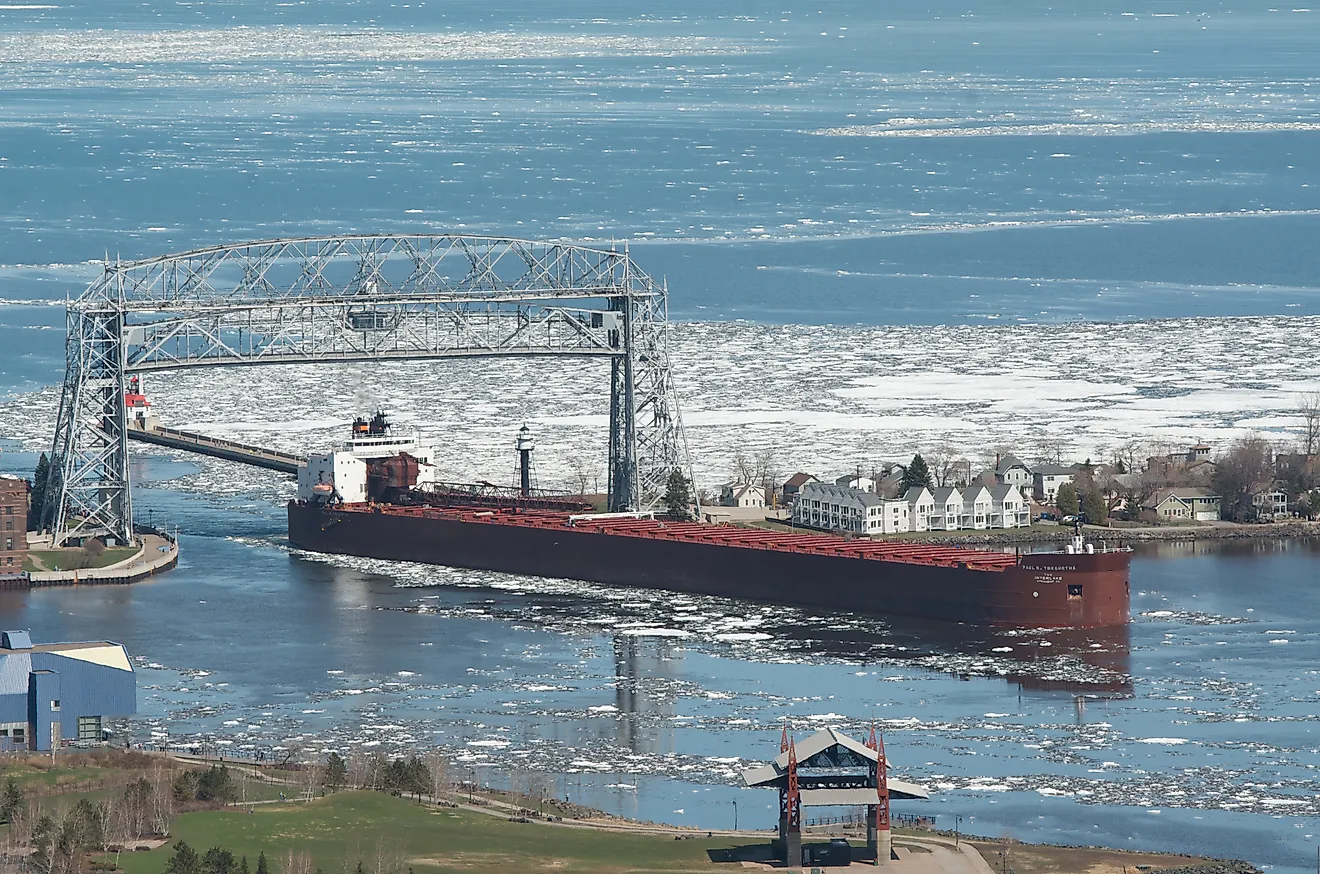
Other Twin Ports boats wait out the winter at cargo docks around the harbor, such as the Enbridge dock in Superior, where the Burns Harbor tied up in 2020-21. On March 22, 2026, the Mesabi Miner left its winter dock in Superior, and the next day the James L. Oberstar became the first ship to leave the Duluth harbor, sailing out under the Aerial Lift Bridge, bound for Marquette to load iron ore pellets.
Lower-Lakes Berths in Toledo and Milwaukee

Lakers come in for winter repairs at the Toledo Shipyard, on the Maumee River near the western end of Lake Erie, where ships have been repaired for more than 100 years and Ironhead Marine has run the yard for the port authority since 2006. Farther east in Cleveland, topside repair crews handle jobs that can be done while a boat stays at the dock.
Ordinary harbor berths suit boats with lighter repair lists. Five vessels spent the 2014-15 winter in Milwaukee's inner harbor, among them the 1,000-footers Stewart J. Cort and Burns Harbor. A daily mooring fee was charged for each vessel, and local companies were hired for repairs before the boats' expected departure in late March or April.
Hamilton and Sarnia, Ontario

Canadian lakers that trade through the St. Lawrence Seaway keep a slightly different calendar. The Seaway's Montreal and Lake Ontario section is scheduled to close January 5, 2027, and the Welland Canal on January 10, and in 2026 both reopened on March 22, three days before the Poe Lock at the Soo. Hamilton, at the western tip of Lake Ontario, is one of their winter ports, with more than 10 vessels laid up at its piers in the 2022-23 winter, five of them owned by Algoma Central. For the 125 to 150 people at Heddle Shipyards' Hamilton yard, the Seaway closure marks the start of the busiest stretch of the year.
Laid-up ships in Hamilton can double as floating warehouses for port tenants, and the Algoma Conveyor spent part of the 2022-23 winter at Pier 10 unloading canola seed into storage. Farther west on the St. Clair River, 10 to 12 vessels berth at Sarnia, Ontario, in a typical winter for layup or repair.
Why the Shipping Season Stops in Mid-January

Every freighter moving between Lake Superior and the lower lakes has to pass through the Soo Locks, where more than 4,500 vessels carrying up to 80 million tons of cargo lock through in a normal year. The locks' operating season is set in federal regulation around the ice that boats typically meet in late winter. In 2026 the locks closed to traffic at 11:59 p.m. on January 15, and the Poe Lock, the only one big enough for the largest lakers, reopened at 12:01 a.m. on March 25. In between, Army Corps of Engineers crews drained the Poe Lock and worked on its gates and machinery.
Most boats make their final runs between late December and mid-January and head straight to a winter berth, where repair crews have until late March to finish. A boat that ends the season at a Lake Superior dock stays on Lake Superior until the Poe Lock opens again, although boats can start loading and running between Lake Superior ports a few days early.
Layup Is the Fleet's Repair Season

Nearly $150 million went into U.S. lakers during the 2024-25 winter, with $51.5 million of the work in Ohio and $51 million in Wisconsin. Crews tune or replace propulsion equipment and swap out worn steel in hulls and cargo holds, and navigation computers and crew quarters get upgrades. In the 2023-24 winter, some of the new hull plating was made from steel that started as iron ore the fleet itself had carried to the mills.
Where a boat spends the winter often depends on whether its hull inspection is due. Federal rules require a laker to come out of the water about every five years so Coast Guard and American Bureau of Shipping inspectors can examine its hull, and for a 1,000-footer that means Sturgeon Bay or Erie. The Paul R. Tregurtha is the longest boat on the lakes at 1,013.5 feet. It laid up at a coal terminal in Superior in the 2020-21 winter, scheduled for a continuous hull survey at the dock, then went to Sturgeon Bay for its five-year inspection in 2024-25. It sails with a crew of 21 to 28, but during layup it typically keeps just two shipkeepers aboard, joined by engineers and contractors as projects require.
The Same Boat, a Different Port Each Winter
The same boat can winter in very different places in successive years. The 1,000-foot Burns Harbor spent the 2020-21 winter at the Enbridge dock in Superior and the 2024-25 winter at the Sturgeon Bay shipyard, after an earlier layup in Milwaukee's inner harbor, while the Mesabi Miner went the other way, wintering in Sturgeon Bay in 2024-25 and at a dock in Superior the following year. Anyone hoping to see the lakers between mid-January and late March can find them from Bullhead Point in Sturgeon Bay or the Blatnik Bridge in Superior. The season restarts at the Soo, and at 12:01 a.m. on March 25, 2026, the tug-barge Dirk S. VanEnkevort and Michigan Trader became the first vessel through the reopened Poe Lock, starting another ten months of hauling ore and stone before the next layup.