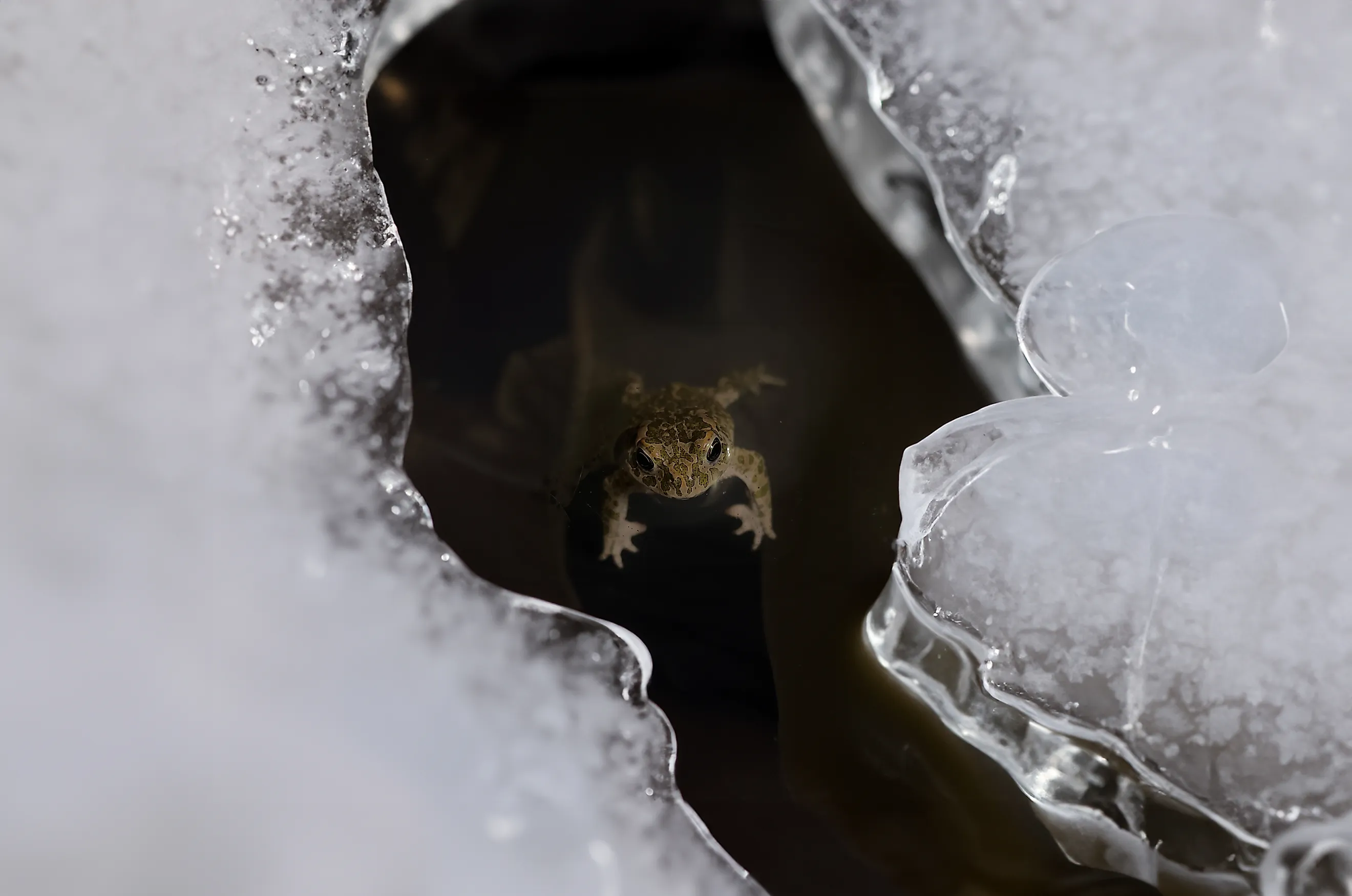
Where Frogs Go When Ponds Freeze
When a pond freezes over, the frogs do not simply disappear. American bullfrogs (Lithobates catesbeianus) and northern leopard frogs (Lithobates pipiens), familiar sights around ponds in summer, spend the winter underwater, resting near the bottom beneath the ice. Other species, like the wood frog, shelter on land and can survive being partially frozen. As autumn temperatures drop and the familiar calls fade, these frogs retreat to places where they survive months of freezing weather. But aquatic frogs face another challenge. They must survive an entire winter underwater without coming up for air.
Aquatic Frogs Find Shelter Beneath The Ice

American bullfrogs and northern leopard frogs overwinter in freshwater habitats that retain liquid water, often right above the layer of sediment at the bottom, during the coldest winter months. They settle on or near the bottom of ponds, lakes, and streams, sometimes among submerged vegetation, rocks, or logs. Some stay resting on top of the sediment, others slowly move around beneath the ice.
The American bullfrog uses permanent ponds, lakes, and sluggish streams as habitat, and both adults and tadpoles overwinter underwater. Northern leopard frogs spend winters in ponds and lakes as well, as well as rivers and streams that do not freeze to the bottom. Some ponds are too shallow and will freeze entirely, others are too stagnant and do not carry sufficient oxygen. Frogs will avoid these water bodies and instead seek out a place with a nearby refuge with lightly flowing water and better oxygenation.
Bullfrogs Keep Moving Through Winter

A study in northeastern Ohio gives a closer look at where aquatic frogs spend the coldest months. During the winter of 1991 to 1992, researchers tracked six adult American bullfrogs at two small ponds in Summit County using radio transmitters. All six frogs left their initial hibernation sites in November and December and moved between 108 feet and 315 feet to their overwintering sites.
Five of the frogs settled in fairly shallow water near small inlet streams, and the sixth remained about 6.5 feet offshore in deeper water. Researchers located the frogs 208 times throughout the study, and they were almost always submerged, but the frogs continued to move during the winter's coldest period, December through mid-February. They were seen floating on the surface or sitting on the bank on 10 occasions, all of them on unseasonably warm days.
The researchers found that the bullfrogs in the study resting on the pond bottom were not buried in the bottom sediment. Instead, the study suggested that these frogs preferred warmer, shallow water at about 39°F and remained active throughout the overwintering period. Although the study covered six frogs at two ponds, it confirmed that frogs do not necessarily spend the winter motionless in a single resting spot waiting for winter to end.
Cold Water Slows Their Bodies, But Oxygen Still Matters

Frogs are ectotherms, so their body temperature depends on their surroundings. As water temperatures fall, their metabolism slows, reducing the energy required to stay alive. This period is known as brumation, the cold-blooded equivalent of hibernation. Brumating frogs stop eating because their digestive systems cannot function in the cold, but unlike true hibernation, brumation is not continuous sleep. If a warm winter day arrives, frogs can temporarily rouse, move around, or bask before returning to dormancy when the cold returns.
That raises the question of how a frog that relies on air to breathe survives an entire winter underwater. Aquatic frogs absorb oxygen directly from the water through permeable skin, a process called cutaneous respiration. This allows them to remain submerged for extended periods without surfacing to breathe air. Their reduced metabolic rate helps them get by on far less oxygen than they need in more active months.
But the presence of cold water alone does not guarantee survival. Frogs need dissolved oxygen, and prolonged ice cover can cause oxygen levels to fall in the pond, and a layer of snow blocks sunlight from reaching underwater plants, reducing photosynthesis. Decomposing organic matter consumes oxygen, and in a pond where oxygen becomes depleted, aquatic frogs may suffocate though water remains beneath the ice.
A Winter Refuge Beneath The Ice

A pond can appear completely frozen from the surface, with unfrozen water still beneath the ice. As the pond water cools, the densest water, at about 39°F, sinks, and colder water stays near the surface and eventually freezes as winter wears on. Because ice floats and helps insulate the water below, a sufficiently deep pond will have an adequate layer of water between the ice and the bottom sediment.
Frogs take advantage of that layer. A study of overwintering northern leopard frogs found individuals resting in small, shallow depressions they had settled into in the mud, some as deep as 10 feet beneath the ice. Settling on the deep bottom puts the frogs in water least likely to freeze, near the steady 39°F of the pond floor.
Not All Frogs Survive Winter Underwater

Some terrestrial frogs use a different strategy. The wood frog (Lithobates sylvaticus), found across much of the northern United States, shelters on land beneath fallen leaves and other forest-floor cover. Rather than avoiding freezing altogether, it survives its entire body being frozen for extended periods of time. As ice forms around it, the frog accumulates glucose that protects its cells from damage. Its heart and breathing stops as long as it is frozen. But when temperatures rise, the frog thaws and resumes its normal activity.
Wood frogs are a good example of how differently amphibians respond to winter. Aquatic species like bullfrogs and northern leopard frogs require suitable underwater conditions, and wood frogs endure the freeze, then thaw out. These strategies are adaptations to different habitats and represent distinct ways individuals weather the same storm.
Spring Brings Frogs Back To The Surface

As winter loosens its grip on the pond, frogs slowly become more active. Rising temperatures allow their metabolisms to increase, and they begin moving about. If the pond is still partially covered in ice when frogs start to become more active, some spend more of their time on land. Bullfrogs generally emerge later as their aquatic habitat takes longer to warm up. The timing varies with species, latitude, elevation, and local weather. The return to activity means feeding and breeding. Bullfrogs resume hunting insects and other prey, and northern leopard frogs move toward breeding wetlands and summer habitats.
The Right Conditions Are Key For Survival
A pond's winter condition can determine if its frogs make it to spring. Loss of deep-water habitat, declining oxygen levels, and damage to wetlands and streams threaten overwintering amphibians that require the right conditions to endure freezing temperatures. Protecting permanent ponds, streams, springs, and the vegetation that surrounds them helps preserve the habitats aquatic frogs need throughout their life cycles.
The next time a pond freezes over, the frogs will be in there, resting or moving slowly beneath the ice. Their survival depends not on escaping winter, but on finding the right conditions to endure it so on those warm summer nights the wetland will once again be filled with their familiar chorus.