The Strangest Things Ever Found On The Ocean Floor
Two steam locomotives built in the 1850s sit upright on the sand about five miles off Long Branch, New Jersey, and no one can say who made them or how they got there. Farther south, the Apollo 11 rocket engines spent 43 years on the floor of the Atlantic Ocean before a private expedition hauled pieces of them back to the surface. The seabed holds the wrecks and cargoes anyone would expect after several thousand years of seafaring, including copper and tin ingots, ceramics, weapons, and the debris of naval warfare. It also holds objects that make no sense at all: a cipher machine snagged in a fishing net, a line of holes punched into sediment more than a mile and a half down, and an Egyptian port city that slid under the Mediterranean and stayed lost for twelve centuries. Some of it was stumbled upon by accident. Other finds were hunted down deliberately, among them the RMS Titanic, whose location went unknown for 73 years.
Steam Locomotives

Two steam locomotives from the 1850s rest upright on the seabed roughly five miles off Long Branch, New Jersey, sitting side by side under 90 feet of water. Diver Paul Hepler located them in 1985 while mapping the bottom with a magnetometer. The puzzle began immediately, because no record survives of the engines being built, purchased, or lost. They have since been identified as Planet Class 2-2-2 T models, produced in small runs and obsolete almost as soon as they were made. The likeliest explanation is a mishap, with the pair going over the side of a barge carrying them south out of Boston. Most of the wooden components have rotted away, but the iron boilers, wheels, and cylinders remain, covered in barnacles and anemones, and have long served as an artificial reef.
Mysterious Holes on the Ocean Floor

NOAA Ocean Exploration recorded a near-perfect line of holes on the Atlantic floor in July 2022, during the second leg of its Voyage to the Ridge expedition. The sublinear sets of holes sat roughly 1.6 miles (2,540 meters) below the surface north of the Azores, near the Mid-Atlantic Ridge. At first glance, they appear deliberate and human-made.
The one natural explanation offered so far is an unidentified deep-ocean animal, since small piles of excavated sediment ring each opening and suggest digging. What remains unexplained is how a sea creature produced a straight line with near-uniform spacing. The holes also appear to have formed at different times, some looking freshly cut and others partly filled in by shifting sediment. Nor was 2022 the first sighting. Researchers logged the same pattern in the same region in 2004, and sediment samples pulled from the fresher holes have yielded nothing.
The Chuuk Lagoon Ghost Fleet

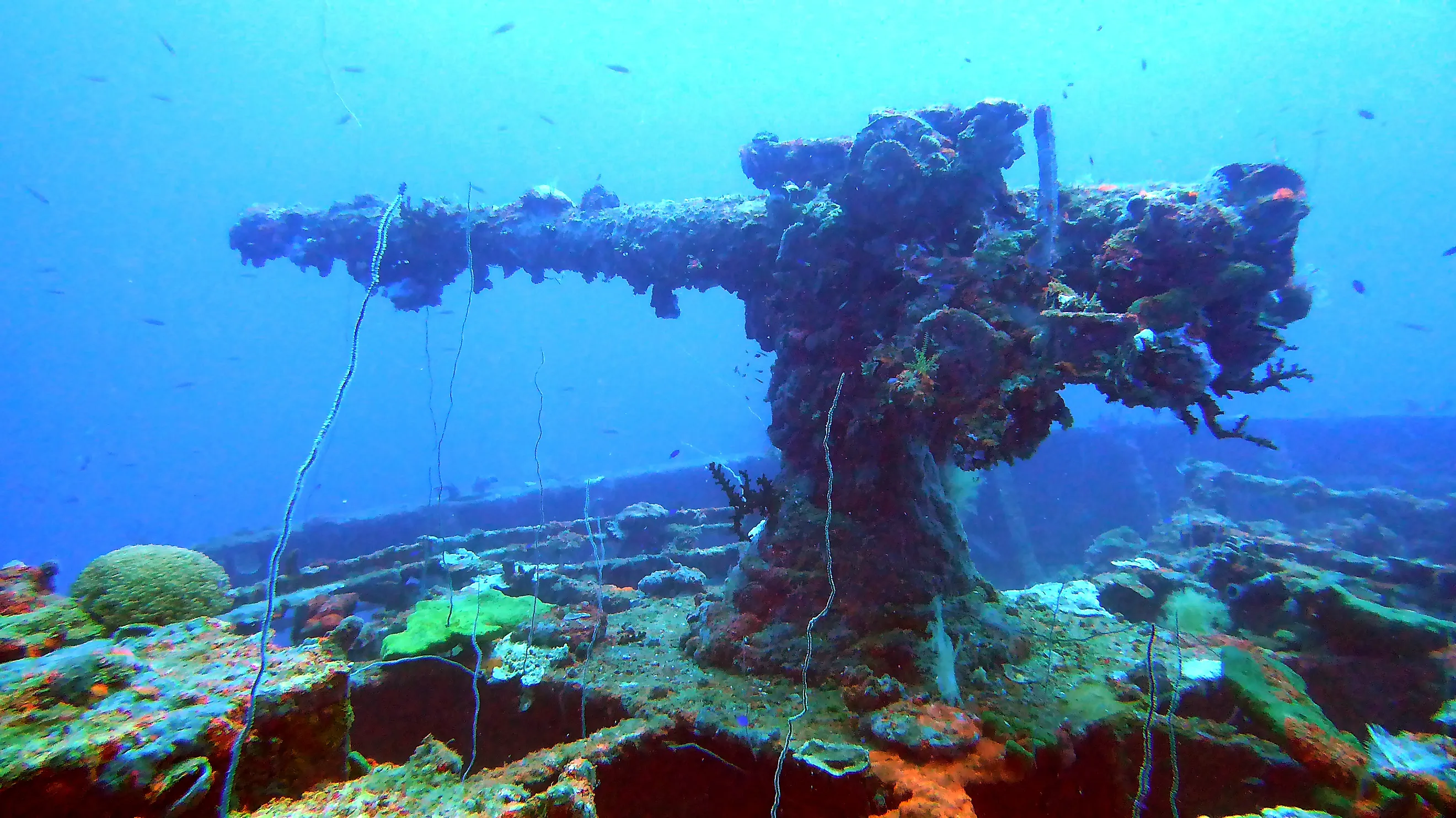
On February 17 and 18, 1944, US Navy Task Force 58 launched a surprise strike against the Imperial Japanese Navy base at Truk Lagoon in Micronesia. Called Operation Hailstone, the two-day raid sank more than 40 Japanese warships and merchant vessels. Truk Lagoon, now called Chuuk Lagoon, was Japan's strategic naval stronghold in the Pacific Ocean and the primary forward operating base for the Combined Fleet. It was heavily armed, and given its importance, it was often described as Japan's Pearl Harbor. The Combined Fleet's major warships had withdrawn the week before, but nearly a hundred merchant and support vessels were still at anchor, and carrier planes and bombers caught them with nowhere to go.
Japan lost supply ships, tankers, and destroyers totaling more than 220,000 tons of shipping. Also destroyed were between 250 and 275 aircraft, the airfields, and 90% of the fuel stored on the atoll. Japanese fatalities exceeded 4,500. American losses came to 25 aircraft and no ships sunk, though the carrier USS Intrepid took a torpedo hit, and between 35 and 40 US service members were killed. The 48-hour raid gutted Japanese naval power at a critical point in the war. The lagoon is now the graveyard for that raid. The ships on the bottom still hold their cargo, including trucks, tanks, and fighter planes. There are rows of fighter plane fuselages, preserved gas masks, and unexploded torpedoes encrusted in coral. As the wrecks decay, the risk of leaking fuel into the water grows, a problem the Federated States of Micronesia contends with today.
The Antikythera Mechanism

Sponge divers working a wreck off the Greek island of Antikythera raised a corroded lump of bronze in 1901 and nobody thought much of it until May 1902, when the archaeologist Valerios Stais spotted a gear wheel inside it at the National Archaeological Museum in Athens. The ship had gone down around 70 to 60 BCE, which makes the mechanism roughly 2,000 years old. Thirty bronze gears survive in the fragments. It is generally regarded as the oldest known analog computer, built to predict astronomical positions and eclipses. A train of epicyclic gearing tracked the synodic month, meaning the cycle of the Moon's phases. Every triangular gear tooth was hand-cut from a single sheet of bronze plate, and the whole assembly was hand-cranked inside a wooden case. One of its dials tracked the four-year cycle of the ancient Olympic Games. The same wreck yielded marble and bronze statues, some dating to the 4th century BCE. What makes the mechanism extraordinary is that nothing of comparable sophistication appears in the record again for more than a thousand years.
Apollo 11 Rocket Engines

The Saturn V that carried Apollo 11 to the Moon in 1969 ran on F-1 and J-2 engines across three stages. Five F-1s made up the first stage, together generating about 32 million horsepower to overcome Earth's gravity. They cut off and separated at an altitude of roughly 42 miles, then fell back and hit the Atlantic at thousands of miles per hour. The second stage came down farther downrange, while the third stage was sent clear of Earth and ended up orbiting the Sun. Sonar located the F-1 wreckage in March 2012, some 350 nautical miles east of Cape Canaveral, Florida, under more than 14,000 feet of water. In March 2013, a privately funded expedition used remotely operated vehicles to recover thrust chambers, turbopumps, liquid oxygen domes, and fuel manifolds. That was enough hardware to rebuild two engines for display. Mission identification looked hopeless at first, because corrosion and the violent impact had erased most serial numbers. Then a conservator working under black light found "2044" stenciled on a thrust chamber, the Rocketdyne number for F-1 engine No. 5 from Apollo 11.
The Baltic Sea Anomaly

A circular formation resembling a crashed spaceship turned up 300 feet below the surface of the Baltic Sea in 2011. Ocean X, a Swedish treasure-hunting team led by Peter Lindberg, captured the shape on side-scan sonar. The object measures about 200 feet across, and its resemblance to a science-fiction spacecraft created a worldwide sensation. Fringe theories arrived within days, proposing a crashed UFO, a sunken military base, and stranger things besides.
Geologists reached a different conclusion. Samples taken from the object came back as common regional rock: granite, gneiss, and sandstone, plus dark volcanic basalt. That is exactly what a glacial erratic looks like, a boulder dropped by retreating ice sheets after the last Ice Age, some 14,000 years ago. What made it look manufactured were the apparent right angles and geometric lines. That is an ordinary property of natural rock joints, since tectonic stress can fracture stone along straight, perpendicular planes.
The Lost City of Thonis-Heracleion

Thonis-Heracleion was an ancient Egyptian port city, the mandatory point of entry for every ship arriving from the Greek world before Alexander the Great founded Alexandria in 331 BCE. Earthquakes and soil liquefaction dropped it into the Mediterranean Sea by the 8th century CE. After survey work that began in 1996, the French archaeologist Franck Goddio and the European Institute for Underwater Archaeology (IEASM) located the city in 2000, about four miles offshore in Aboukir Bay under roughly 30 feet of water. Divers uncovered granite statues standing more than 15 feet tall and preserved sphinxes buried in mud. They also brought up gold and silver ritual instruments, libation dishes, and bronze offerings.
The Grand Temple of Amun-Gereb held a lapis lazuli Djed pillar, the ancient symbol of stability. That same temple is where Cleopatra is thought to have received her investiture as pharaoh. More than 70 shipwrecks and over 700 anchors have also been recorded in the bay, along with stone blocks carrying Greek and Egyptian inscriptions and dozens of sarcophagi. Until the discovery, Heracleion was considered legendary. It was known mainly from the Histories of Herodotus, who described a temple raised where Heracles first set foot in Egypt and reported a visit by Helen of Troy with her lover Paris before the Trojan War.
Nazi Enigma Machines
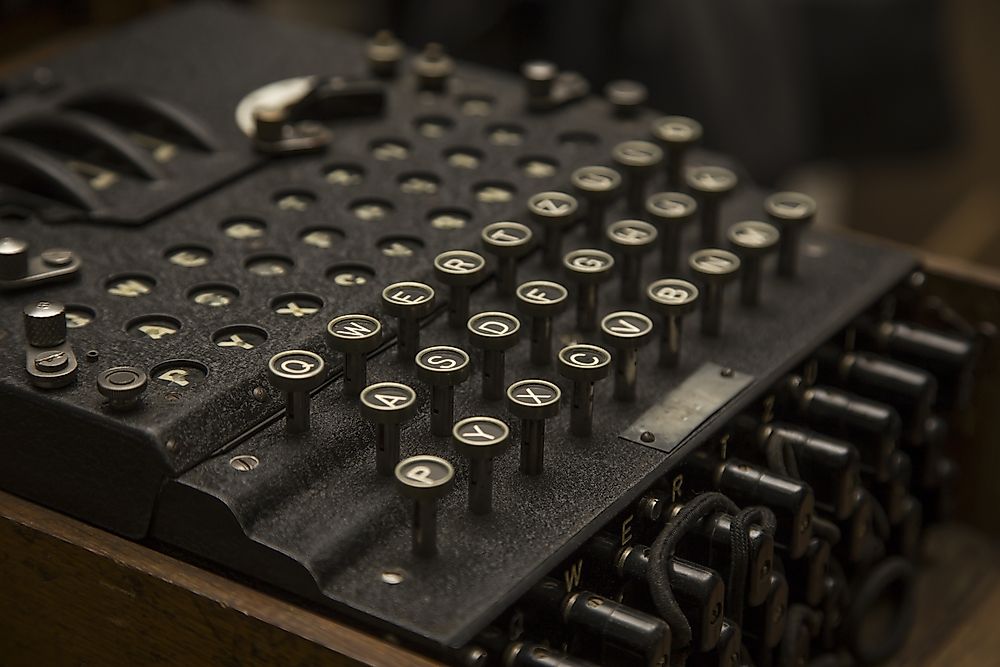
In November 2020, divers from the Kiel-based research firm Submaris were scanning the Baltic seabed for abandoned fishing nets on behalf of the World Wildlife Fund (WWF). Ghost nets, as the discarded gear is known, can go on killing marine life for decades. Tangled in one of them was what the team took for a rusted antique typewriter. Underwater archaeologist Florian Huber identified it as a three-rotor Enigma M3, the electro-mechanical cipher device the German military used to encrypt radio traffic. It surfaced in Gelting Bay, off northern Germany.
On the night of May 4, 1945, crews there scuttled 47 U-boats and a destroyer on orders from Grand Admiral Karl Doenitz rather than surrender them intact. Those crews were also told to destroy their Enigma machines. Naval historian Jann Witt has argued that this particular machine came off a surface warship rather than a submarine, since U-boats carried the more complex four-rotor version. The machine was handed to the state archaeological office of Schleswig-Holstein and went into a tank of demineralized water for nearly a year to draw out the salt, bound for the collection at Museum Schloss Gottorf in Schleswig.
Million Dollar Point

The town of Luganville on Espiritu Santo, the largest island in Vanuatu, served as a forward staging base and launchpad for Allied operations in the Pacific theater of World War II. When the Pacific War ended in August 1945, the US faced the logistical problem and expense of shipping thousands of tons of heavy machinery home. The military offered the surplus for pennies on the dollar to the British and French, who jointly administered the New Hebrides archipelago, now Vanuatu. Both declined, as did the local population. All parties calculated that the Americans would be forced to walk away and leave the lot free for the taking.
A manufacturing agreement also barred military surplus from flooding post-war commercial markets. Rather than abandon the equipment, the US built a jetty and spent two days driving hundreds of vehicles off the end of it, bulldozing crates of supplies in after them, and finally running the bulldozers in as well. The seabed off the south shore of the island is now littered with six-wheel-drive trucks, jeeps, forklifts, tractors, and earth-moving bulldozers. Scattered among them are landing craft hulls, artillery barrels, heavy wheel axles, and bulldozer tracks. There is construction material too: corrugated roofing iron, structural steel beams, mess hall cooking equipment, and crates of unopened Coca-Cola bottles.
Archaeologists Have Barely Begun to Explore the Ocean Floor
The history of the sea is well represented on the seabed, in voyages, fishing, and warfare. What keeps turning up alongside it are unexpected objects that have no business being there, and the residue of disaster and human miscalculation. The ocean floor covers more than 70% of the planet's surface, and NOAA estimates that over 80% of it remains unmapped and unexplored. The remnants of civilization lie scattered across it, some for centuries, and archaeologists, scientists, and explorers have found only a fraction of what is almost certainly down there.
.jpg)