Why The Antikythera Mechanism Was Ahead of Its Time
When divers recovered a cluster of corroded bronze fragments from a shipwreck off Antikythera in 1900, they could not have known they had found one of the ancient world’s most remarkable devices. Dated to the first century BC, the Antikythera Mechanism is often described as the world’s oldest known analog computer, built to track time, celestial movements, and recurring cycles. More than a century later, scientists still do not fully understand how it worked. Even in fragments, it has transformed our understanding of ancient Greek engineering and continues to raise questions about the world that produced it.
The Discovery of the Antikythera Mechanism

In 1900, a group of sponge divers exploring the waters around Antikythera Island in the Aegean Sea came across the submerged remains of a large cargo ship. The shipwreck, later dated to around the mid-1st century BC, was a remarkable find for archaeologists. Subsequent expeditions revealed that the vessel was packed with artifacts, many of which are now on display in the National Archaeological Museum of Athens.
The shipwreck was initially difficult to investigate due to its depth and location near underwater cliffs. However, as diving technology advanced, so did access to the site, and archaeologists were able to bring up more from the seabed. Items recovered from the wreck over the years include marble statues, a 7-foot-tall marble figure, a flute, a spear, glass, pottery, coins, and jewellery. The bronze statue, now known as the Antikythera Ephebe, has been dated to 340-330 BC.
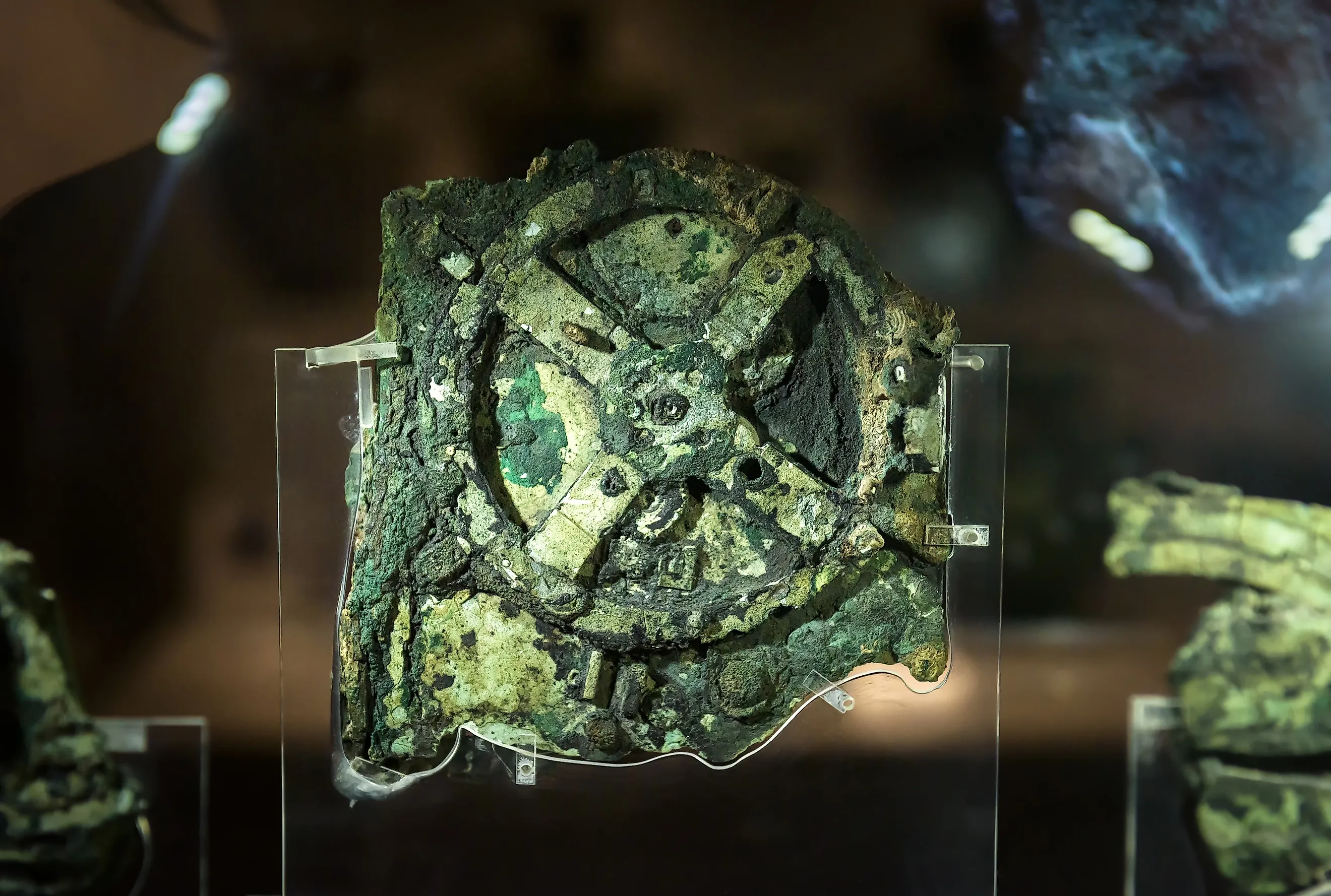
Along with this impressive haul, several strange-looking bronze fragments were found. When it was found, the Antikythera Mechanism was damaged and fragmented in the wreck. Now split into 82 fragments, including 30 gearwheels, all were in poor condition and heavily corroded from spending more than two millennia underwater. With careful study and aided by new technologies, archaeologists gradually began to decipher the shape and form of the mysterious object.
An Ancient Timepiece

Although only a third of the original device has been recovered, scientists have a rough estimate of what the Antikythera Mechanism looked like. It was a shoebox-sized wooden case with bronze plates on the front and back, and a crank on the side. Inside this box was a circular apparatus with dials and rotating hands, not unlike a many-layered watch. Turning the crank moved the gears so users could see the positions of the sun, moon, and planets on certain dates. On the back were several more dials that operated as calendars: one tracked the 19-year lunisolar (Metonic) cycle, another eclipses, and another marked athletic festivals such as the Olympics.
After more than a century of study, scientists agree that the Antikythera Mechanism was a highly sophisticated device that tracked the positions of the sun, the moon, and five planets visible to the ancient world: Mercury, Venus, Mars, Jupiter, and Saturn. One of the earliest clues to its purpose was fragments of writing on the mechanism, which were translated as ‘ray of sun’. In 2005, high-resolution X-ray imaging showed further engravings on the back that predicted solar and lunar eclipses. Other engravings on the front of the mechanism have also been partly deciphered.
Unanswered Questions

Much of the work on the Antikythera Mechanism has been undertaken by an international consortium of academics, museum staff, and advanced technologists, who together comprise the Antikythera Mechanism Research Project (AMRP).
It was the AMRP who spearheaded the advanced imaging of the fragments in the 2000s, helping to piece together the outline of the device as we understand it today. Despite extensive AMRP study, working models have been built, but none match all current evidence, leaving it a kind of 3D puzzle for the archaeological community. Some have suggested that the device wouldn’t have worked properly in its own time and was more of a toy or a demonstration model. Others say we can’t possibly know, since pieces of the device are still missing, and the fragments recovered are so badly corroded that the delicate mechanisms have been worn away and damaged.
Aside from how it worked and why it was built, another lingering question is who made the device? It’s been traced back to the Hellenistic period, but was obviously the work of an advanced mathematician and engineer. One name often linked to the device is the legendary inventor Archimedes. In the first century BC, Cicero referred to an astronomical model created by Archimedes. While it’s impossible to say for sure if this is the Antikythera Mechanism and Archimedes had died by the estimated date of the device, most researchers agree that Archimedes’ inventions certainly laid the groundwork for such a device.
What We Can Learn From The Antikythera Mechanism

There are many gaps in our knowledge of the Antikythera Mechanism, but it remains one of the most important discoveries of the ancient world and a striking example of ancient technology in the archaeological record.
The world’s oldest known computer tells us a lot about one of the world’s most advanced civilizations. Before its discovery, it was believed that the Greeks used only fixed gears in windmills and watermills, but the mechanism shows they had advanced knowledge of epicyclic gears (gears mounted on other gears). They also had an advanced knowledge of the cosmos and knew to account for the non-linear path of the sun and moon. In this, the Greeks were building on knowledge gleaned by the Babylonians, who recorded the daily positions of the astronomical bodies on clay tablets in the first millennium BC. The Babylonians tracked the sun, moon, and planets in cycles relative to one another, and these cycles are used in the Antikythera Mechanism.
Why the Mechanism Still Matters

When the Nobel Prize-winning physicist Professor Richard Feynman visited the Athens Museum in 1980 and saw the Antikythera Mechanism firsthand, he was enthralled, writing to his family, “Among all those art objects, there was one thing so entirely different and strange that it is nearly impossible.”
The world’s oldest known analog computer continues to capture attention, prompting a stream of presentations and articles as scientists continue to debate its purpose and function.
There is still more to learn about the Antikythera Mechanism. Scientists hope that in the future, more devices of its kind will be found and can help fill in some of the blanks. At present, the mechanism exists in a kind of historical vacuum. There are no artifacts of a similar technological level from that time period, which makes it difficult to place within a broader technological tradition.
This could be because bronze devices would’ve been melted down once they outlived their usefulness, as bronze was a highly prized resource. The reason the Antikythera Mechanism survived was that it was lost in a shipwreck. Following this logic, it’s likely that more ancient computers remain under the waves, still waiting to be found.