Where Is Micronesia?
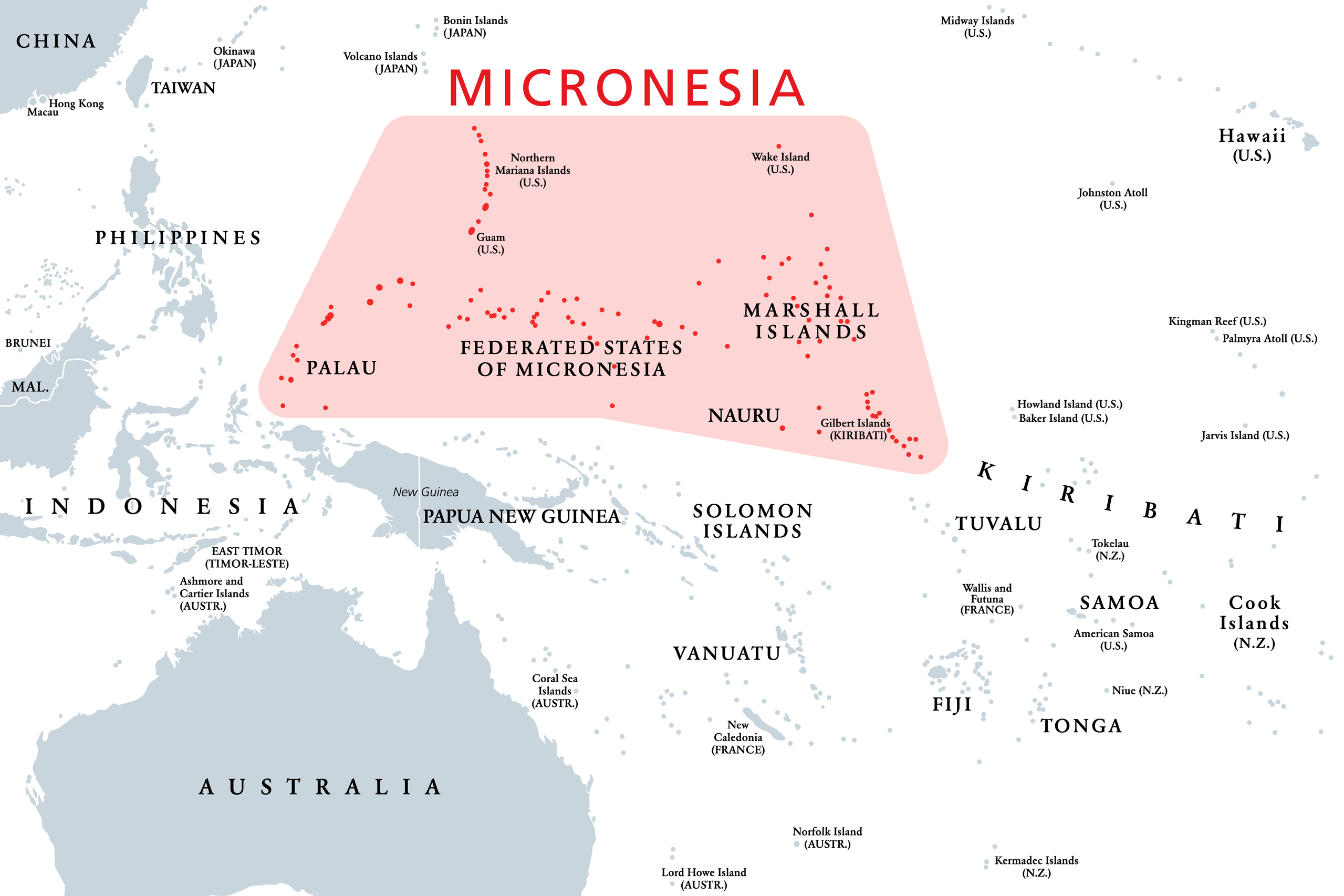
Micronesia, which is Greek for "small islands," is located in the western Pacific Ocean, east of the Philippines, west of Polynesia, north of Melanesia, and south of Japan. Not to be confused with the Federated States of Micronesia, which is just one country in the region, Micronesia is composed of several different countries and territories, making up thousands of small islands, which are of volcanic or coral origin. The independent countries of Micronesia include the aforementioned Federated States of Micronesia, Kiribati, Marshall Islands, Nauru, and Palau. Micronesia also consists of several US territories, including Guam, the Northern Mariana Islands, and several other minor US-controlled islands like Palmyra and Johnston Atoll. Around 551,000 people live in the region of Micronesia today.
Contents:
- Islands Of Micronesia
- History
- Economy
- People And Culture
- Biodiversity
- The Existential Threat Of Climate Change
Islands And Island Groups Of Micronesia

As previously mentioned, the region of Micronesia is made up of several countries and US territories stretching over thousands of islands. The largest island is the US territory of Guam, which measures 561 square km (217 square miles). Guam is part of the island chain known as the Mariana Islands, which consists of both Guam and the Northern Mariana Islands.
South of the Mariana Islands are the Caroline Islands, which number about 500 coral islands. The Caroline Islands comprise two countries, the Federated States of Micronesia and Palau. The Federated States of Micronesia is a federal republic composed of four states, roughly divided along ethnic and/or linguistic lines. To the west of the Federated States of Micronesia is the country of Palau, composed of around 340 volcanic and coral islands.
East of the Federated States of Micronesia is the Marshall Islands, which are all part of the Republic of the Marshall Islands. There are around 1,200 islands and islets in the Marshall Islands.
South of the Marshall Islands are the Gilbert Islands, all of which are part of the Micronesian nation of Kiribati. This island group consists of 33 islands, though only 20 of those are inhabited.
The tiny state of Nauru is located to the west of Kiribati but is not part of one of the major island groups.
A Brief History Of Micronesia

Micronesia was initially settled approximately 3,500 years ago. Western Micronesia, including Palau and the Mariana Islands, was probably inhabited by people from what are now the Philippines and Indonesia. Conversely, Eastern Micronesia was likely first settled by migrants from Melanesia. The region was originally managed by individual chieftains. However, around 500 CE, a centralized kingdom known as the Saudeleur Dynasty emerged on Pohnpei, now part of the Federated States of Micronesia. Its capital was Nan Madol, a city built on small artificial islands connected by canals. Today, some refer to Nan Madol as the 'Venice of the Pacific.' The Saudeleur Dynasty governed Pohnpei for about 1,000 years, uniting approximately 25,000 residents. By the time Europeans arrived in Micronesia, the kingdom had fallen.
European arrivals in the 16th century marked the beginning of contact, with Ferdinand Magellan being the first European visitor to the islands in 1521. By the early 1600s, Spain had established colonies in Guam, the Northern Mariana Islands, and the Caroline Islands. It wasn't until the late 1800s that all of Micronesia came under European control. After Spain's brief involvement in the Spanish-American War in 1898, the United States took over Guam. Germany controlled Nauru, as well as the Marshall, Caroline, and Northern Mariana Islands. Meanwhile, the British governed the Gilbert Islands.
After World War I, Germany’s territories in the Pacific were confiscated. Nauru was put under Australian control, while the other German-controlled islands came under Japanese rule. After World War II ended, the Japanese-controlled islands of Micronesia were put under what was known as the United Nations Trusteeship, governed by the US.
Nauru was the first country in Micronesia to become independent in 1968, followed by Kiribati in 1979. In 1986, the Trust Territory of the Pacific Islands, the trusteeship given to the US by the UN after WWII, became the independent states known as the Federated States of Micronesia and the Republic of the Marshall Islands. The remainder of the Micronesia region, including Guam and the Northern Mariana Islands, remain under US control.
Economy

Agriculture and fishing are the mainstays of the economy in the region of Micronesia, mostly on a subsistence basis. The main staples include breadfruit, taros, coconuts, bananas, yams, cassava, and sweet potatoes. Some people in Micronesia raise livestock, such as pigs and dogs. In Nauru and Kiribati, the mining of phosphate was a major economic activity. By the late 20th century, however, the phosphate deposits were largely exhausted.
There is some commercial fishing activity in the waters of Micronesia. In addition, countries in the region have allowed other countries to use their territory for specific activities. Nauru, for example, has hosted many people seeking asylum in Australia. Territory in the Marshall Islands and Guam is used by the US military. And Kiribati’s proximity to the equator has attracted interest from national and transnational entities wanting to build spacecraft-launching facilities in the country. Tourism is another industry that has seen significant growth in recent years.
Despite some development of local industry, however, the countries and territories of Micronesia are still heavily dependent on foreign aid for revenue, which comes mainly from the US. They are also very dependent on imports, which come mainly from Japan, the US, Australia, and New Zealand.
People And Culture

The people of Micronesia are a mixture of many different ethnic, linguistic, and cultural groups. Most of the population of the region are of Micronesian descent, with some having mixed Micronesian and Melanesian ancestry. There are also small groups of Southeast Asians and Europeans. The Chuukese make up about half the population of the Federated States of Micronesia, while the Chamorro are the main Indigenous inhabitants of Guam and the Northern Mariana Islands. The countries of Nauru, Palau, and Kiribati are inhabited mostly by their own Indigenous populations.
There are also many different languages and dialects spoken in Micronesia. The Federated States of Micronesia alone is home to several different languages, including Chuukese, Yapese, Pohnpeian, and Kosrae. The people of Palau, Nauru, and the Marshall Islands have their own Indigenous languages, known simply as Palauan, Nauruan, and Marshallese. The Indigenous language of Kiribati is known as I-Kiribati, while Chamorro is spoken by the people of the same name in Guam and the Northern Mariana Islands. English is an official language in most of Micronesia’s countries and territories.
In terms of religion, although some people in Micronesia still practice Indigenous religious traditions, the majority of the population is now Christian. Micronesians are mostly affiliated with either the Roman Catholic Church, or Protestant denominations.
Inasmuch as Western culture has significantly changed the way of life for Indigenous Micronesians, traditional customs and practices are still alive and well in the region. Some Micronesians still wear traditional dress. In the Federated States of Micronesia, for example, male members of the Yap and Chuuk peoples still wear loincloths, while women wear grass skirts, called Lavalavas (sarongs). Some in the region are still great seafarers and are even able to construct traditional Micronesian outrigger canoes.
Many Micronesians enjoy traditional dances and music for entertainment. In Kiribati, song and dance competitions are quite popular. However, a number of Micronesians also favor Western-style entertainment, including sports like volleyball and football (soccer). Baseball is especially loved in Palau. Additionally, immigrant communities from Asian countries such as the Philippines, Korea, Japan, and China, along with people from the mainland US, contribute to Micronesia's diverse cultural landscape.
Biodiversity

Micronesia features diverse landscapes and ecosystems, ranging from coral reefs to tropical forests. The islands are either volcanic or coral-based, supporting a wide array of plant and animal species. For instance, Palau has more marine species than any other country of a similar size, making it a favorite spot for scuba divers. Its marine life includes fish, sea urchins, snails, clams, starfish, and squid. Visitors swimming or diving in Micronesia should also be cautious of jellyfish. The region is also home to many colorful birds, some residing permanently on the islands and others migrating seasonally.
Plantlife in Micronesia is also diverse and includes beach morning glory, Polynesian ironwood trees, pandanus, coconut palms, and breadfruit. Coconuts are a main staple in the diet of Micronesians who still live a traditional lifestyle. In fact, some Micronesians use the sap of coconuts, known as toddy, for cooking and for making a traditional sweet beverage that, when fermented, becomes intoxicating.
The Existential Threat Of Climate Change

Every part of the world is affected by climate change. The region of Micronesia is no exception. In fact, climate change threatens the very existence of the region’s countries and territories.
The reason for this existential threat is rising sea levels. Much of Micronesia’s many islands are just a few feet above sea level. Therefore, even a slight rise in sea levels, which occurs because of melting ice in the world’s Arctic and Antarctic regions, has the potential to destroy whole countries. If humanity does not curb pollution enough to halt the continuing global warming of the planet, some of Micronesia’s countries and territories, if not the whole region, could cease to exist.