The Fastest Animals In The Sea
In the open ocean, there is nowhere to hide, so speed is one of the most essential and advantageous adaptations for survival. The fastest animals in the sea have arrived at the same design from very different branches of the family tree, boasting such features as a streamlined body, a tail built for thrust, and the muscle to drive it. NOAA's National Marine Sanctuaries names sailfish, swordfish, and marlin the fastest fish in the ocean, all three reaching about 70 mph (113 km/h). The shortfin mako shark is the fastest shark, working the waters off both US coasts at more than 40 mph (64 km/h). Among marine mammals, the Dall's porpoise crosses the North Pacific at 34 mph (55 km/h), and the killer whale that hunts it has been timed at 34.5 mph (55.5 km/h). These are the ocean's fastest swimmers, group by group.
Shortfin Mako Shark

The shortfin mako shark (Isurus oxyrinchus) is one of the fastest sharks in the world, and it can be found in waters off both US coasts, including off New England, Florida, and the West Coast. NOAA Fisheries reports that shortfin makos can reach speeds of more than 40 mph (64 km/h). The mako's body is built for speed. It has a streamlined shape, a powerful tail, and muscles adapted for maintaining body temperatures above the surrounding water. Those adaptations help it chase fast-moving prey such as tuna, swordfish, and squid.
Sailfish

Sailfish (Istiophorus platypterus) are famous for their enormous dorsal fins and long bills, but their most remarkable feature may be their speed. NOAA's National Marine Sanctuaries identifies sailfish, swordfish, and marlin among the fastest fish in the ocean, with speeds reaching up to 70 mph (113 km/h). That would put a sailfish at roughly the speed of a car traveling on a US interstate highway.
The sailfish's body is shaped like a torpedo, reducing resistance as it moves through the water. Its large dorsal fin, known as a sail, can be folded down against its body when the fish needs to move efficiently. Sailfish also use their bills to attack schooling fish. Rather than simply charging through a school, they can use the bill to slash or stun individual prey before turning back to feed. They occur in tropical and temperate waters around the world, including US waters.
Swordfish

Swordfish (Xiphias gladius) belong to the same broad group of fast-swimming billfish and are another serious contender for the title of fastest marine animal. NOAA Fisheries describes swordfish as one of the fastest predators in the ocean, with streamlined bodies capable of speeds up to 50 mph (80 km/h). The swordfish's long, flattened bill gives the species its name, but it is not simply a weapon attached to a fast fish. Its entire body is designed for rapid movement through open water.
Swordfish are also unusually capable of hunting in different parts of the ocean. Adults can travel widely through open waters, while their large size and powerful swimming ability allow them to pursue energetic prey. In the US, swordfish are found in Atlantic, Pacific, and Gulf waters and are managed as highly migratory species. Their speed helps explain why they are such effective predators of other fast-moving fish.
Black Marlin

Marlin is not one species. The name covers several billfish spread across a few genera, and the one usually singled out for speed is the black marlin (Istiompax indica), a warm-water fish of the Indian and Pacific oceans that reaches east as far as the waters off Mexico and Central America. NOAA National Marine Sanctuaries places marlin alongside sailfish and swordfish among fish capable of reaching speeds of about 70 mph (113 km/h). The 80 mph figure often attached to black marlin comes from line stripping off an angler's reel rather than a measurement of a free-swimming fish.
Black marlin themselves grow to about 15 feet (4.65 m) and 1,650 pounds (750 kg), which ranks them among the largest bony fishes in the ocean. In US Atlantic and Gulf waters, the marlin most anglers meet is the blue marlin (Makaira nigricans). That species can exceed 14 feet (4.3 m) in length and weigh more than 1,800 pounds (816 kg), depending on the individual and measurement method.
Great Barracuda
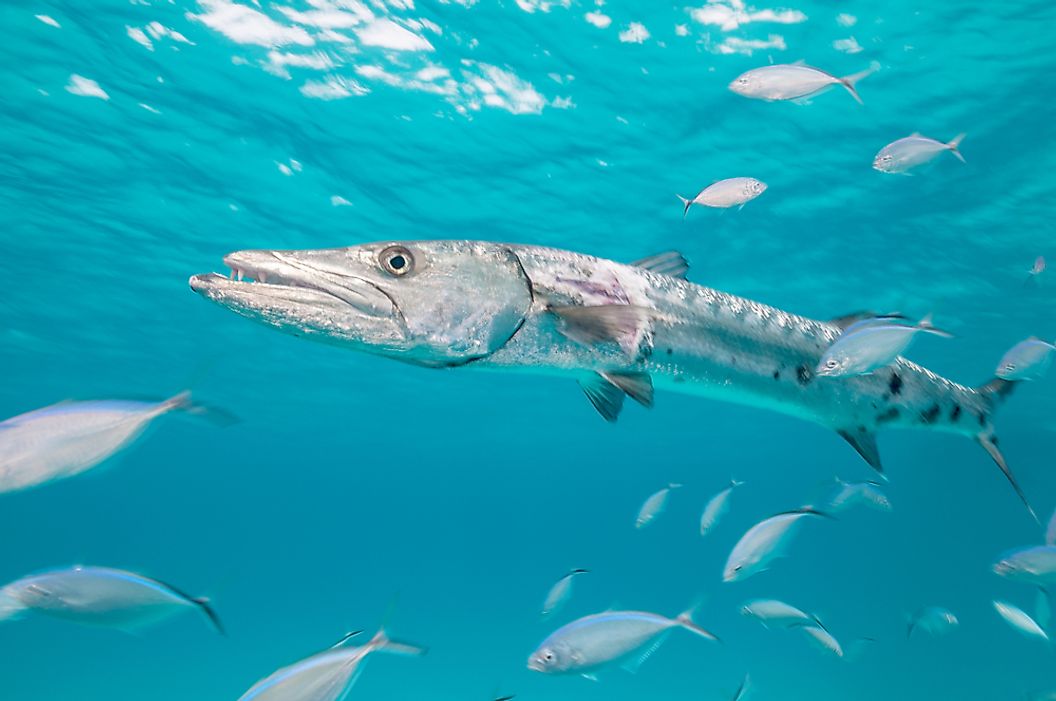
The great barracuda (Sphyraena barracuda) hunts by sight and by surprise, and the Florida Museum of Natural History estimates its top speed at roughly 36 mph (58 km/h). That speed works only in short bursts. A barracuda spends most of the day hanging almost motionless over a reef or along a channel edge, then covers the last few yards to its prey faster than the prey can react. Its dorsal and anal fins sit far back on the body, an arrangement that trades turning ability for straight-line acceleration.
Great barracuda are common on Florida reefs and throughout the Caribbean Sea, and the western Atlantic population reaches as far north as Massachusetts. Adults grow past 5 feet and 100 pounds, making this the largest of the roughly two dozen barracuda species. They are also curious around divers and drawn to anything that flashes like a fish scale, which is why dive guides suggest leaving shiny jewelry on the boat.
Little Tunny

The little tunny (Euthynnus alletteratus) is the small tuna that Atlantic anglers know as false albacore, and it is the quickest fish here that almost nobody eats. Hooked fish strip line at a rate usually given as 40 mph (64 km/h), the figure quoted as its top speed, although it comes off a reel rather than out of a laboratory. Muscle-contraction studies place the species just behind the great barracuda for burst performance, and ahead of it once body length is taken into account.
Little tunny travel in fast schools through the western Atlantic, the Caribbean, and the Gulf, north as far as New England, and they come close to shore wherever bait piles up. Anglers off the North Carolina coast plan a whole autumn around them. A typical fish measures about 32 inches and weighs about 20 pounds. It is also prey, hunted by sailfish, swordfish, wahoo, and sharks, which goes some way toward explaining why it swims the way it does.
Dall's Porpoise

The fastest marine animals are not all giant fish or sharks. Off the US West Coast and throughout Alaska, Dall's porpoises (Phocoenoides dalli) can race through the North Pacific at speeds of 34 mph (55 km/h) over short distances. NOAA Fisheries considers them the fastest swimmers among small cetaceans, a group that includes dolphins and porpoises. Dall's porpoises are only about 6 to 7 feet (1.8 to 2.2 m) long, but their compact bodies are built for rapid movement. They are particularly famous for riding the bow waves of boats.
When a Dall's porpoise races alongside a vessel, it can create a rooster-tail spray as it surfaces, making its speed visible even from a distance. The species is common in the North Pacific, including waters off California and north into Alaska's Bering Sea. Unlike many of the ocean's famous speedsters, Dall's porpoises are marine mammals rather than fish. They breathe air, nurse their young, and must surface even while traveling at remarkable speeds.
Killer Whale (Orca)

The killer whale (Orcinus orca), also called an orca, is the largest member of the dolphin family, and a bull weighing several tons can still outswim most of what it hunts. The record is a male timed at 34.5 mph (55.5 km/h) in the northeastern Pacific in 1958. Bursts closer to 28 mph (45 km/h) are better documented, and ordinary travel is far slower, around 4 to 5 mph, which is how a pod covers long distances without exhausting itself.
Speed matters most in the hunt. Killer whales work in coordinated pods, and the mammal-hunting groups of the North Pacific chase down Dall's porpoises, the same animal that holds the small-cetacean speed record. Off Washington and British Columbia, the fish-eating Southern Resident population pursues Chinook salmon instead, and it is listed as endangered under the Endangered Species Act. Both groups depend on acceleration rather than endurance.
How The Ocean's Fastest Compare
Set the ocean's fastest swimmers side by side, and every group has a clear leader. Sailfish, swordfish, and marlin are the fastest fish in the ocean, reaching around 70 mph (113 km/h). Shortfin makos are the fastest sharks, with NOAA documenting speeds above 40 mph (64 km/h). Dall's porpoise is the fastest small cetacean at 34 mph (55 km/h) over short distances, and the killer whale, the largest dolphin in the ocean, has been timed at 34.5 mph (55.5 km/h). The little tunny and the great barracuda fill in the tier below the billfish, at about 40 mph (64 km/h) and 36 mph (58 km/h). A human swimmer can work for minutes to cover a few hundred yards. A mako shark can cross that distance in seconds. A Dall's porpoise can rocket alongside a boat, and a billfish can turn an open stretch of ocean into a high-speed hunting ground.
The sea may look calm from a beach, but beneath the surface, some of its inhabitants are moving at highway speeds. For creatures that spend their lives in a world without roads, tracks, or finish lines, speed can mean the difference between catching a meal or becoming one. In the open ocean, that race never really stops.