The Deepest Point Off The East Coast
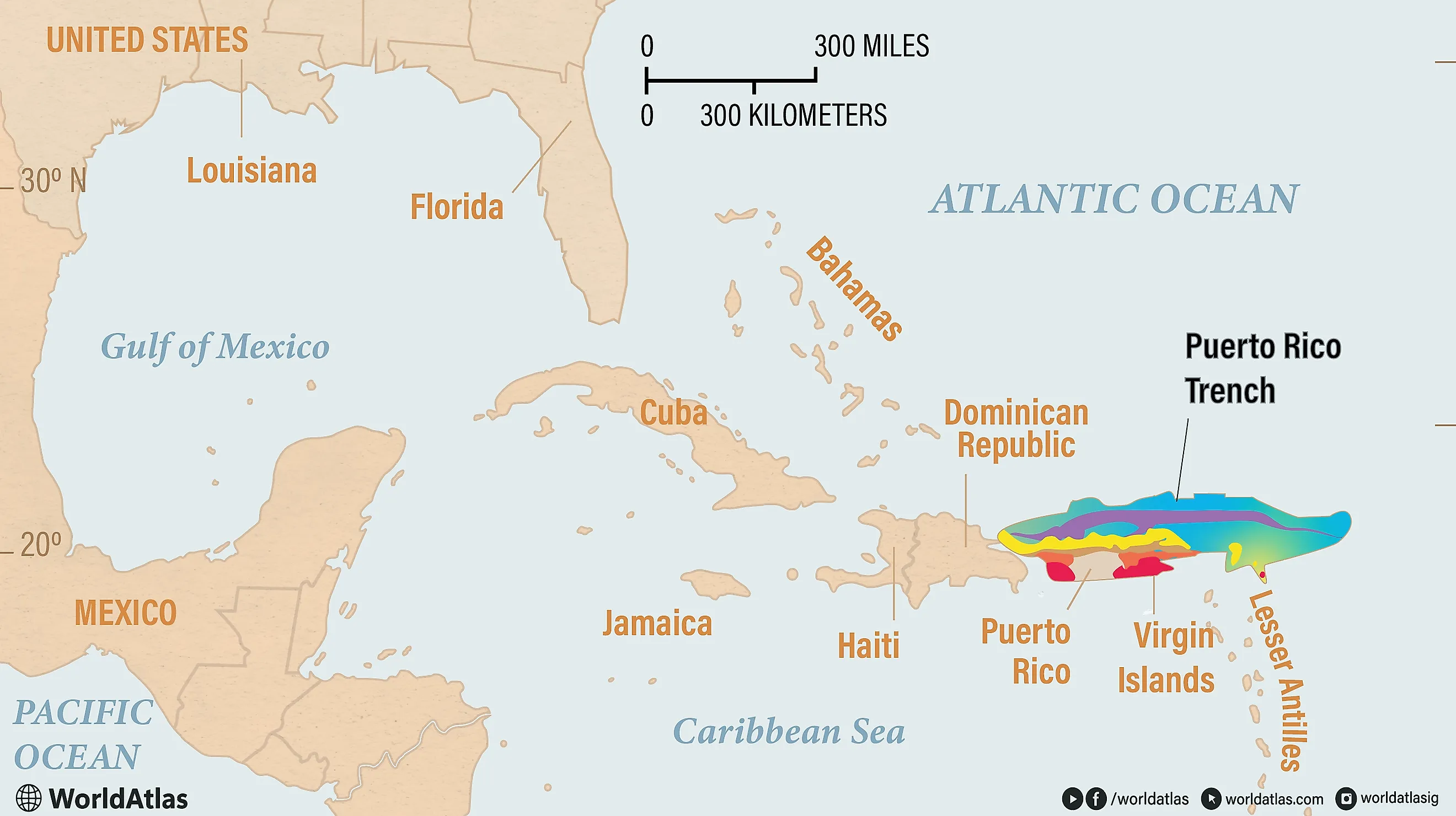
Brownson Deep, in the Puerto Rico Trench, lies roughly 27,487 feet beneath the Atlantic's surface. That is more than five miles of water over the ocean floor. It is the deepest known point in the Atlantic, north of Puerto Rico and far southeast of the mainland US East Coast. This depression belongs to an active tectonic boundary near a US territory, well beyond the continental shelf off the eastern states. A submersible built in Florida reached its bottom in 2018. Elsewhere in the same trench, animals have been filmed carrying seaweed that sank thousands of feet out of the sunlit ocean.
Five Miles Down, Sunlight Is Long Gone

The Puerto Rico Trench extends roughly 500 miles, approximately parallel to Puerto Rico's northern coast. Brownson Deep occupies part of its floor, where modern sonar mapping measured a maximum depth of 8,378 meters. Older accounts often use the name Milwaukee Deep for the Atlantic's deepest water; the detailed Five Deeps survey identifies the deepest point within Brownson Deep.
Sunlight disappears long before a vehicle gets there. Below about 3,280 feet, no sunlight penetrates the ocean, leaving more than four additional miles of descent to Brownson Deep. A camera needs its own lights to photograph the bottom.
Water pressure increases by approximately one atmosphere for every 33 feet of descent. At this depth, it exceeds 800 times atmospheric pressure at sea level. Gas-filled spaces, including human lungs, are vulnerable to that pressure. Many deep-sea animals lack lungs or swim bladders, reducing one of the dangers of living so far underwater.
A Florida-Built Submersible Reached The Bottom

On December 19, 2018, explorer Victor Vescovo descended alone to the Atlantic's deepest point inside Limiting Factor. The vehicle had been built by Triton Submarines in Sebastian, Florida. Its support ship first mapped the trench floor with sonar to locate the descent target. Getting to the bottom took approximately two and a half hours. A French submersible, Archimede, had explored the trench in 1964, reaching about 8,300 meters without reaching its deepest point. Vescovo made the first crewed descent to that point.
Inside Limiting Factor, the passenger compartment is a titanium sphere with walls roughly 3.5 inches thick. Its interior measures about 59 inches across, providing room for two people when both seats are occupied. Three acrylic viewports let the occupants look outside, while external lights illuminate the seafloor.
Seaweed Feeds Animals Thousands Of Feet Below The Surface

In 2022, the submersible Alvin filmed a crustacean swimming upside down in the Puerto Rico Trench, carrying a piece of Sargassum seaweed. The animal was about 20,000 feet underwater, well above Brownson Deep's deepest point but already beyond the reach of sunlight. Its food had grown at the surface. Cameras also recorded Sargassum scattered across the seabed, where the isopods could collect it and swim away carrying individual fronds.
The animal, Bathyopsurus nybelini, is an isopod with large paddle-like legs. It swims backward and upward while holding a frond that can be as long as its body. Serrated mouthparts help it tear into the tough algae, and grinding surfaces break the food down further. Bacteria in its gut have genes that help process the seaweed's complex carbohydrates.
The Seafloor Drops Along A Moving Plate Boundary

North of Puerto Rico, the North American plate slides past the Caribbean plate and also descends beneath it. Much of the movement is sideways, with a smaller component of subduction, the process in which one plate moves underneath another.
On the slope toward Puerto Rico, a thick limestone platform originally deposited near sea level now tilts northward. Its northern edge lies about 13,800 feet underwater, while its southern edge rises above sea level on Puerto Rico. The deep end of this platform lies between the island and the still deeper floor of the Puerto Rico Trench. The Caribbean plate moves eastward relative to the North American plate by roughly three-quarters of an inch each year. Stress can accumulate along faults until the rocks shift abruptly in an earthquake.
Brownson Deep sits within a region whose moving seafloor has affected people on Puerto Rico's coast. The earthquake and tsunami of October 11, 1918, originated in the Mona Passage, west of the island. The tsunami damaged communities along the western and northern shores, with water reaching elevations of about 20 feet above sea level in the worst-hit locations. That event occurred away from the trench's deepest point, along another part of the region's active fault network. Mapping these faults helps identify potential earthquake sources near the island. At Aguadilla, historical accounts put the arrival of the 1918 tsunami roughly five to six minutes after the earthquake.