The Deepest Shipwreck In American Waters
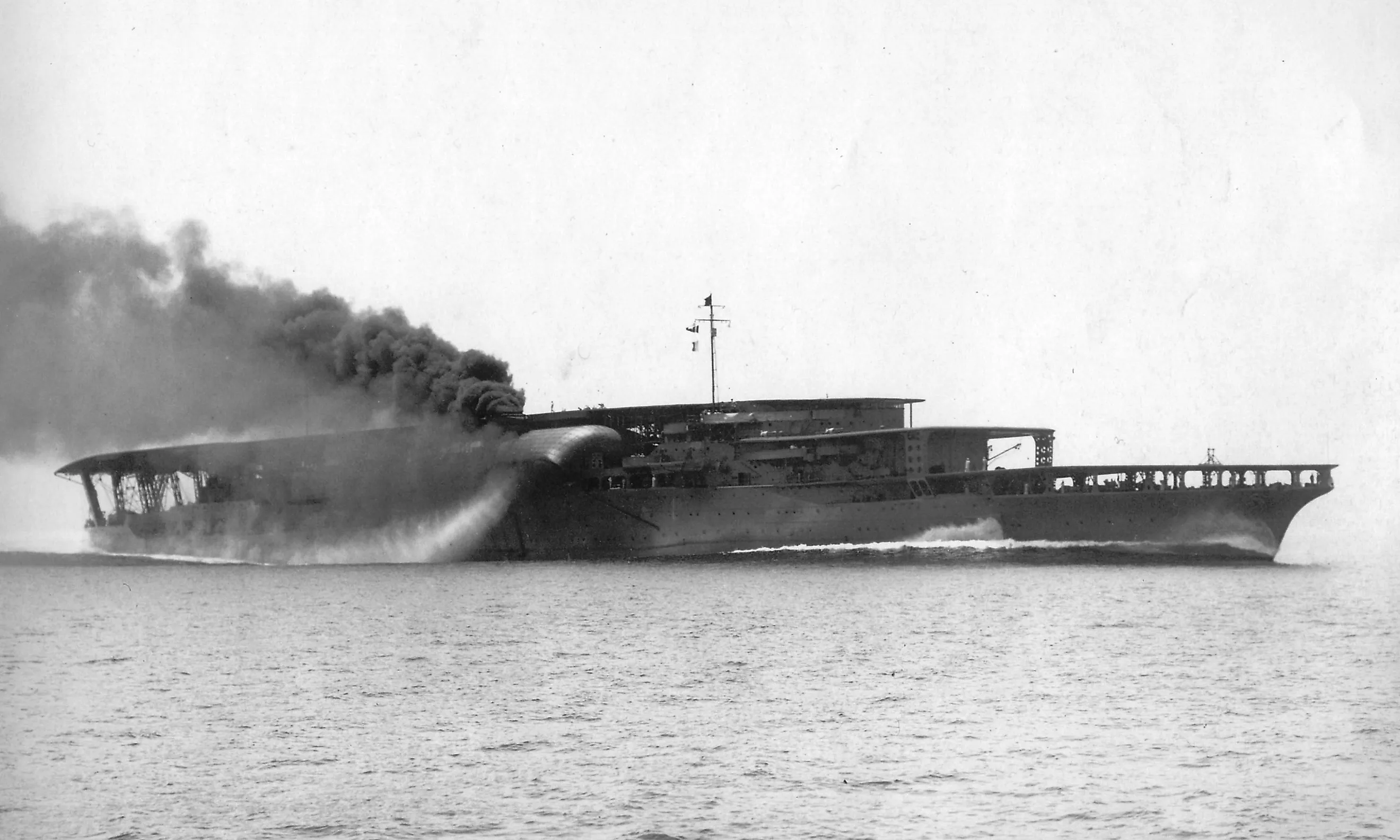
The deepest known shipwreck in American waters belongs to a navy that was never American. Roughly 18,000 feet down, on the seabed northwest of Midway Atoll, rests the Imperial Japanese Navy carrier Akagi, lost during the Battle of Midway in June 1942. At about 856 feet long it ranked among the largest warships afloat, until a single American bomb set off the chain of fires that finished it. For eight decades the wreck lay unseen in the cold, high-pressure dark of the deep Pacific Ocean, its position fixed only within a wide search box. No one laid eyes on it until 2023, when a joint American and Japanese team guided remotely operated vehicles down to the bottom.
What the Akagi Was, and How It Sank

The Akagi began as something other than a carrier. Its hull was laid down as an Amagi-class battlecruiser, then converted into an aircraft carrier after the Washington Naval Treaty capped the number of capital ships the major powers could keep. The finished vessel measured 261 meters, close to three football fields, with a beam of 31 meters. It reached 31.5 knots, about 36 miles per hour, carried a complement near 1,630 officers and sailors, and could operate up to 88 aircraft. By late 1941 it served as the flagship of the Kido Butai, the carrier strike force at the center of Japan's early war in the Pacific.
That strike force opened the war for Japan at Pearl Harbor on December 7, 1941, with the Akagi as Vice Admiral Chuichi Nagumo's flagship. In the months after, the carrier took part in the Indian Ocean raid against Allied shipping off British Ceylon and in operations around Rabaul. Its last action came at Midway. On the morning of June 4, 1942, a Douglas Dauntless dive bomber flown off the USS Enterprise put a 1,000-pound bomb through the flight deck near the midships elevator. The hit detonated fueled and armed aircraft below, and the fires spread past any hope of control. The crew abandoned ship, and before dawn on June 5 the destroyers Arashi, Hagikaze, Maikaze, and Nowaki sank the hulk with torpedoes.
A 2019 mapping survey by Vulcan Inc., working with the U.S. Navy's History and Heritage Command, first pinned down where the Akagi had come to rest. Four years later, in September 2023, a team from the Ocean Exploration Trust aboard the vessel Nautilus ran the first visual survey, spending about 14 hours circling the wreck with a remotely operated vehicle. The archaeologists, drawn from both American and Japanese institutions, found the Akagi intact in outline but badly disarticulated, its hull settled into the seafloor sediment. The damage aft of amidships, where the bomb and the explosions that followed tore the ship open, was still plain to read.
Kaga, a Battleship Hull Turned Carrier

A short distance away on the same deep plain lies the Kaga, slightly higher on the slope than the Akagi, which is why the Akagi holds the record for the deeper of the two. The Kaga shared its neighbor's unusual history. Its hull started as a Tosa-class battleship, and like the Akagi it was rebuilt into a carrier once the naval treaty ended the battleship program. The two ships then served together, and the Kaga was part of the same force that struck Pearl Harbor in December 1941.
The Kaga's end at Midway came within minutes of the Akagi's. On the same June morning, Dauntless dive bombers off the USS Enterprise scored several hits, and the resulting fires gutted the ship from within. With the Kaga burning beyond saving, a Japanese destroyer finished it with torpedoes, and it dropped to roughly 5,400 meters. The 2019 survey that located the Akagi found the Kaga as well, and the 2023 Nautilus expedition carried out the first detailed archaeological survey of the carrier, producing the first public record of its condition on the seabed.
Yorktown, the Carrier That Kept Fighting

On the American side of the battle, the carrier USS Yorktown rests nearby, about three miles down. Commissioned in 1937 and roughly 809 feet long, the Yorktown absorbed punishment at Midway that would have ended most ships sooner. On June 4, three bombs from Aichi D3A "Val" dive bombers launched off the Japanese carrier Hiryu struck home, yet the damage-control crews patched the ship well enough that it resumed flight operations. A second strike put two aerial torpedoes into the hull, and the Yorktown took on a heavy list.
The crew abandoned ship, but the Yorktown stayed afloat, and a salvage party reboarded to try to save it under tow back toward Pearl Harbor. On June 6 the Japanese submarine I-168 slipped through the screen and torpedoed both the carrier and the destroyer Hammann alongside it. The Hammann sank in minutes; the Yorktown capsized and went down the next morning, June 7, 1942.
Robert Ballard's team located the wreck in 1998, and the 2023 Nautilus survey delivered the first real-time views of the site. The fullest look came in April 2025, when a NOAA Ocean Exploration expedition aboard the Okeanos Explorer became the first to examine the Yorktown's hangar deck. Inside, the remotely operated vehicle found a hand-painted mural titled "A Chart of the Cruises of the USS Yorktown," a world map roughly 42 feet across that tracked the carrier's travels. Nearby sat an automobile, tentatively identified as a 1940-41 Ford Super Deluxe "Woody" station wagon, along with several Douglas SBD Dauntless dive bombers that had been stowed below and went down with the ship.
A Battlefield Still Being Mapped

All three carriers rest inside the Papahanaumokuakea Marine National Monument, the largest contiguous fully protected conservation area under the U.S. flag and a UNESCO World Heritage Site. Japan lost four carriers at Midway, the Akagi, Kaga, Soryu, and Hiryu, along with the heavy cruiser Mikuma, and not all of them have been found. Hundreds of aircraft went down with the ships across the five days of fighting, scattered over a seabed that sits miles below the surface. Some of that wreckage may lie even deeper than the Akagi, which means the deepest shipwreck in American waters could still be waiting for the next survey to reach it.