Why Yellowstone Has No Grizzly-Free Zones Left
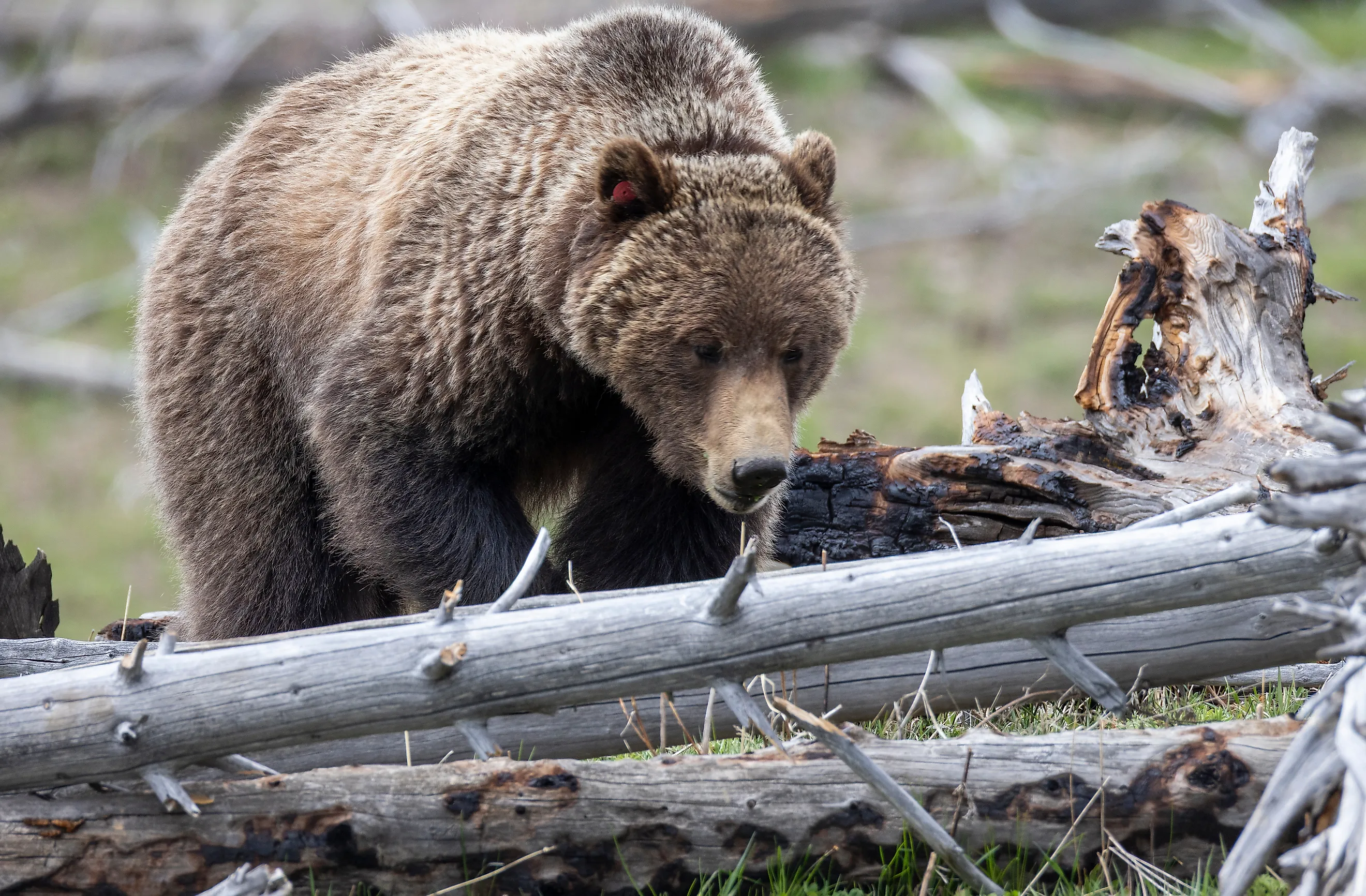
Often times, people travel to Yellowstone National Park to see grizzly bears. It is one of the best places in the world to view them in their natural habitat. Yellowstone is the center of the Greater Yellowstone Ecosystem, one of the largest nearly intact temperate zone ecosystems on Earth. It is composed of Yellowstone National Park, Grand Teton National Park, and several national forests. It is estimated that there are between 150 and 200 grizzly bears whose home range is entirely or partially within the park, and around 1,030 grizzlies in the Greater Yellowstone Ecosystem. But the grizzly population was not always thriving the way it is.
Grizzly Bears Were Once Eradicated from Yellowstone

In 1800, as many as 50,000 grizzly bears roamed across the West, north into Canada and south into Mexico, with a range reaching east as far as Kansas and west to California. But when European settlers arrived in the West in the 19th century to expand industry and agriculture, grizzly bears suffered from overhunting, poison, and habitat loss.
By 1975, fewer than 1,000 grizzly bears lived in the contiguous United States. They were listed under the Endangered Species Act that same year.
Yellowstone had its own complicated relationship with grizzly bears. Although hunting grizzly bears was prohibited in 1886, grizzlies began feeding on garbage behind some of the park's hotels. Instead of discouraging bears, hotel managers set up "lunch counters" with adjacent bleachers for visitors to view, feed, and photograph bears. These lunch counters remained from 1921 until the mid-1930s, although the garbage dumps remained open.
The results were predictable. Bears had become accustomed to associating humans with food. In 1910, Yellowstone recorded the first incidents of bears seeking food along park roads, and in 1916, a bear caused the park's first confirmed human fatality.
Between 1931 and 1969, park managers recorded an average of 48 bear-inflicted human injuries and over 100 incidents of bear-caused property damage. Yellowstone initiated a more intensive bear management program in 1970. Open-pit garbage dumps were removed. The feeding of bears was prohibited. Proper storage of human food and garbage was required. Bear-proof garbage cans were introduced.
The intention was that bears would resume feeding on a natural diet. But as their range grew in search of food, so did the number of conflicts with humans. An average of 38 grizzly bears had to be relocated to backcountry areas, while an annual average of 12 grizzly bears had to be euthanized.
Why is Yellowstone Perfect Grizzly Habitat?

The Greater Yellowstone Ecosystem is one of the largest nearly intact ecosystems on Earth, stretching across Wyoming, Montana, and Idaho. Its vast forests, Rocky Mountain perimeter, and national forests provide grizzly bears with enough space to safely travel beyond Yellowstone. Within the park, the Gallatin Mountains are closed to recreational activities during spring, summer, and fall to protect grizzly habitat.
Yellowstone established its Bear Management Areas in 1983 when the park implemented a new grizzly bear management program. These areas are places where grizzlies are known to congregate seasonally due to the abundance of elk and bison carcasses. Recreational activities may be limited or completely restricted during periods of peak bear activity.
These restrictions serve several purposes. They reduce the chance of bears becoming habituated to humans or associating them with food. They prevent human-caused displacement of bears. Finally, they reduce the risk of bear-human conflicts and injuries.
The protection might have worked too well. As the Greater Yellowstone grizzly population recovers, scientists are now beginning to question whether some parts of the ecosystem are approaching their capacity for resident bears.
Why You Might Not See a Grizzly

But just because grizzly-free zones do not exist in Yellowstone does not mean grizzlies are everywhere or that park visitors are guaranteed to see them. Yellowstone National Park covers 2.2 million acres. The Greater Yellowstone Ecosystem covers 22 million acres. Although there are a lot of grizzlies in Yellowstone, they occur in low densities.
Other factors make grizzly sightings difficult. They are characteristically shy, they are active in the early morning and late evening, and they frequent remote habitats and rugged terrain.
Additionally, they will migrate seasonally to different areas in the park. In the spring, snow is too deep at higher elevations, which keeps them out of the mountains and on the valley floor. Here they will meticulously forage through tall grasses and bushes in search of deer fawns and elk calves. Between late March and mid-May, a grizzly bear's diet primarily consists of deer fawns, elk calves, and winter-killed carrion that they dig up from the ground and under snow.
In the heat of the summer, bears become more elusive. The hotter temperatures keep them confined to wooded areas where it is shaded and cooler. This often means moving to higher elevations where they will feed on moth larvae, dandelion, wildflowers, berries, and other forms of vegetation.
Where Are You Most Likely to Encounter a Grizzly?

Yet there are times and places within Yellowstone where grizzlies are prevalent. Spring and fall see cooler temperatures, when bears will either be hungry after emerging from hibernation or continuously eating, sometimes up to 20,000 calories per day in preparation for hibernation. In particular, fall is when visitors should be cautious. As grizzlies become more focused on food, they may venture into areas outside of their home range and become more visible to visitors.
The Lamar Valley is one of the most notable places in Yellowstone where grizzly bears are commonly seen. Grizzly bears may be seen along Specimen Ridge and the slopes of Mount Norris, with visitors potentially viewing bears breeding in May and June. In the spring and summer, grizzly bears are also seen feeding on wildflowers.
Places like Grizzly Overlook and Elk Antler Creek in the Hayden Valley allow visitors to get a vantage point of valley bottoms and tree line where there is a lot of bear activity, including sows with cubs. Bears that have just emerged from hibernation will often feast on winter-killed elk and bison. In the Hayden Valley, as many as 20 grizzlies have been observed around a single carcass at once.
What Happens When a Grizzly and a Human Meet?

Several outcomes are possible when a human and a grizzly bear cross paths. Most of the time, bears will run away, ignore people, or alter their initial path.
However, there are instances where bears attack people. In these instances, either a human has not been making enough noise while on the trail and surprised the bear, or a sow with cubs has attacked as a means of defense. Seldom do bears predate on humans.
Everywhere in Yellowstone National Park is grizzly bear country. Visitors and hikers can minimize negative bear interactions by following a few basic procedures. Hike in groups, make noise on the trail, and avoid hiking at dawn, dusk, and at night. Look for signs of bears on the trails like tracks, scat, or claw marks on trees. These are all ways to reduce the risk of a problematic grizzly encounter.
Yellowstone is Grizzly Country Again
Yellowstone once came close to losing its grizzly bears. Today, they have reclaimed much of their former range by expanding into places they have not been seen in years. Grizzlies now move through forests, mountains, valleys, and backcountry areas where visitors once might not have known them to be present. That does not mean a grizzly bear is waiting around every corner on the trail or stalking every campsite. Rather, they have recovered, are widespread, and are here to stay.