The National Parks Where Bison Injure The Most Visitors
The American bison (Bison bison) ranks among the most dangerous animals found in US national parks. Since 1980, bison have injured more people in one of the United States' most popular national parks than any other animal, including grizzlies. Bulls can weigh up to 2,000 pounds and run at 35 mph, and they turn far more quickly than most visitors expect. While the National Park Service does not maintain a park-by-park ranking of bison injuries, official reports show that two national parks have documented numerous violent incidents. Other national parks have notable bison herds that could cause harm to visitors if they don't follow NPS rules. These are the national parks where visitors most often underestimate North America's largest land mammal, and sometimes pay the price.
Yellowstone National Park

In July 2026, a 65-year-old visitor was seriously injured after a bull bison suddenly charged through Bridge Bay Campground, hooked him with its horns, and tossed him roughly 8 feet into the air. The attack, captured on video by a nearby photographer, occurred during Yellowstone National Park's annual bison rut, when bulls become especially aggressive. According to witnesses, the man and his grandson had been observing the animal before it unexpectedly charged. It marked Yellowstone's second reported bison-related injury of 2026, after a 12-year-old visitor was injured near Mud Volcano on June 26. The National Park Service repeatedly warns that even a bison that appears calm can turn without warning.
No national park comes close to Yellowstone's history of bison-related visitor injuries. The park supports the largest bison population on public land in the United States, averaging about 5,000 animals over the past decade, and the 2024 management plan holds the herd within a target range of 3,500 to 6,000 after calving. Yellowstone's herd is also unique because it is the country's only continuously wild, free-ranging population that has existed since prehistoric times and retains important genetic diversity.

The injury statistics explain why Yellowstone dominates this list. A peer-reviewed National Park Service study documented 25 people injured by bison between 2000 and 2015, with 2015 alone accounting for five injuries, the highest annual total during the study period. Every incident occurred in developed areas such as hiking trails, geyser basins, and campgrounds rather than deep in the backcountry. There were two reported injuries by Yellowstone Park officials in both 2025 and 2024, and one injury reported in 2023.
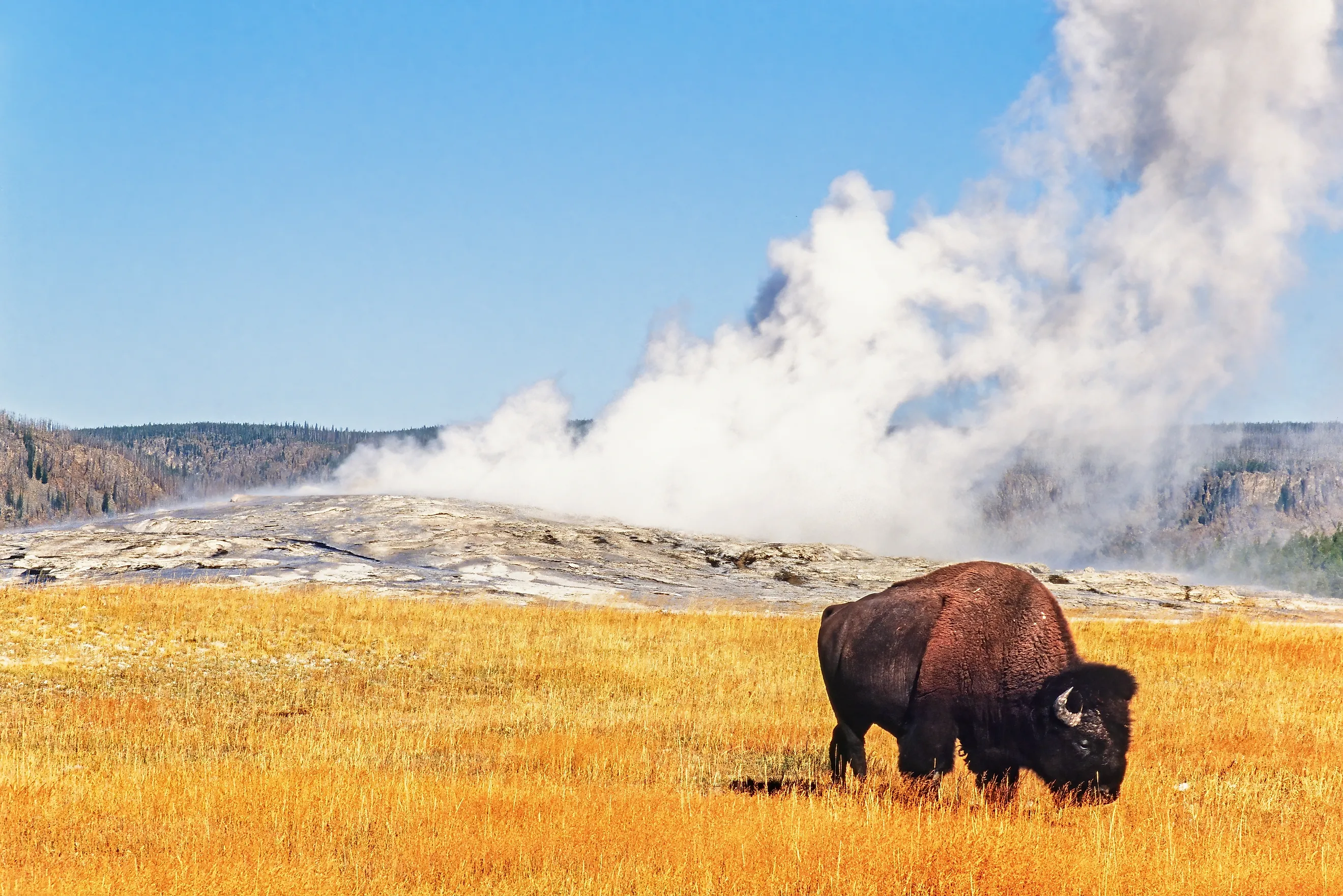
The Old Faithful geyser area recorded seven of those injuries, more than anywhere else in the park. It sits in the Wyoming section of Yellowstone, which also reaches into Montana and Idaho. Researchers found that 80% of injured people had deliberately approached the animals and nearly half were attempting to take photos. The average injured visitor stood 3.4 m from the bison, well inside Yellowstone's long-standing rule requiring at least 25 yards (23 m) of separation. Of the 25 injured people, 22 required medical treatment and 12 were hospitalized. None died.
The National Park Service reports that since 1980, bison have injured more pedestrian visitors in Yellowstone than any other wild animal. Between 1983 and 1985 alone, 33 visitors were injured, prompting the park to overhaul its wildlife safety campaign with graphic warning posters and expanded visitor education. Those efforts dramatically reduced injuries over the following decades, but they did not eliminate them. Every summer, Yellowstone's millions of visitors continue sharing roads, campgrounds, geyser boardwalks, and hiking trails with North America's largest land mammal.
Theodore Roosevelt National Park

Yellowstone may record the highest number of bison injuries, but Theodore Roosevelt National Park has experienced a remarkable series of serious attacks in recent decades. Official National Park Service records document at least five separate visitor injuries since 2002, including incidents in 2002, 2017, 2019, 2020, and 2023. Several victims required hospitalization, and one was airlifted by helicopter. In one case, a park ranger shot an aggressive bull bison to prevent further harm to an injured hiker.
The North Dakota park is known for its bison and prairie dogs. It is home to approximately 300 to 400 plains bison, split between its North and South units as part of one of the National Park Service's long-running conservation herds. Unlike Yellowstone's thousands of animals spread across an enormous landscape, Theodore Roosevelt's smaller herd often grazes close to scenic roads and hiking trails, increasing the likelihood of close encounters. During the mid-July through August rut, bulls become especially territorial and unpredictable, prompting park officials to remind visitors that bison can run much faster than humans and require a minimum viewing distance of 25 yards.

Several of the park's attacks illustrate how quickly seemingly calm encounters can become dangerous. In 2019, a 17-year-old hiker was walking between two bull bison that had been fighting on the Lower Paddock Creek Trail when one charged from behind, gored the teen in the thigh, and tossed them about 6 feet into the air before they were airlifted to a hospital. In 2020, a 55-year-old woman hiking the Buckhorn Trail rounded a bend and unexpectedly encountered a bull standing in the trail. The bison charged, knocking her down and leaving her with multiple facial fractures and broken vertebrae. Rangers responding to the scene found the bull continuing to threaten the injured hiker and ultimately euthanized the animal after hazing attempts failed. Most recently, in 2023, a Minnesota woman suffered serious abdominal and foot injuries after a bison attack at the Painted Canyon Trailhead during the height of the breeding season.
Unlike Yellowstone, Theodore Roosevelt National Park has not published a peer-reviewed analysis explaining why these attacks occurred or a cumulative injury database. Nevertheless, its repeated official incident reports over more than two decades demonstrate that even parks with relatively modest bison herds can experience severe visitor injuries.
Other National Parks With Bison
Yellowstone and Theodore Roosevelt National Park are the only US national parks where the National Park Service has consistently documented multiple visitor injuries caused by bison. Several other national parks also protect free-ranging herds, but despite frequent close encounters and repeated safety warnings, the National Park Service has not published a comparable public record of visitor injuries. That doesn't mean the danger isn't real. It simply means documented attacks appear to be far less common, or at least far less reported.
Grand Teton National Park

The Jackson bison herd belongs to two places at once, splitting its year between Grand Teton National Park and the neighboring National Elk Refuge. The herd has averaged roughly 485 animals in recent years, wintering on the refuge before dispersing across Grand Teton in Wyoming for the rest of the year. No bison injury to a visitor has been publicly documented in the park, though vehicle collisions and near misses are routine.
In June 2023, Grand Teton rangers asked the public for help identifying two visitors who approached and touched a bison calf at Elk Ranch Flats. Park officials warned that interfering with wildlife can cause mothers to reject their young and emphasized that bison are wild animals that can turn dangerous without warning. Vehicle strikes tell the same story. Six collisions in 2025 involved eight bison and killed five, about 150% of the average for the preceding five years.
Badlands National Park

Badlands National Park protects around 1,200 plains bison, making it one of the National Park Service's largest herds outside Yellowstone. The animals graze beside the Badlands Loop Road and rest near popular overlooks, often crossing hiking trails to get between the two. NPS has reported no violent bison encounters in the South Dakota national park. However, close calls have been documented. In July 2026, a widely shared video showed a woman walking to within a few feet of a massive bull bison to take selfies while another visitor filmed the encounter. The animal lowered its head several times but ultimately walked away without charging.
Wind Cave National Park

Fourteen bison arrived by rail from the Bronx Zoo in 1913, and their descendants have made Wind Cave National Park one of the National Park Service's most important bison conservation sites. The park now holds roughly 400 plains bison, and the herd helps supply genetically diverse animals to tribal nations and conservation herds across North America. Visitors regularly encounter them grazing across the park's mixed-grass prairie or standing directly on hiking trails. Bulls become noticeably more aggressive during the July and August breeding season. Despite these close encounters, there is no public National Park Service record of a visitor being injured by a bison inside the South Dakota national park.
Wind Cave's Superintendent's Compendium notes that approaching bison can result in serious injuries, and the park instructs hikers to turn around rather than attempt to pass an animal blocking a trail. Rangers also warn motorists to drive cautiously after dark because bison frequently stand on roadways, and collisions kill three to four bison each year.
Grand Canyon National Park

Grand Canyon National Park's bison aren't famous for attacking visitors, but they have become one of the Arizona park's biggest wildlife management challenges. The Kaibab Plateau herd, which moves freely between the Kaibab National Forest and the park's North Rim, expanded from a few dozen animals into several hundred over recent decades, causing widespread damage to fragile springs and archaeological sites.
Since reduction efforts began in 2018, Grand Canyon has removed 306 bison from the North Rim, 282 of them transferred alive to eight tribes through the InterTribal Buffalo Council. Despite visitors frequently encountering bison along Highway 67 and in the North Rim meadows, the National Park Service has not published any official reports of visitors being injured by bison inside Grand Canyon National Park.
What The Injury Records Show
The pattern in National Park Service records has barely shifted in four decades. Most injuries follow a visitor who closed the distance, usually for a photograph, in the developed corners of a park where people and bison share the same ground. However, the Bridge Bay goring is a reminder that the pattern is not a rule, since that visitor kept his distance and was charged anyway. Yellowstone and Theodore Roosevelt dominate the documented record largely because both parks publish it, while the herds at Badlands, Wind Cave, Grand Teton, and the North Rim generate the same close encounters without the same paper trail.