The National Forests With The Most Coral Snakes
Few animals in a national forest are as easy to misjudge as a coral snake. It is barely longer than a forearm, moves slowly, yet its venom attacks the nervous system and can stop a person's breathing. The eastern coral snake, Micrurus fulvius, lives in the longleaf-pine sandhills and sand-pine scrub of Apalachicola and Ocala in Florida and Conecuh in Alabama. In Sam Houston National Forest in Texas, the resident species is the Texas coral snake, and in Coronado in Arizona it is the smaller Sonoran coral snake of the desert borderlands. The animal turns up in a different setting in each forest, and each is a place where a hiker should know what the red, yellow, and black rings mean.
Apalachicola National Forest, Florida

A juvenile eastern coral snake appeared beside a Munson Sandhills wetland during a striped-newt release in early 2020. Here, south of Tallahassee, longleaf pine uplands surround shallow ponds that fill and dry with changing water levels. An open, grassy understory grows on the sandy hills, with turkey oaks among the pines.
Eastern coral snakes, also called harlequin coralsnakes, occupy Apalachicola's pine flatwoods as well as its sandhills. Across southeastern study sites that included this forest, their locations were associated with sandier soils and greater scrub or shrub cover. The snakes hunt at ground level, pushing their heads into fallen leaves to find small snakes and lizards. In Apalachicola, some have been observed crossing roads; others have been found dead on the pavement.
Ocala National Forest, Florida

The Big Scrub of Ocala National Forest occupies dry, sandy ground between the forest's springs and lakes. Sand pines grow above low scrub vegetation in the world's largest contiguous sand-pine scrub ecosystem. Eastern coral snakes live in Ocala, and scrub is one of the habitats they use across Florida.
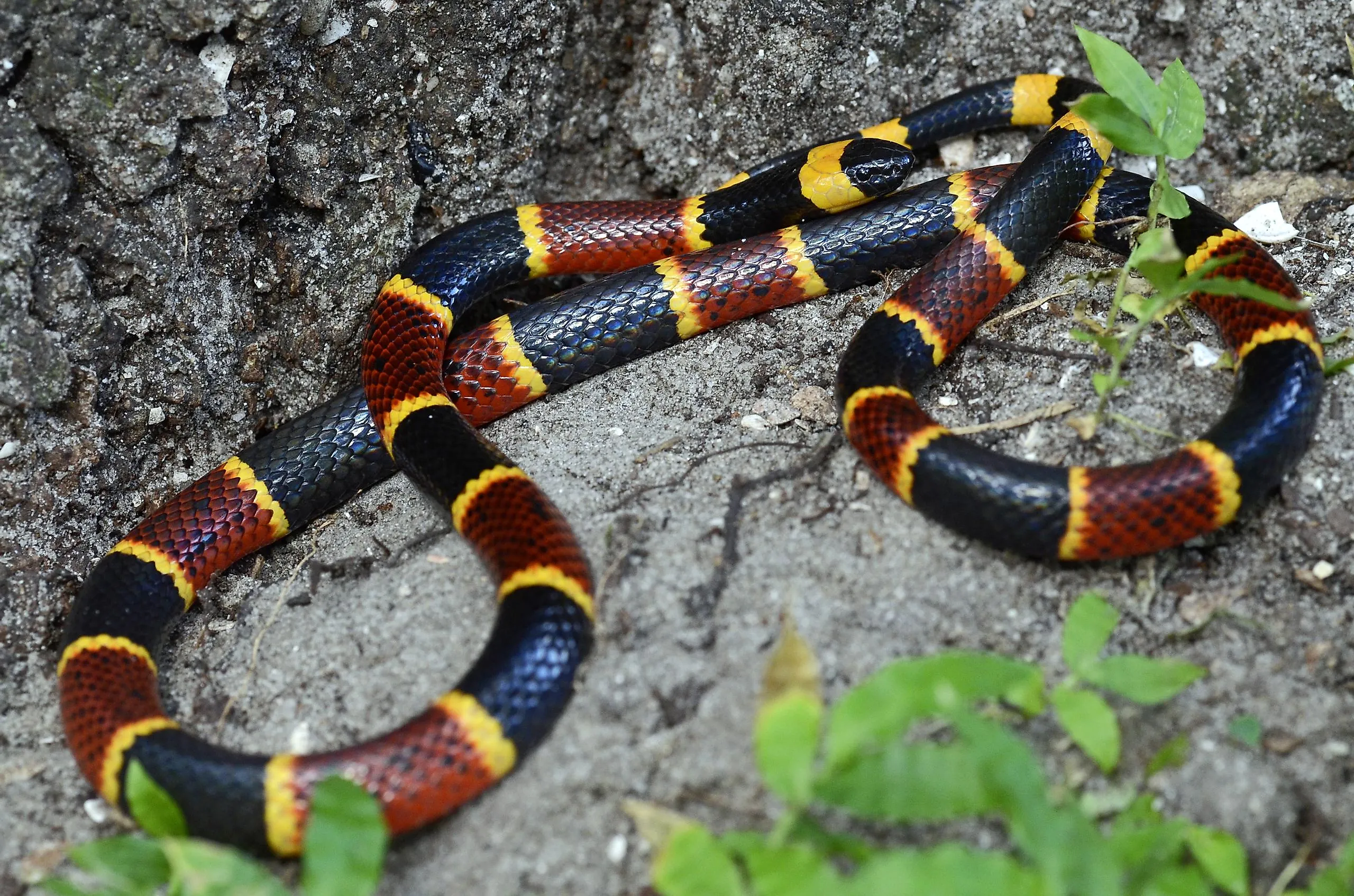
An adult is usually only 20 to 30 inches long, with smooth scales and a rounded black snout. Narrow yellow rings separate the broader red and black bands. The tail carries black and yellow bands without the red found along the body.
A red-banded snake seen in Florida may also be a harmless scarlet kingsnake or scarletsnake. Both resemble the coral snake, but normally have red snouts. Unusual markings can make color rhymes unreliable. Leave a banded snake undisturbed instead of approaching to identify it.
Conecuh National Forest, Alabama

Across the Florida line in southern Alabama, Conecuh's longleaf-pine uplands are broken by wet bottoms. Eastern coral snakes occur here, although they are secretive and considered rare in Alabama. The state wildlife agency lists the species as rare and possibly declining, and ties that decline to the loss of longleaf pine and wiregrass ground cover across the lower coastal plain, the same habitat that prescribed burns in Conecuh are meant to keep. The forest's sandy ground fits their preference for loose soils in open or brushy woodland. Along the Conecuh Trail, hikers pass through pine stands maintained with fire and wetter swamps in the low ground. Eastern coral snakes shelter in soil and decaying wood, and may enter gopher tortoise burrows. Although often hidden, the eastern species can forage during daylight. They also reproduce beneath cover. Females lay their eggs underground or under fallen leaves, and young can hatch in August or September. The hatchlings already have the same banded coloration as adults.
Sam Houston National Forest, Texas

In Sam Houston National Forest, the resident species is the Texas coral snake, Micrurus tener. Its range runs west of the Mississippi River through Louisiana, Arkansas, and eastern Texas, where it uses moist woodland. The snakes shelter under fallen logs and leaf litter and spend much of the daytime hidden in debris or shallow burrows.
About 50 miles north of Houston, the forest contains pine-covered ridges separated by hardwood creek bottoms. That arrangement continues into Little Lake Creek Wilderness, where loblolly and shortleaf pines grow on the higher ground. The Lone Star Hiking Trail crosses the same mix of pine ridge and bottomland, and its leaf-littered stretches are the kind of ground the species uses. The Texas species commonly moves at night or around dawn and dusk. Small snakes make up most of its diet, though it also eats lizards.
Coronado National Forest, Arizona

Coronado's coral snakes inhabit a much drier landscape. The Sonoran coral snake, Micruroides euryxanthus, occurs in the Atascosa Highlands west of Nogales, near the Mexican border. Oak woodland grows on north-facing slopes, with scrub and grassland on slopes facing south. Sycamore Canyon lies within these highlands.
At roughly 13 to 21 inches long, the Sonoran species is smaller than the usual adult eastern coral snake. It uses rocky ground and lower mountain slopes, eating primarily blind snakes and black-headed snakes.
This species usually emerges after sunset, though rain or overcast conditions can bring it out during daylight. Museum collections hold specimens taken near Ruby, the old mining camp on Ruby Road in Santa Cruz County, which places the species along the paved road that runs through the southern part of the forest.
Keeping A Safe Distance On The Trail
Coral snakes can defend themselves even when most of their bodies remain hidden. Eastern coral snakes may tuck their heads beneath their coils and raise their tails, drawing a predator's attention away from the head. Grabbing or pinning the animal can provoke a bite. Eastern and Texas coral snakes have fixed fangs at the front of the mouth and can inject venom without prolonged chewing. Any suspected bite needs immediate medical attention, even if symptoms have not appeared. On a forest walk, leave a coral snake room to retreat. Around the fallen timber in Texas's pine woods, keep hands out of gaps where the animal could be concealed.