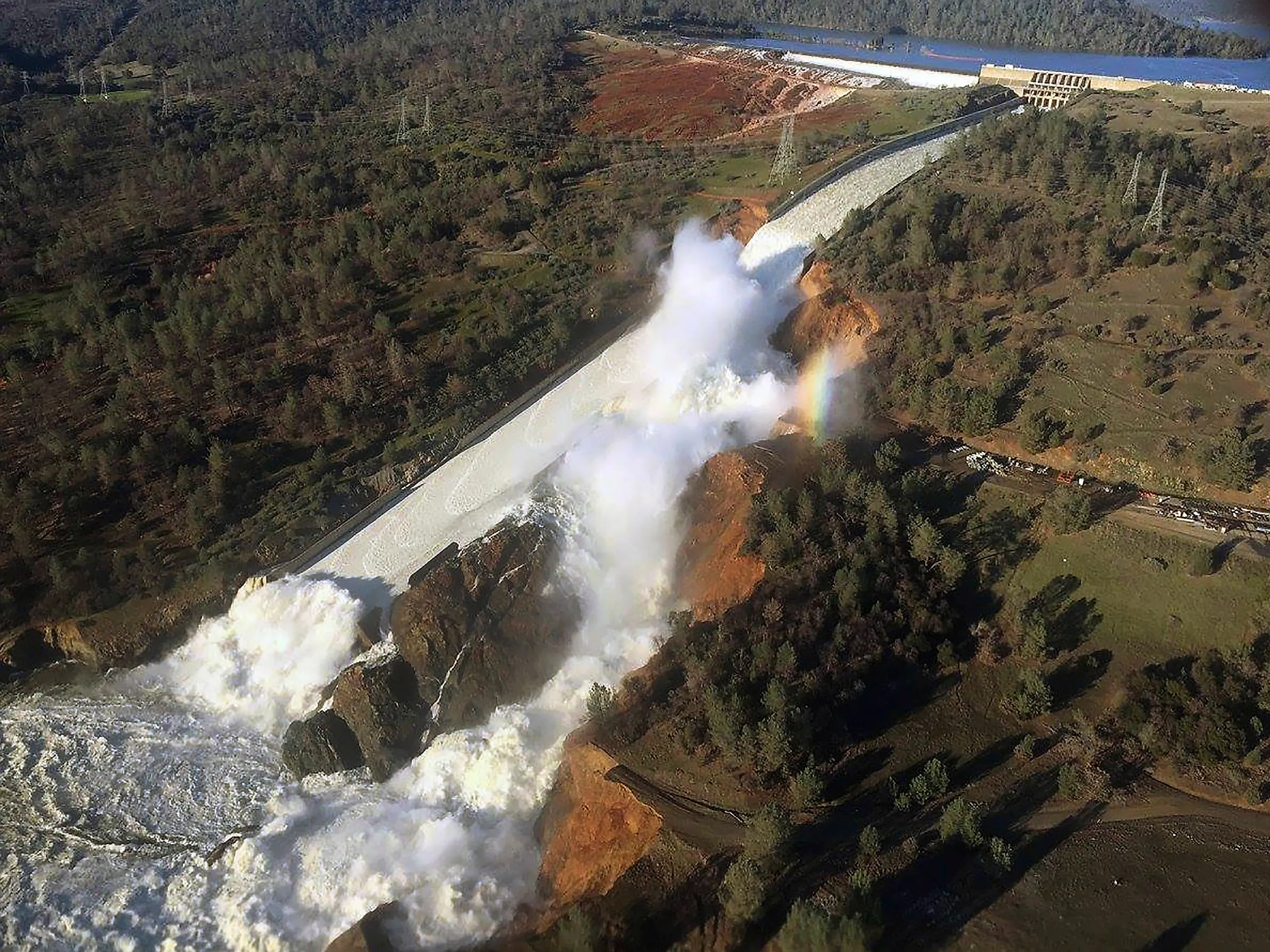
The Day Oroville Dam's Spillway Collapsed
Lake Oroville counts as full at 900 feet, and the crest of its emergency spillway sits 1 foot higher. For nearly half a century, no water crossed that last foot. The trouble came from somewhere else first. On February 7, 2017, a section of concrete slab on the main spillway lifted out during a winter release, and the ground beneath it washed away. Five days later, about 188,000 people downstream were under an evacuation order in California. The emergency response and rebuild that followed carried an estimated price of $1.1 billion.
The Lake Behind The Nation's Tallest Dam

Oroville Dam rises 770 feet, which makes it the tallest dam in the United States. It stands in the foothills of the Sierra Nevada, about 5 miles northeast of the City of Oroville in Butte County. Work on the dam wrapped up in 1967. The reservoir began filling behind it in the late 1960s and first reached full pool in 1969.
At full pool, the reservoir holds 3.54 million acre-feet across 15,810 acres, with 167 miles of shoreline. Its water goes into the State Water Project, the system that delivers water to 27 million Californians.
The clearest view comes from the 47-foot observation tower at the Lake Oroville Visitor Center on Kelly Ridge, which looks out over the lake and dam together. In May 2026, the California Department of Water Resources, known as DWR, listed the center as open daily from 9 am to 5 pm, with free admission.
Upstream, the Middle Fork of the Feather River became one of the first National Wild and Scenic Rivers on October 2, 1968. The designation covers the whole Middle Fork down to Lake Oroville, which was filling behind the new dam at the time.
A Morning On The Main Spillway

At about 10:10 am on February 7, 2017, the flow down the main spillway showed a substantial disturbance. DWR staff on site had been ramping releases up toward 52,500 cubic feet per second, or cfs. The order to close the gates went out at about 11:15 am, and they finished closing by about 12:25 pm.
The closed gates exposed the damage. A significant section of the concrete slab was missing, and a large erosion hole had opened where it had been. The chute runs just over 3,000 feet long and about 179 feet wide.
Its original design discharge, with all eight gates open and the lake at 917 feet, was 296,000 cfs. On state documents, the main spillway goes by another name, the Flood Control Outlet. Its record discharge, about 160,000 cfs, dated from January 1, 1997.
Water Over The Hillside

Nothing had flowed over the emergency spillway in the project's history before February 11. DWR had reopened the main gates at about 4 pm on February 8 for test releases between 20,000 and 65,000 cfs. Late on February 10, operators cut the chute's flow back to 55,000 cfs and kept it there for nearly two days.
During the 7 am hour the next morning, the lake passed an elevation of 901 feet. Water spilled across the crest for the first time. That crest is a pair of weirs totaling 1,730 feet, and whatever crosses them runs over natural ground on its way to the Feather River.
Overflow continued for about 36 hours. The lake topped out near 902.6 feet around 3 pm on February 12, more than a foot and a half over the crest. Flow across the weirs peaked near 12,500 cfs in that same hour.
Below the weirs, the slope eroded severely and fast. Engineers call what happened next headcutting.
The Evacuation Order

The evacuation order came at 3:44 pm on February 12. By then, concentrated areas of erosion were moving rapidly upstream on the hillside, cutting back toward the crest structure itself.
About 188,000 downstream residents fell under the order issued by the Butte County Sheriff's Office. Communities told to leave included Oroville, Gridley, Live Oak, and Marysville.
Nine minutes earlier, at 3:35 pm, DWR was already opening the main spillway gates wider. Damaged or not, the chute was carrying 100,000 cfs by about 7 pm, and water stopped crossing the emergency weirs around 8 pm. Releases stayed at 100,000 cfs until 8 am on February 16.
At about 3:30 pm on February 14, the order dropped to an evacuation warning, which remained in place until March 8.
What The Forensic Team Found
A report released on January 5, 2018, named no single root cause. The Independent Forensic Team wrote that no simple chain of events led to the failure. It pointed instead to a complex interaction of physical, human, organizational, and industry factors.
On the main chute, water pressure built beneath one section of slab until the uplift force exceeded what the slab could resist. Water had reached the underside through open joints, spalled concrete, and unsealed cracks over the herringbone drains. Weathered rock and soil-like material lay beneath that section. The chute's original design called for slabs at least 15 inches thick.
At the emergency spillway, the team singled out deep, erodible soil and rock that let the erosion race uphill. Its summary called the incident a long-term systemic failure of DWR, regulatory, and general industry practices.
Rebuilding Both Spillways

More than 1,000 people worked over 2 million hours to rebuild the two Oroville spillways, according to DWR. The first construction contract, awarded in April 2017, came to $275 million.
By November 1, 2017, crews had rebuilt and strengthened more than 2,270 feet of the main chute, enough for the repaired channel to handle 100,000 cfs. Over 2018, crews reconstructed the whole main spillway to its final design.
The emergency spillway received a roller-compacted concrete buttress at its base and a new splashpad, and DWR completed it in 2018 as well. In September 2018, the agency put the full emergency response and reconstruction at an estimated $1.1 billion.
The New Chute's First Run
Spring 2019 brought the rebuilt main spillway its first test. Operators sent water down it on April 2, 2019, with the lake near 854 feet, and releases reached 8,300 cfs that day. That level left the surface roughly 47 feet below the emergency crest that had overflowed in 2017.
The new concrete averages 7.5 feet thick, against the old slab's design minimum of 15 inches. Some 12.4 million pounds of reinforcing steel went into the structure.
Winter flood control still runs through it. In January 2026, DWR reported making required flood control releases through the main spillway.
Lake Oroville Today

Lake Oroville reached 897 feet on May 14, 2026, which put it at 99% of capacity. Two weeks later, DWR reported 895 feet and about 3.35 million acre-feet, or 98% of the lake's total capacity. With the reservoir that high, wind can splash water onto and over the emergency spillway crest, and DWR calls that wetting normal and expected.
Hillsides next to both spillways are getting attention too. DWR is seeding about 70 acres with native grasses and replanting 6 acres of woody vegetation. The first phase was due by November 2026, with planting continuing into 2027.
Downstream, the Feather River Fish Hatchery in Oroville raises Chinook salmon and steelhead. Its underwater viewing window shows migrating fish from about mid-September to June, and visitors can watch salmon spawning on weekdays from mid-September to mid-November.
Back At The Brim
The crisis opened with a disturbance in the water on a concrete chute. Within five days, a hillside built for emergencies was carrying Lake Oroville's overflow, and about 188,000 people were under orders to leave. Today the concrete in the rebuilt chute averages six times the thickness of the old design minimum. In mid-May 2026, Lake Oroville sat 1 percentage point short of full.