8 Off-The-Grid Oklahoma Towns To Visit In 2026
Oklahoma's small towns honor their heritage and stay true to their roots, keeping it simple in the very best way. Medicine Park was built from creek cobblestones in 1908 as Oklahoma's first resort town. Guthrie was the state's capital before losing it to Oklahoma City and still boasts one of the country's most comprehensive historic districts. Pawhuska sits on the largest surviving stretch of tallgrass prairie on earth. These eight towns stretch across the Wichita Mountains and the pine-covered Ouachitas. Each boasts a unique draw, like a spring-fed swimming hole, a bison loop through free-roaming herds, and a 54-mile ridge-top drive that turns gold in October. When the itinerary calls for a step back from the daily grind, a little Oklahoma might be just what you need.
Medicine Park

Founded in 1908 as Oklahoma's first resort town, Medicine Park still lines its streets with the rounded cobblestones pulled from Medicine Creek. At the center of downtown, the Bath Lake Swimming Hole is a spring-fed rock pool that has drawn swimmers since the 1920s. Just west, the Wichita Mountains Wildlife Refuge spreads across roughly 60,000 acres of mixed-grass prairie, granite peaks, and lakes, with free-roaming herds of bison, longhorn, and Rocky Mountain elk, plus trails, fishing, and birding. Summer brings Rock'n the Park, the town's music festival and Fourth of July celebration, with regional and national acts and food vendors filling the cobblestone core. At the Medicine Creek Boardwalk boutiques, galleries, and creekside restaurants line the water, an easy stroll that shows off the town's distinctive cobblestone construction.
Pawhuska

Set among the rolling hills of northeastern Oklahoma, Pawhuska pairs prairie scenery with Osage and Western heritage. The Joseph H. Williams Tallgrass Prairie Preserve protects one of the largest remnants of tallgrass prairie on earth, home to hundreds of free-roaming bison and to more than 700 plant, 300 bird, and 80 mammal species; visitors circle the 15-mile bison loop, hike marked trails, and stop at scenic turnouts. Downtown, Ree Drummond's Pioneer Woman Mercantile serves comfort food alongside a bakery and general store, with tours of the nearby Lodge where she films her show and rooms at the Boarding House. The Osage Nation Museum, established in 1938 and the oldest tribally owned museum in the country, traces Osage art and history, while the Ben Johnson Cowboy Museum honors the actor and champion rodeo cowboy.
Guthrie

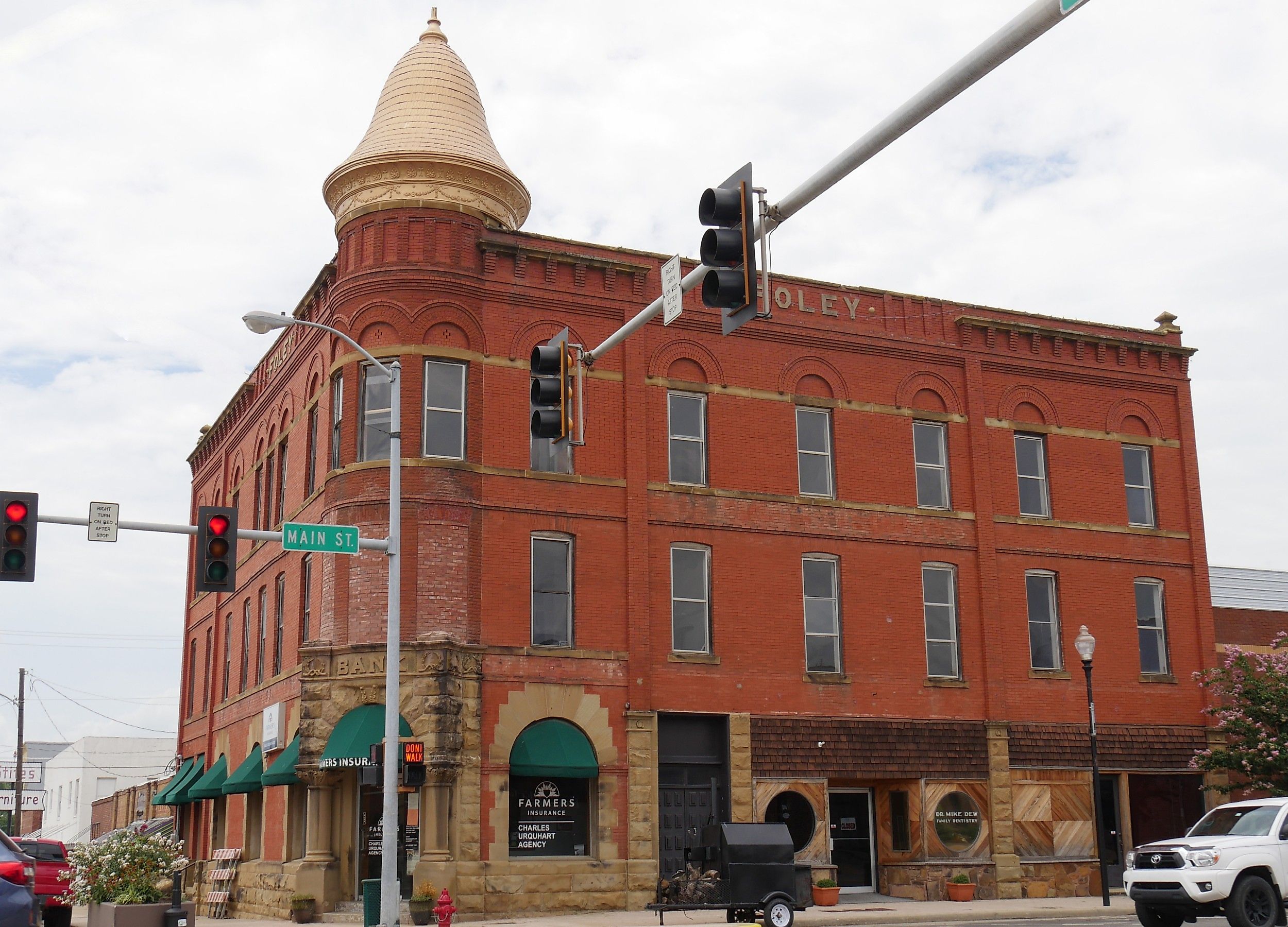
Oklahoma's original capital, Guthrie holds one of the largest historic districts in the country, its walkable streets lined with restored 19th-century brick storefronts. A Victorian Downtown Walking Tour showcases the boomtown-era architecture, and in winter, it becomes the Victorian Christmas Walk, with carolers and dozens of decorated store windows. The Oklahoma Territorial Museum traces the 1889 Land Run, pioneer life, and Guthrie's turn as first capital, with the adjacent 1902 Carnegie Library, built through a grant from the Carnegie Foundation and saved from demolition when Fred Pfeiffer added a connecting museum in 1973. The Pollard Theatre, a restored former vaudeville house downtown, stages several plays and musicals each year as one of the state's few professional resident companies, and fall brings the Oklahoma International Bluegrass Festival with workshops and jam sessions.
Broken Bow

Surrounded by the forested peaks of southeastern Oklahoma, Broken Bow has become a top destination for outdoor travelers. Beavers Bend State Park offers miles of trail through pine forest, with trout fishing, kayaking, and canoeing along the Mountain Fork River, plus cabins, campsites, and the Beavers Bend Lodge on Broken Bow Lake. The lake itself, ringed by federally protected land with no commercial docks or shoreline homes, stays remarkably clear and open for pontoon and jet-ski rentals among wooded coves. Families can also head to Hochatown Amusements for an 18-hole mini golf course and a figure-eight go-kart track. The surrounding area is thick with luxury cabin rentals, many with private hot tubs, fire pits, and decks set deep in the woods.
Eufaula

On the shores of Lake Eufaula, Oklahoma's largest lake, Eufaula seamlessly blends outdoor recreation and small-town life. Lake Eufaula State Park offers sandy beaches, shaded picnic areas, and trails along the state's most popular recreation lake, with fishing, swimming, and camping. Downtown's historic district, established in 1872, still holds many of its original buildings across a roughly 20-block core, now filled with antique stores, dealer malls, and locally owned shops. The Xtreme Amphitheater, an outdoor venue seating about 7,000, hosts seasonal concerts, festivals, and movie nights. On the water, Eufaula Cove Marina is a popular family destination with cabin rentals, RV sites, a swimming pool, and an inflatable obstacle course. As a Jellystone Park resort, it also runs Yogi Bear-themed activities and character appearances.
Claremore

In the rolling hills of northeastern Oklahoma, Claremore pairs frontier history with quiet outdoor spaces. The Will Rogers Memorial Museum features artifacts, films, and writings on the life of Oklahoma's humorist and actor, while the J.M. Davis Arms & Historical Museum displays the world's largest privately assembled firearms collection alongside thousands of military and Native American artifacts and Western collectibles. For a look at the town's early prosperity, the 1907 Belvidere Mansion, a few blocks off Route 66, offers self-guided tours of its restored three-story interior, a gift shop, and lunch or afternoon tea at the on-site Pink House. Claremore Lake closes out the day with fishing spots, paved walking trails, waterfowl hunting, and shaded picnic areas just outside town.
Sulphur

In the foothills of the Arbuckle Mountains, Sulphur is built around natural springs and Chickasaw heritage. The Chickasaw National Recreation Area is home to mineral springs, hiking trails, and the cool waters of Travertine Creek, set amid a landscape suited to camping, swimming, boating, and fishing. The Chickasaw Cultural Center brings the nation's history to life with exhibits, a recreated traditional village, and seasonal stomp dance demonstrations. A visit usually starts at the Chikasha Poya Exhibit Center before moving on to the Chikasha Inchokka' Traditional Village and gardens. The restored Artesian Hotel & Spa offers spa treatments, dining, and shopping steps from the park. For a longer look at the terrain, Arbuckle Trail Rides leads guided horseback excursions through the surrounding forests, hills, and overlooks.
Talihina

In the heart of Oklahoma's Ouachita Mountains, Talihina is a quiet mountain town and a gateway to some of the state's most striking scenery. Its biggest draw is the Talimena Scenic Drive, a 54-mile ridge-top byway known for mountain views that peak in fall, when the surrounding forests turn red, orange, and gold. In October, the Talihina Foliage Festival is a downtown celebration with craft vendors, live music, food trucks, and helicopter rides. The Ouachita National Forest opens onto the Ouachita National Recreation Trail, miles of rugged hiking through remote woodlands and ridges. About three-quarters of a mile from the trailhead, an overlook takes in Holson Valley and the scenic drive. Winding Stair Campground offers shaded sites for those who want to stay a little longer.
Beyond the Crowds
These eight towns show how much of Oklahoma sits outside its busiest routes. A resort village in the Wichitas, a prairie town full of Osage history, a Victorian capital, and a mountain gateway to a ridge-top byway each reward a different kind of trip, from spring-fed swimming and lake days to museums, festivals, and horseback trails. For travelers ready to unplug, they make a strong case that some of the state's best experiences are found off the beaten path.