9 Old-Timey General Stores In Illinois
Galena's oldest building opened as a limestone trading post, with rough lodging for fur traders. The first store in Knoxville resurfaced during a house demolition in the 1960s. A 1912 country store in Clark County quits grilling Moonburgers just after noon, and the menu drops to cold cuts. Old-timey general stores like these survive across Illinois, two of them rebuilt and a handful still ringing up sales. Ordered by the year each one first opened for business, these nine stores trace a short history of how the state shopped.
Dowling House, Galena

John Dowling built Dowling House out of limestone in 1826, the founding year of Galena, the seat of Jo Daviess County. For a time it was Galena's only trading post. Its primitive living quarters hosted many fur traders.
The building now ranks as the oldest in Galena, a survivor of the town's lead-mining years. Guided tours cover both floors from May into the fall, past original fireplaces, period furnishings, and artifacts tied to the area's lead mines. The guides trace Galena's growth alongside the house's own past. Admission is free for anyone under 12.
Sanburn Log Cabin, Knoxville

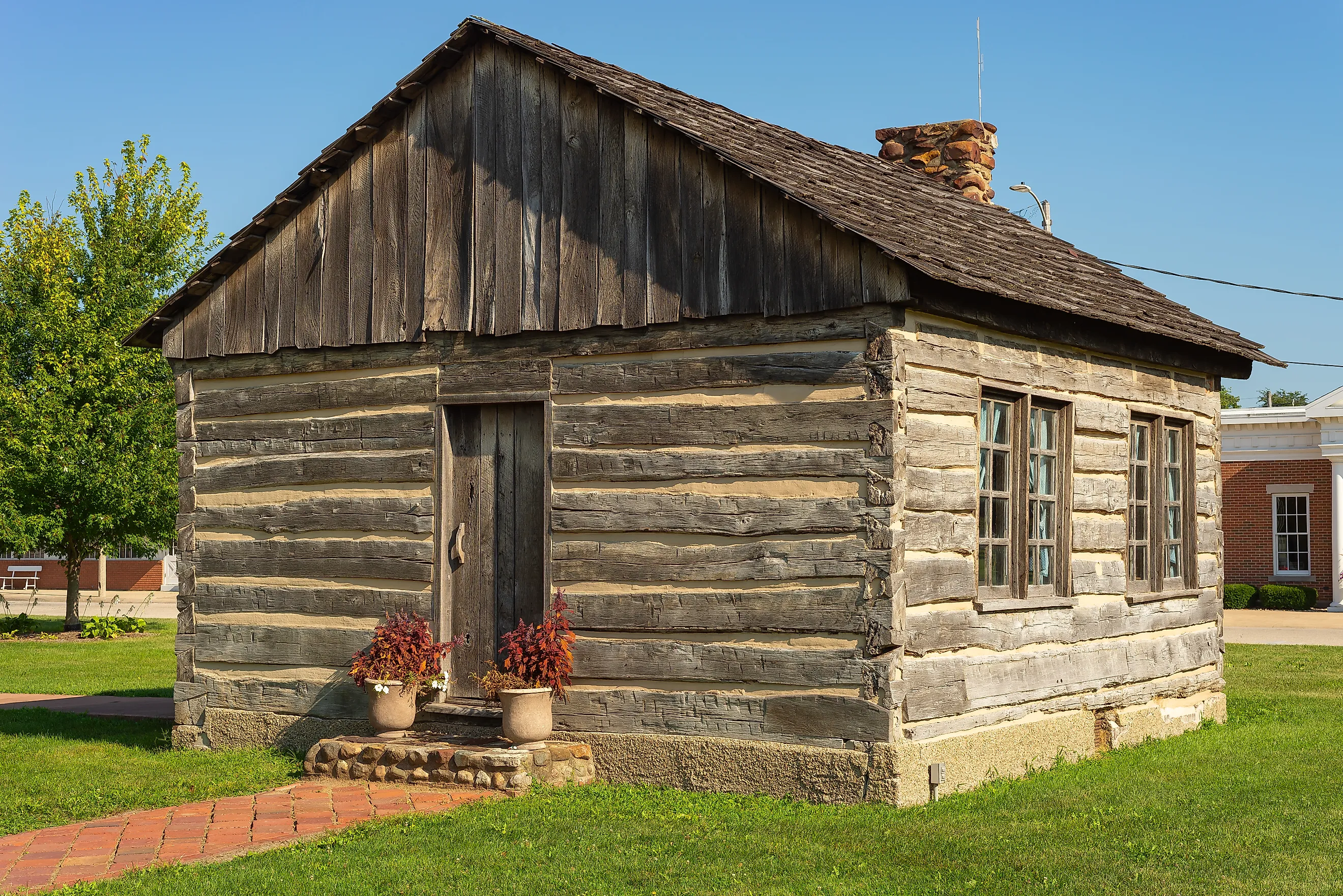
For more than a century, Knoxville's first store stayed hidden. John G. Sanburn opened it in the spring of 1832. The logs went unnoticed until workers demolished a house on the site during the 1960s.
Knox County Historical Sites, Inc. raised money to move the Sanburn Log Cabin beside the Old Knox County Courthouse. Restoration followed the next year. The restorers added a fireplace chimney made from native stones gathered out of nearby creek beds. The interior now recreates a frontier general store, stocked with museum artifacts.
The courthouse next door dates to 1839, and its upstairs exhibits include farm equipment and a desk used by Stephen Douglas. Downstairs is a large collection of Abingdon pottery.
Lincoln-Berry Store, New Salem

Abraham Lincoln's run as a storekeeper lasted only a few months. He went into partnership with William F. Berry in January 1833 to buy a small store in New Salem. The village stood just south of today's Petersburg, the Menard County seat. By April, Lincoln had sold his share to Berry.
The venture left a long tail. By Lincoln's own account, the store only sank him deeper into debt. Berry died in January 1835 and left Lincoln with the partnership's debts. Lincoln finished paying them years later, during his time in Congress. He called the obligation his "national debt."
New Salem was already fading when Lincoln left in 1837. The Civilian Conservation Corps rebuilt the village during the 1930s and 1940s, and the Lincoln-Berry Store is one of 23 furnished buildings at Lincoln's New Salem State Historic Site. The store is wheelchair accessible, and so is the nearby Rutledge Tavern.
Red Brick Store, Nauvoo
On January 5, 1842, Joseph Smith opened the Red Brick Store in Nauvoo, the Hancock County town his followers had settled on the Mississippi River. The main floor was the shop, with an office at the back where customers could settle their bills.
Upstairs, a large room handled council meetings and other gatherings, and the store was church headquarters between 1842 and 1844. Most of Nauvoo's Latter Day Saints left in 1846. The store slowly deteriorated in the decades that followed, and the building on Water Street today is a 1980 reconstruction.
Missionaries lead tours through the rebuilt rooms, where the first floor once more looks like a working store. Tours take place Monday through Saturday between 9 am and 5 pm, and on Sunday afternoons between noon and 5 pm.
Colony Store, Bishop Hill

Swedish immigrants founded Bishop Hill in 1846 as a communal colony in Henry County. The colonists built the Bishop Hill Colony Store in 1853. The ground floor held the shop and the colony's post office, and the upper floor housed colony offices and the living quarters of Swan Swanson, the storekeeper.
The colony broke up in 1861 and divided its property among the settlers, yet the store kept trading for nearly a century after that. Its southwest corner collapsed in April 1969, and the newly formed Bishop Hill Heritage Association bought the building and restored it.
The store reopened on May 25, 1975. Counters, shelving, and display fixtures from the original store are still inside. Scandinavian foods, crafts, and gifts fill the shelves now, and the sales help the association restore the other colony buildings it owns.
H.I. Lincoln Building, Franklin Grove

A distant cousin of Abraham Lincoln went into business in Franklin Grove, in Lee County, on May 1, 1853. Henry I. Lincoln kept that store going into the 1890s. He built the native limestone H.I. Lincoln Building in 1860 for his dry goods trade.
The building outlasted the store by a long way. It went on to serve as a hospital, a post office, a newspaper office, and a storage building. A renovation in the 1990s turned it into the headquarters of the Lincoln Highway Association.
Inside, the national interpretive center traces the history of the Lincoln Highway, the first transcontinental highway. Part of the building still trades, too. Its welcome center sells local merchandise and work by regional artists. The center asks guests to call ahead between November and March.
Council Hill Station, Council Hill

Back in Jo Daviess County, the railroad reached the East Fork of the Galena River in 1854. A business district grew up at Council Hill with it, and Council Hill Station is all that is left of that district. The 1850s building did double duty as depot and general store. Council Hill lies just outside Galena, making it a neighbor of Dowling House.
These days the old store pours rather than sells. More than 90 beers share the bill with country breakfasts, and live music and barn dances fill out the calendar. The yard has fire pits and an outdoor stage.
J. L. Robinson General Store, Hagaman

Railroad wages paid for Hagaman's general store. Charles Crossland Robinson, a railroad worker, put the store up in 1881 in Western Mound Township, Macoupin County. His son, James Leo Robinson, later ran the business and gave it his name.
The J. L. Robinson General Store was the main supplier of household and farming goods for the township and the communities around it. The township's mail and its railway express shipments passed through the same building.
The store joined the National Register of Historic Places on September 12, 1980. Its building off Illinois Route 108 is now home to the Hagaman Historical Society. The society announced its 14th annual Fourth of July celebration for 2025.
Moonshine Store, Moonshine

One building makes up nearly all of Moonshine, an unincorporated spot in the southwest corner of Clark County. The Moonshine Store dates to about 1912, when it went up as a country grocery. The Tuttles bought it in 1982 and made it a restaurant.
The Moonburger is the signature order. Double beef, cheese, and bacon are among the ways to build one, though timing matters. Moonburgers stop at 12:30, and cold cut sandwiches take over after that.
Customers eat on benches inside or at picnic tables beside a kerosene pump, and the guest book carries names from all 50 states. During a 2010 motorcycle rally, the store went through 1,908 sandwiches.
Where Illinois Once Shopped
Nine counters, opened more than 80 years apart at either end, tell the story of how Illinois shopped. A trading post hosted fur traders in Galena, and Lincoln's brief partnership saddled him with debt for years. Swedish colonists ran a shared storefront in Bishop Hill. Some of these buildings still sell something, be it Scandinavian crafts or a double Moonburger. Others keep their history for tours, with the old shelves set up as they once looked.