This National Park Has Some of the Oldest Rocks on Earth
Located in the northern reaches of Minnesota, Voyageurs National Park sits above a geological foundation that began forming billions of years ago into what is now some of the oldest rock on Earth. Yet the park is more than a geological time capsule, with several major lakes, forests, islands, historic sites, and remote trails providing plenty for us to explore in modern times. This contrast between extremely ancient bedrock and the natural features we see now, ones primarily shaped by comparatively recent glacial movements, makes Voyageurs particularly valuable for understanding how dramatically our planet's surface can change over immense spans of time. Read on to learn more about this fascinating Midwestern national park and figure out how to plan your next visit.
A Quick History of Voyageurs National Park

Voyageurs National Park was established in 1975 after nearly a century of proposals, dating as far back as 1891, to protect the lakes and forests along Minnesota's northern border. The idea faced opposition from some local residents and landowners, who were concerned about federal restrictions on development and private property, but Congress ultimately authorized the park, formally establishing it after the federal government acquired the necessary lands in this rugged part of the state.
The park takes its name from the French-Canadian "voyageurs" who traveled the region's waterways during the fur trade era before the creation of the United States itself. However, long before European/American exploration, the area was inhabited for thousands of years by Indigenous peoples, including the Ojibwe.
Today, Voyageurs encompasses more than 218,000 acres of water and land, with its history still closely tied to Indigenous use, the region's later resource-extracting operations, and a current boon in outdoor tourism.
An Unimaginably Old Landscape

Geographically speaking, the park sits on the southern edge of the Canadian Shield, a vast swathe of exposed Precambrian bedrock that forms the geological foundation of much of northern North America. Some of Voyageurs' rocks are approximately 2.7 billion years old, dating to the Archean Eon when Earth was vastly different from today in a variety of ways.
These rocks formed from ancient molten material and were later subjected to intense heat and pressure that transformed them into metamorphic rocks. Then, over billions of years, erosion repeatedly wore away younger layers, eventually exposing the bedrock at the surface.
Now visibly present in many places across the national park, the geology of Voyageurs represents just a small portion of an unimaginably long natural history. For better context, the age of these formations also predate the first dinosaurs by more than 2 billion years, placing their initial creation into a period of time when only the earliest/simplest of lifeforms were emerging from whichever primordial soup they came out of.
How Voyageurs' Geological Past Affects the Present

The region's landscape records two very different stages of Earth's history. As said, the bedrock formed roughly 2.7 billion years ago, but the lakes, islands, and exposed rocky shorelines seen today are largely the result of much more "recent" glaciation. During the last Ice Age, which began over 100,000 years ago, massive glaciers advanced repeatedly across this part of northern Minnesota, grinding against the hard bedrock and widening existing fractures and depressions.
As the ice moved and eventually melted, it left behind a landscape marked by thousands of lakes, coves, ridges, and interconnected waterways, of which visitors now come to see and explore. Glacial erosion also stripped away plenty of soil and younger rock, exposing to the open air portions of what many geologists consider some of the "world's oldest rocks" on the Canadian Shield.
Where to See the Ancient Bedrock

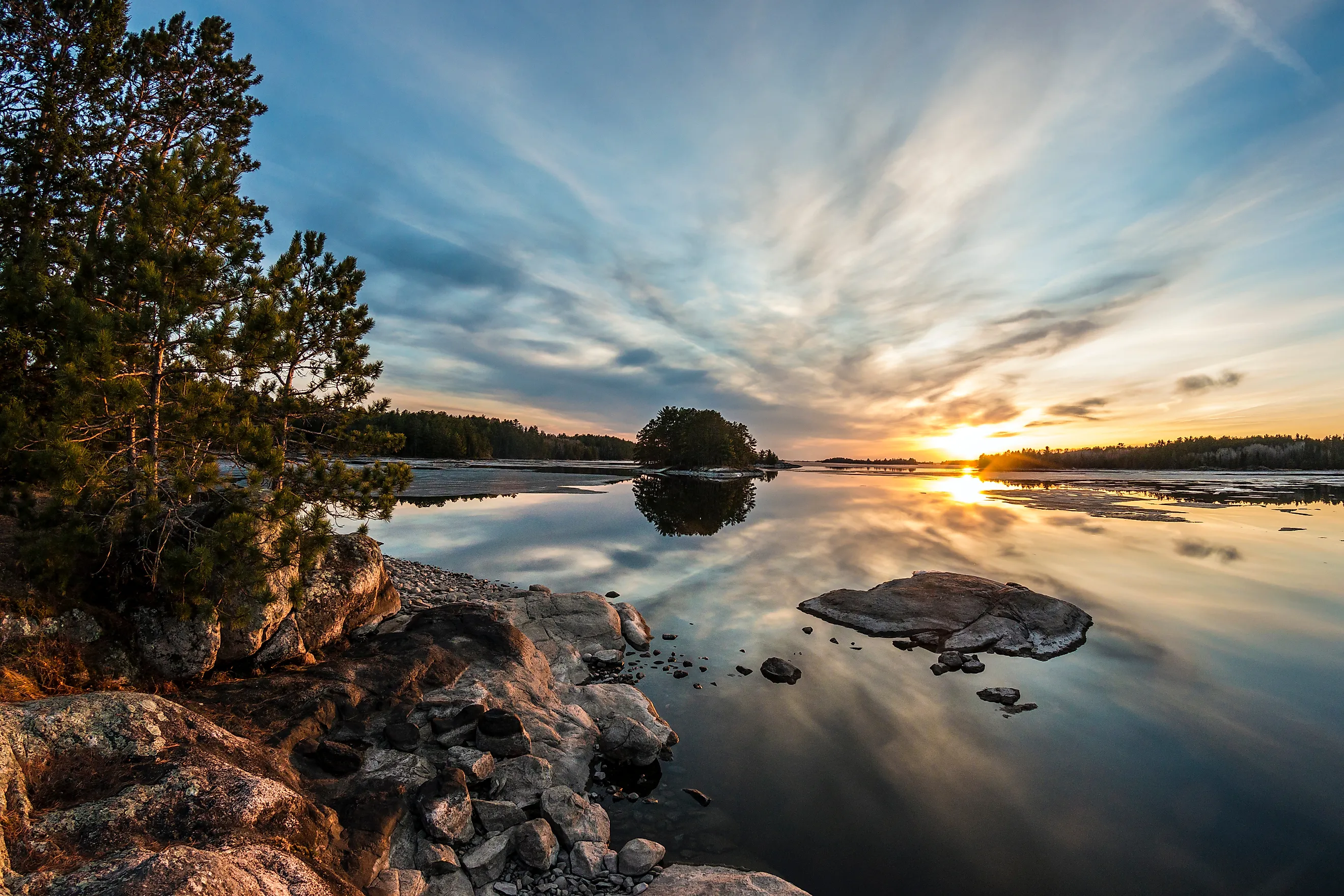
The ancient bedrock is visible throughout almost all of Voyageurs National Park, particularly along shorelines, bare islands, and areas where glaciers clearly removed much of the overlying soil. If you're traveling across the park's major lakes, you can often simply spot sections of the Canadian Shield directly along the water's edge, where smooth, weathered rock contrasts with the surrounding forests.
Hiking trails also provide opportunities to encounter exposed bedrock away from the water. The Locator Lake Trail and Blind Ash Bay Trail, for example, both pass through landscapes where glacial erosion is obvious, with rocky surfaces and outcrops visible for lengthy portions of their routes.
The park's vast network of rivers and streams provides another way to appreciate the aged geology. Paddling trips across Rainy Lake, Kabetogama Lake, Namakan Lake, and Sand Point Lake and into connecting waterways reveal even more the relationship between the ancient rock and the younger landscape carved into it.
Since many of the most exposed surfaces contain cracks, grooves, and other marks created by moving ice during the last glaciation, these natural features often appear to move in the same direction, kind of like when you pull a garden rake over soil. Furthermore, you should not expect to see any single dramatic rock formation identified as THE oldest on Earth. Instead, the geological significance of Voyageurs comes from encountering bedrock repeatedly across the park's near-total foundation.
What Else is there to do Here Other than Looking at Rocks?
Many visitors probably aren't even aware of this area's natural history, and yet Voyageurs National Park still draws hundreds of thousands of people annually with plenty to see and do beyond gawking at the rocks.
Canoeing, kayaking, and smallcraft boating are the main ways to get around, with the aforementioned Rainy, Namakan, Sand Point, and Kabetogama lakes providing access to hundreds, if not thousands, of islands, secluded shorelines, and up to 14 backcountry campsites. If you don't have your own, visitors can rent boats, join guided tours, or use water taxis to reach areas that are difficult to access by road.
Dozens of miles of hiking trails can provide a different perspective on the landscape. The Blind Ash Bay Trail comes highly recommended, following a forested route along Kabetogama Lake, while the Locator Lake Trail passes through denser boreal forest and craggy terrain. Wildlife watching is also quite popular, whether on land or water, with moose, white-tailed deer, black bears, beavers, river otters, and bald eagles found throughout the national park and surrounding woodlands.
A number of historic sites add another bit of interest. The Kettle Falls Hotel, built in 1913, is among the best-known structures here and is still open for bookings. Moreover, the Ellsworth Rock Gardens are definitely worth a stop, too, containing hundreds of stone sculptures created by famed contractor and artisan Jack Ellsworth.
Voyageurs is a designated International Dark Sky Park as well, making its remote lakes and islands at night particularly suitable for stargazing and viewing the northern lights when conditions are favorable.