Why The Midwest Has So Few National Parks
There are so few national parks in the Midwest due to its large percentage of privatized farmland. It takes up vast percentages of the land here. That is far more than the states with the most national parks such as Alaska and California. In addition, the foundation of the National Park System in 1916 was performed long after the Midwest had been heavily settled. It put a much larger focus on parks in the American West.
What is the Midwest, and how many national parks does it have?

First, it's important to define what the Midwest is, as there are many competing definitions of the boundaries of this region. For this article, we will be using the US Census' categorization, which includes the states of North and South Dakota, Nebraska, Kansas, Minnesota, Iowa, Missouri, Wisconsin, Illinois, Michigan, Indiana, and Ohio. This accounts for 12 states in total.
The Census further notes that the Midwest has a population of 69,762,666 people, making up 20.4% of the entire population of the U.S. It has a larger population than the Northeast, but is smaller than the West and South. Furthermore, the Midwest accounts for 18% of the total landmass of the U.S., with 673,000 square miles.
Of the 63 national parks in the U.S., only 8 are found in the Midwest. These include:
- Theodore Roosevelt National Park in North Dakota.
- Badlands National Park and Wind Cave National Park in South Dakota.
- Indiana Dunes National Park in Indiana.
- Cuyahoga Valley National Park in Ohio.
- Voyageurs National Park in Minnesota.
- Gateway Arch National Park in Missouri.
- Isle Royale National Park in Michigan.
Farmland
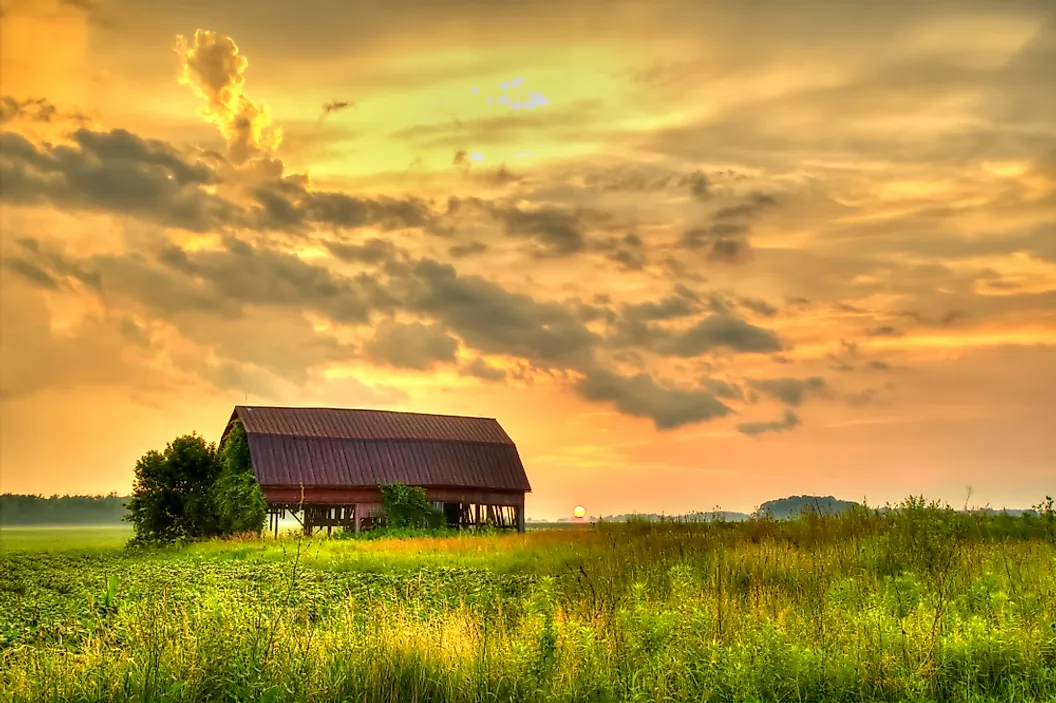
The primary reason for there being so few national parks in the Midwest is how much of its land is set aside for farming. The Midwest is one of the largest agricultural centers of both the U.S. and the world. In fact, it is often called the Corn Belt due to the volume of corn produced within its borders. In fact, in most of the Midwestern states, more than 50% of the total land area is devoted specifically to farms.
North and South Dakota, for example, have 87.2% of their land set aside for farming. Nebraska has the highest percentage of farmland of any state at 89.5%, with Iowa closely following at 85.6%.
The only states in the Midwest that have values below 50% are Minnesota at 49.8%, Wisconsin at 39.8%, and Michigan at 26.2%. However, this value is still higher than that of the two states with the most national parks: Alaska, which only uses 0.2% of its land for farms, and California at 23.9%
Part of the reason for these huge farms is the Homestead Act of 1862, passed by Abraham Lincoln during the American Civil War, which allowed loyal Unionists the right to claim 160 acres of government land in the Midwest for $1.25 an acre.
Farmland, save for special circumstances where it can be converted into its former environments, is unsuited for national parks. In fact, currently Kansas, Nebraska, Iowa, Wisconsin, and Illinois have no national parks. Nebraska's sheer amount of farmland also prevents it from having many state parks. It has the smallest number of state parks in the U.S., with only 8 official state parks within its borders.
What places are considered for a national park?

The National Park Service defines a national park as having "a variety of resources and encompasses large land or water areas to help provide adequate protection of the resources."
Prior to the establishment of the National Park Service, Yellowstone National Park was the first spot to be declared by Congress in 1872 to protect its wildlife and geothermal landmarks. Within 40 years, there were 35 national parks and monuments that were run by the Department of the Interior. These original parks were mostly located in the Western U.S., although one was located in South Dakota, Wind Cave National Park, which was set up in 1903 under Theodore Roosevelt. The National Park Service was established in 1916 to manage these lands.
In order to become a national park, a site must receive congressional approval or be approved through a presidential declaration with the Antiquities Act of 1906, which is used to designate areas worthy of protection. This act itself is today only used to declare national monuments, and Congress controls national park designations.
The National Park Service will carefully analyze sites to determine what designation, if any, an area should receive, looking at its environment, natural resources, wildlife, and historic significance.
In the Midwest, the first national park established under the National Park Service was Isle Royale National Park in 1940 to protect the largest island in Lake Superior. The next Midwestern national parks would not be established until the 1970s, consisting of Voyageurs in 1975 and Badlands and Theodore Roosevelt National Parks in 1978.
In place of federal protection, many states in the Midwest protect natural places through their individual park systems. These include places like the Maquoketa Caves State Park in Iowa, which protects 13 caves and river bluffs. Another is the Brown County State Park in Indiana, protecting hills and woodlands in an unusually hilly section of the state, with the highest hill reaching 1,058 feet at Weed Patch Hill.
However, there have been efforts recently in the Midwest to expand their monuments and lakeshores into national parks, including areas that do not meet the more traditional definition of a national park.
The Gateway Arch National Park

The Gateway Arch National Park sits in St. Louis, Missouri. It is only 0.14 square miles, making it the smallest national park in the U.S. The main attraction here is the 630-foot-tall steel arch, which was built in 1965 by Finnish architect Eero Saarinen. This arch is meant to celebrate the Louisiana Purchase by Thomas Jefferson in 1803 and the subsequent expansion out to the West.
The park includes a museum, an Old Courthouse, and a 91-acre greenspace. The park was initially established by Franklin D. Roosevelt in 1935 as the Jefferson National Expansion Memorial. In 2018, it was redesignated as a national park, following an introduction of Bill S. 1438 by Senator Roy Blunt from Missouri. This park is unique as it has no natural resources and is entirely made by humans.
As this park does not contain natural resources, it did receive some pushback from Robert Vogel, the acting deputy director of the National Park Service in 2017, who recommended it be renamed as a national monument rather than a national park. However, the Senate and House passed the senator's bill, and it was signed into law on February 22, 2018, by President Donald J. Trump.
This is not the newest of the national parks in the Midwest. That honor falls to the Indiana Dunes National Park.
Indiana Dunes National Park

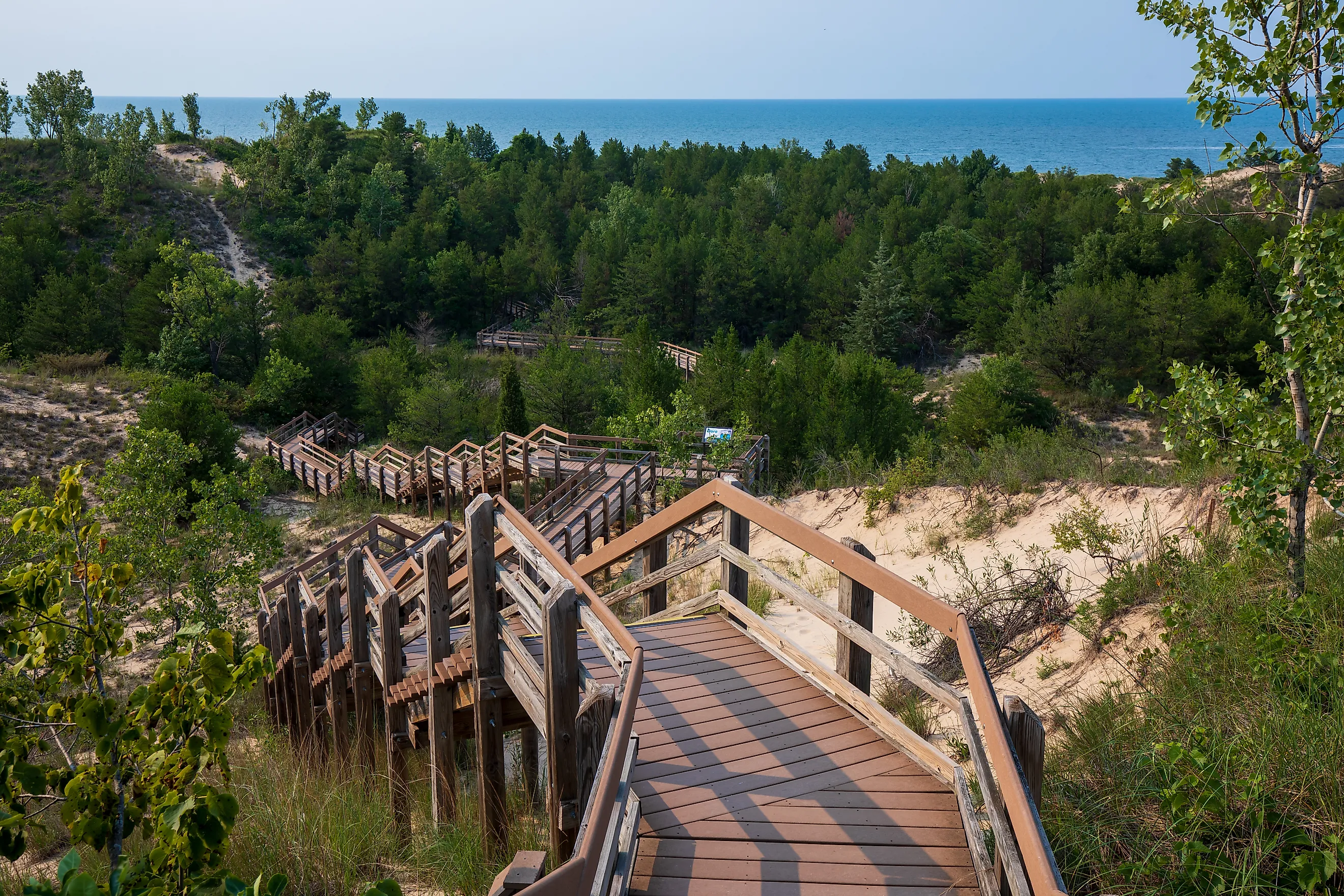
The Indiana Dunes National Park is located on Indiana's shoreline with Lake Michigan, and it protects an environment that fits the traditional definition of a national park. It has a great deal of natural landmarks, such as the freshwater sand dunes, rare bogs, the lakeshore beaches, and historic sites.
In 1899, there was a push from botanist Henry C. Cowles, Illinois Sen. Paul H. Douglas, and English teacher Dorothy R. Buell to protect the vegetation and landmarks on the sand dunes. However, the region also saw large amounts of industry such as steel mills and power plants. With the establishment of the National Park Service in 1916, these three citizens continued their work. Eventually, they gained some measure of success with the state, creating the Indiana Dunes State Park in 1926.
However, the dunes were still under threat by industry, such as in 1963 when much of the dunes in the central part of the park was bulldozed. Conservations continued to push for federal action, which led to the creation of the Indiana Dunes National Lakeshore in 1966.
In 2019, President Donald Trump signed a bill designating the lakeshore as Indiana Dunes National Park to "preserve for the educational, inspirational, and recreational use of the public certain portions of the Indiana dunes and other areas of scenic, scientific, and historic interest and recreational value in the State of Indiana."
Will the Midwest get more national parks?
There is currently an effort to create a 9th national park in the Midwest at the Apostle Islands in Wisconsin. Currently designated as the Apostle Islands National Lakeshore, Rep. Tom Tiffany of Wisconsin introduced a bill in 2026 to designate it as a national park. Located just off the shore of Wisconsin on Lake Superior, it is known for its lighthouse, ice caves, cliffs, and shoreline.
This bill has received pushback over concerns from residents, who are concerned that too many visitors can overwhelm the infrastructure. This reveals another reason why a state might not have a national park. Political considerations from constituents, such as overcrowding or dealing with too many tourists, can discourage the establishment of national parks. And as the Gateway Arch National Park demonstrates, national park considerations can at times be more driven by state interests than input from the National Park Service.
It is also worth noting that even though the Midwest has few national parks, each state has state park systems that preserve important historic and natural environments.