The National Parks Where Rattlesnakes Den For The Winter
Warm weather draws humans out of their homes and onto the natural lands of America's national parks. Rattlesnakes are no different. They are the most widespread venomous snake in the United States, found in every state, excluding Alaska, Hawaii, Maine, and Rhode Island. Their winter dens are essential to their survival. In the summer, the dens provide security for pregnant females to gestate their young, while in the winter, rattlesnakes will gather communally to see out the winter together.
Great Basin National Park, Nevada

Great Basin National Park covers over 77,000 acres of the Great Basin Desert, the largest desert, the largest desert in the United States. The park comprises several Great Basin ecosystems, like salt-desert shrublands, sagebrush steppe, and pinyon-juniper woodlands. Great Basin rattlesnakes (Crotalus oreganus lutosus) can occur up to 11,000 feet in elevation within the park, although they are most common below 8,000 feet in the sagebrush-covered foothills. They inhabit many of the park's habitat types, although the common denominator is rocky terrain.
Rattlesnakes utilize south-facing rocky outcrops for their winter dens, or hibernacula, as they are also known. In Great Basin National Park, rattlesnakes hibernate communally in ancestral winter dens and are highly philopatric, with strict fidelity to certain sites. Individuals return to their specific hibernaculum in late September each year. They remain underground in their den throughout the winter, emerging in May. Male and non-reproducing females will migrate up to 2.5 miles away from their den in search of food and mates. Pregnant females will remain close to their dens, basking often to aid in the development of their embryos, which they will give live birth to between mid and late September.
Bryce Canyon National Park, Utah

Great Basin rattlesnakes also hibernate communally in Bryce Canyon National Park. They are the only species of venomous snake found in the park. Since the park covers a vertical distance of over 2,000 feet, it exists in three different climatic zones: spruce or fir forest, ponderosa pine forest, and pinyon-juniper forest.
Just like in Great Basin National Park, the Great Basin rattlesnakes in Bryce Canyon hibernate communally through the winter. Mating occurs when they emerge from their winter dens between March and May, although it may also happen in the fall. Females give birth between August and October. Similarly, Great Basin rattlesnakes of Bryce Canyon return to the same den annually. Rattlesnakes generally inhabit lower elevations of the park as cold evening temperatures keep them out of higher elevations.
Grand Canyon National Park, Arizona

Grand Canyon National Park is home to six different species of rattlesnakes, as well as several other species in the Grand Canyon region. Rattlesnakes are occasionally found on the rim, although they are primarily observed within the canyon, near springs, streams, and the Colorado River. The diversity of rattlesnake species in the Grand Canyon includes different methods of hibernation.
Western diamondback rattlesnakes (Crotalus atrox) den in groups of between 10 and 20 individuals, whereas black-tailed rattlesnakes (Crotalus molossus) tend to hibernate by themselves. In the Grand Canyon, gopher snakes (Pituophis catenifer affinis) often share winter dens with rattlesnakes. Although rattlesnakes generally emerge from their winter dens between March and April, they do occasionally appear above ground during the winter to bask on warm days. However, this is only likely to happen when rattlesnakes require a reason to warm up, like to fight an infection.
Badlands National Park, South Dakota

Other than the buttes and spires of the badlands and ancient fossil beds, Badlands National Park contains the largest protected mixed-grass prairie in the United States. The park is home to a diverse range of fauna, including animals as large as bison and small mammals, like prairie dogs, burrowing owls, ground squirrels, and endangered black-footed ferrets. These smaller animals are all predated by prairie rattlesnakes (Crotalus viridis).
Not only will prairie rattlesnakes eat prairie dogs, but they will also inhabit abandoned prairie dog burrows as their winter dens. Since snakes have no way to dig, their winter dens are often underneath rocky outcrops or in underground holes. When prairie rattlesnakes leave their den, they can be found under thick prairie grasses or in shaded badlands formations, like hoodoos.
Great Smoky Mountains National Park, North Carolina-Tennessee

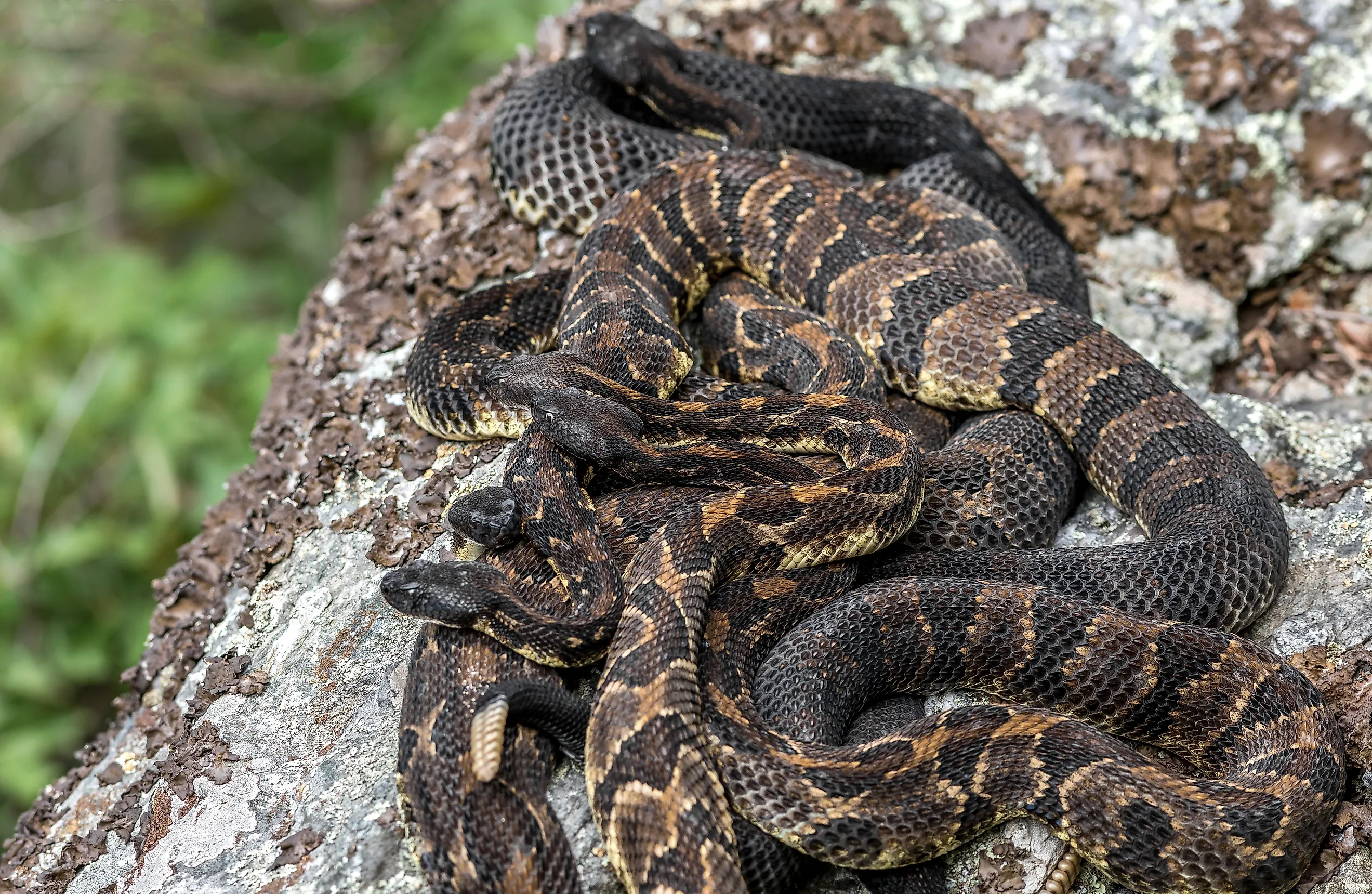
Great Smoky Mountains National Park is comprised of forested ridges between North Carolina and Tennessee. It is home to 23 different species of snake, including the timber rattlesnake (Crotalus horridus). Timber rattlesnakes are an upland species of rattlesnake, found at elevations of up to 6,000 feet. The northern copperhead (Agkistrodon contortrix) is the only other venomous snake in the park. Although it is found at lower altitudes than the timber rattlesnake, the two species are known to hibernate together.
Timber rattlesnakes often den in rocky areas. They are either in crevices at the bottom of cliffs or talus slopes below cliffs. Generally, den sites are situated on south- or west-facing slopes where temperatures are higher. Like other species of rattlesnakes, timber rattlesnakes exhibit high rates of den fidelity. Colonization of new dens is therefore a rarity. Pregnant females will give birth within the den or within 500 meters of the den, usually along rocky ridgelines.
Why Rattlesnakes Return to the Same Dens
Since rattlesnakes are ectothermic, their winter dens are not only essential for them surviving the winter, but also for the survival of their species, as the dens are used by generations of snakes. Rattlesnakes emerge from their dens to hunt and mate in the spring, then retreat back to them in fall to give birth and overwinter. Although the timing of this behavior varies depending on local environmental conditions, the cycle remains essential to their survival.