8 Prettiest Small Towns In Portugal
One house in Monsanto has a boulder for a roof. The whole boulder, as found. In Piódão, every door and window frame is painted the same blue because, the story goes, the village shop never stocked another color. In Óbidos you drink sour cherry liqueur out of a chocolate cup and then eat the cup. Portugal is a small country, and its small towns are where the fun is. These eight are the prettiest of the lot, and the roads between them are half the trip, with mountain roads through chestnut woods, flat plains all the way to the Spanish border and coast roads with the ocean on one side the whole way. Pack a swimsuit and an appetite.
Amarante

Start in Amarante with your elbows on the Ponte de São Gonçalo. The bridge has four balconies built into the deck and a stone obelisk at each end, and the Tâmega is right there under your feet, with balconied houses crowded along both banks. Next to the bridge is the Igreja e Convento de São Gonçalo, which took about 80 years to finish after work began in 1543. The upside of a slow build is one facade with Renaissance, Mannerist and Baroque work side by side, including the Varanda dos Reis and its four Portuguese kings in stone. The convent buildings also hold the Museu de Arte Moderna Amadeo de Souza-Cardoso, reopened in December 2025 with the country's main collection of the Amarante-born modernist.
Then eat. The convent sweets here are a reason to visit on their own. Foguetes, brisas do Tâmega, papos de anjo and lérias have been on sale at the Confeitaria da Ponte since 1930, and the river is right below the windows. Once you have walked that off, the Ecopista do Tâmega follows almost 40 kilometers of old railway line upriver toward Arco de Baúlhe, and behind town is the Serra do Marão, with hiking routes and big views back over the valley. Come on the first weekend of June and locals fill the streets for the Festas do Junho, with drum duels, folk groups and a procession to São Gonçalo.
Piódão

The people of Piódão picked one color and stuck with it. Their schist houses are stacked in tiers on a steep slope of the Serra do Açor, and from the road above you see the whole village at once, a grey curve of stone with blue paint on every door and window frame. The local explanation is that the village shop only ever stocked blue. The schist is dark and oddly luminous, on the walls, on the roofs and underfoot, and the white Igreja Matriz with its cylindrical buttresses is the one bright exception in the middle. Climb to the eira, the old threshing floor, for the view back over the roofs. Just below it are the Fonte dos Algares and the communal bread oven.
Ten minutes away at Foz d'Égua, two streams meet at a river beach. A suspension footbridge opened there in July 2025, 58 meters long and 20 meters above the water at its highest point, so bring your nerve. About 300 rock engravings survive in the valley around it, and nearby the Fraga da Pena waterfall drops 19 meters inside the protected landscape of the Serra do Açor. One note of caution. The fires of August 2025 reached this area and access has been under repair, so check before you set out.
Sortelha

Walk through the gate at Sortelha and the calendar flips back to the 1500s. Granite houses are built straight onto granite outcrops, the lanes go around the boulders rather than through them, and in the middle is a castle with a square keep. The walls and the keep have been a national monument since 1910, and the climb along them is the best seat in the house, roofs below and open country beyond. The real fun here is in the stone itself. At the foot of the keep, someone carved a nine men's morris board into the slab, and soldiers once killed time playing it there. Over the main gate are the royal arms of King Manuel I, armillary spheres and all. At the Porta Nova, the medieval standard measures are cut straight into the rock, a cubit at 67 centimeters and a pole at 110, so traders could settle an argument on the spot.
Outside the walls, two granite outcrops lean together lip to lip. That is the Beijo Eterno, the eternal kiss, complete with a legend about a Moorish man and a Christian girl. Every September the Sabugal council stages Muralhas com História inside the walls, a medieval weekend with a market, a military camp, falconry and tournaments on horseback. Yes, actual jousting.
Monsanto

In Monsanto the boulders got there first and the builders worked around them. Roofs rest on single slabs of rock, walls run straight into the outcrops, and one house has an entire boulder for a roof. The houses cover a hill in the Beira Baixa that tops out at 758 meters. The walk up to the castle is steep and worth every step. Visit Portugal calls the view from the top one of the most breathtaking in the region, and the Idanha plain spread out far below is the proof. Inside the castle walls are the ruins of the 12th century Capela de São Miguel and a scattering of rock cut graves. Back in the village, a replica of the silver cockerel Monsanto won in a 1938 national competition is mounted on top of the Torre de Lucano. Come in early May for the Festa da Divina Santa Cruz, when villagers sing and drum their way up to the castle and then throw clay pots down from the walls. Marafonas, the faceless rag dolls made here, hang from the towers for the festa, and drummers on the adufe, a square sheepskin drum, set the rhythm.
Óbidos

Óbidos is a white town wrapped in a full ring of medieval walls, and you can walk the whole ring. The circuit along the top is 1,565 meters with no railing, so mind your feet. From the southern stretch you look out over the plain to the arches of the Aqueduto da Usseira, built in the 1570s to bring water 6 kilometers to the fountain on Praça de Santa Maria. Inside, Rua Direita is the main street, from the Porta da Vila, whose inner walls are covered in baroque azulejo panels from the 1740s, all the way up to the castle. The houses along it are whitewashed with bands of blue and yellow painted around the doors and windows and along the base of the walls, and in summer the bougainvillea spills over all of it.
Now the important part. Ginja is the local sour cherry liqueur, made to a 17th century convent recipe and served in a small chocolate cup that you eat afterward. Off the main street, the Igreja de Santa Maria has 17th century tile panels and paintings by Josefa d'Óbidos, and near the castle, the Igreja de São Tiago is now a bookshop. Locals go all in on the seasons here, with an international chocolate festival each March and a Christmas village through the winter. Twenty minutes west is the Lagoa de Óbidos, the largest coastal lagoon system on the Portuguese coast at about 6.9 square kilometers, good for birdwatching and an afternoon on the water.
Azenhas do Mar

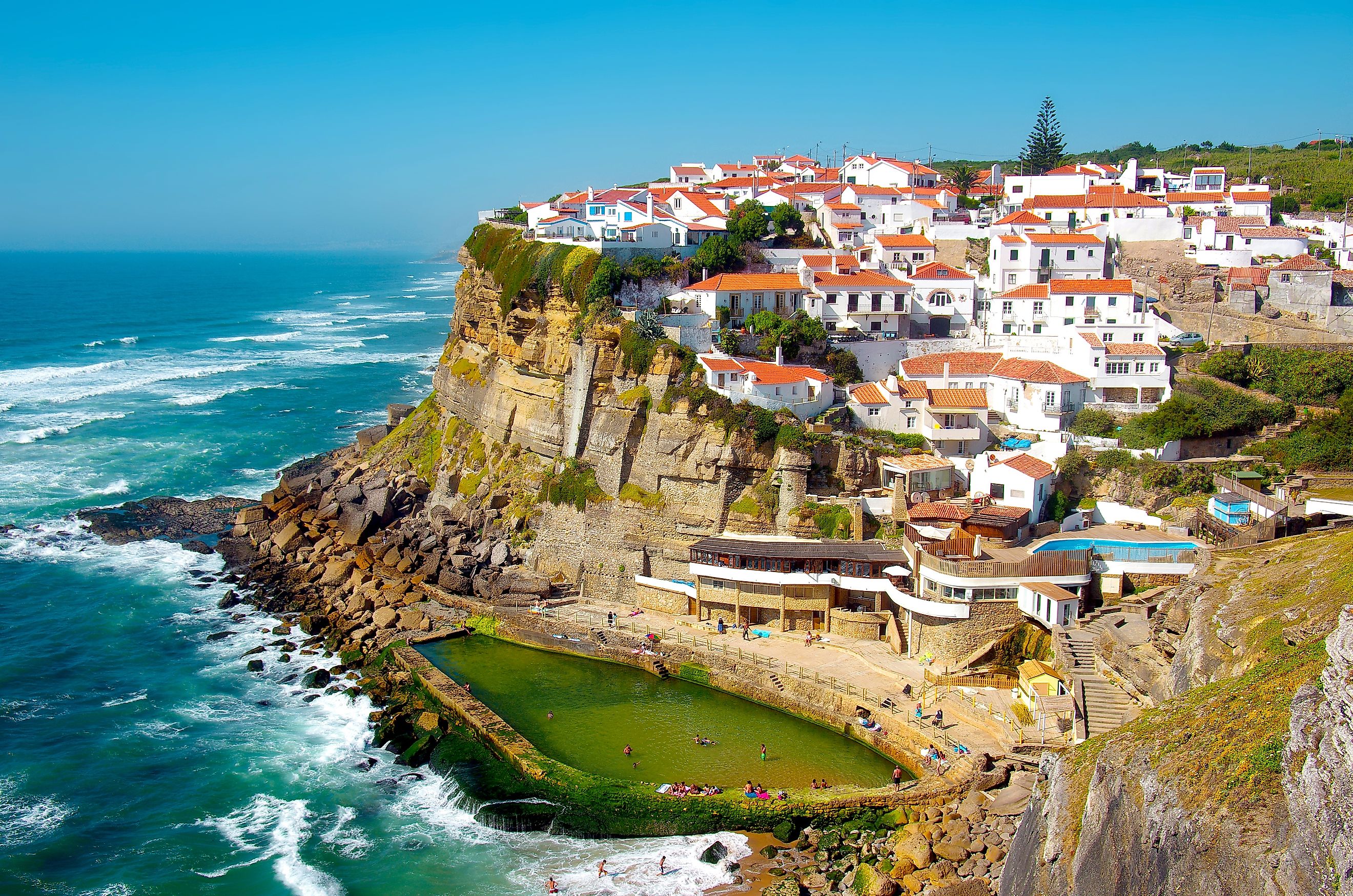
Azenhas do Mar is a stack of white houses with blue trim, built in tiers down the face of an Atlantic cliff, with an ocean pool cut into the rock at the bottom and open water beyond. For the full picture, go to the Miradouro das Azenhas do Mar and look down. Visit Sintra compares the village to a nativity scene set on a cliff, which is exactly right, and ranks it among the most beautiful places in Sintra. The name comes from the azenhas, the water mills that once turned here on streams off the Sintra hills. About that pool. Sintra council closed it in September 2025 for structural repairs, and it reopened in May 2026. It has been shut before, so check it is open before you pack a towel.
Most of this coast is inside the Sintra Cascais Natural Park, which is why the cliffs are still free of development, and the drive up the N247 from Praia das Maçãs is the approach to take. Praia das Maçãs itself, the next cove south, is a broad sandy bay at the mouth of a stream. The Sintra tram still comes down from the hills to meet it, about 45 minutes of single track through the woods. The line closes for maintenance for months at a time, so plan ahead.
Marvão

Marvão is 860 meters up on a quartzite crag in the Serra de São Mamede, and you get the whole idea from the switchback road before you arrive. The walls follow the ridge, granite houses fill whatever space is left inside them, and on three sides there is nothing but sky. From the castle walls, the Alentejo spreads out below in every direction, with the Spanish border about 13 kilometers away. Inside the castle, a vaulted cistern 6 meters long still collects rainwater through openings in its roof. The former church of Santa Maria is now the municipal museum, and in the lanes below it is granite houses and iron balconies full of flowers, one after another.
For a walk, the municipality's PR1 trail is a 7.7 kilometer loop from Portagem down in the valley, past a medieval road and poplars along the Sever River, then up through cork oaks and chestnut trees. Autumn is the season here. Chestnuts come in through November, when villagers throw the Feira da Castanha with roasted chestnut gatherings, brass bands and Cante Alentejano, and restaurants across the municipality put chestnut menus on for a fortnight. In late July, concerts fill the churches and the castle for the Festival Internacional de Música.
Monsaraz

Monsaraz is a small white village inside medieval walls on a hill above the Alqueva reservoir, with a castle at one end and a great deal of water below. The reservoir covers 250 square kilometers, is 83 kilometers long and has more than 1,100 kilometers of shoreline, and from the village walls you look straight out over it. Inside, everything is whitewash and schist paving, with the Igreja de Nossa Senhora da Lagoa in the middle, first built in the 13th century. The Museu do Fresco is in the old courthouse, where a 15th century fresco found under plaster in 1958 shows a good judge and a bad judge side by side. Pick your favorite. Then wait for dark, because the best part comes after sunset.
The village is inside the Dark Sky Alqueva reserve, staff at the observatory at Cumeada run night sessions, and the lake is dark enough that the Milky Way shows up in ordinary photographs. Boat trips leave from the lake, there is a municipal river beach below the village for swimming, and there are megaliths in the fields around, including the Cromeleque do Xerez and the Menir do Outeiro. Wine made around here goes to market under the local names, since Reguengos and Monsaraz are both protected Alentejo denominations.
Every one of these towns fits into a day on foot, and the setting is the whole point, a river under a balconied bridge, schist roofs on a mountainside, white walls above a lake, an Atlantic cliff with the ocean at the bottom. Distances are short and the roads are a pleasure, so two or three villages strung together make an easy weekend. Pick a few of the prettiest small towns in Portugal, put them on a map, and go find out which one you like best.