10 Safest Towns In Switzerland For Senior Living
Switzerland's high standard of living makes it an attractive retirement destination, but everyday safety and access to essential services can matter just as much as the scenery. In Zug, an obstacle-free walking route makes the historic center easier to navigate, while Mendrisio arranges regular check-ins for older residents living alone. Glarus offers the reassurance of a 24-hour hospital emergency department, and Altdorf provides dedicated senior programs through Pro Senectute Uri. These practical advantages can make a meaningful difference in maintaining independence as residents age. From lakeside communities to historic Alpine towns, these ten Swiss destinations combine healthcare access, senior support, and encouraging local or regional crime statistics to create appealing places to spend retirement.
Pully, Vaud

Along the shores of Lake Geneva, Pully provides a retirement setting where its approximately 19,500 inhabitants can revolve their day-to-day lives around a compact town center rather than needing long trips between isolated Alpine settlements. Residents can stroll along the waterfront, visit Pully-Plage to enjoy lakeside recreation, or explore the historic town center, the Pully Museum, and nearby vineyards for deeper insight into local lore. The municipality's railway connections link it to the wide Lake Geneva region, including Lausanne, Vevey, and Geneva, all of which make it extensively easier for elderly residents to reach services beyond their immediate locality as needed.
Maison de santé Pully Hospital offers general medical consultations, urgent outpatient care, and chronic-condition management, adding an integral layer of reassurance for any resident who must prioritize convenient access to healthcare. As of 2025, Pully recorded roughly 59.5 offenses per 1,000 residents under the Swiss Criminal Code, a figure lower than the national rate despite its location directly adjacent to the major urban center of Lausanne. Violent crime remains exceedingly rare, while local foot patrols, well-lit pathways, and low speed limits all help create a safe environment that older adults can navigate with confidence and peace of mind.
Altdorf, Uri

Uri's crime statistics provide Altdorf with a strong starting point for senior living. Recent records list 25.8 offenses per 1,000 residents, including just 2.15 violent offenses, both of which are among the lowest rates in Switzerland. Although these figures reflect the broader area of Uri rather than the town of Altdorf alone, they provide an encouraging context for a settlement of roughly 10,600 people, where daily life can orbit a familiar center rather than requiring lengthy trips between distant townships. The historic heart, marked by the Tell Monument, is centered on shops and cafes where locals can run routine errands and enjoy leisurely outings, with the Uri Museum offering exhibits that let visitors learn more about the region's past. A short excursion toward the Reuss offers a change of scenery, with route conditions accessible for visitors with limited mobility.
Healthcare is available at Kantonsspital Uri, which administers hospital and emergency services for the locale, as well as Pro Senectute Uri, which renders advice, activities, movement programs, and social meals to older adults to help them manage everyday needs while still maintaining a connection with the community. Altdorf's appeal, then, hinges on more than a favourable regional crime statistics. Its localized health care systems and established support for older residents allow seniors to preserve independence while still having support built into their routines.
Scuol, Graubünden

In Scuol, safety is just as dependent on how the community organizes its healthcare as it is on the reported crime record across the surrounding region. Inhabited by about 4,600 residents scattered throughout several villages in the Lower Engadine, the locality benefits from a coordinated regional network through the Center da sandà Engiadina Bassa, which combines hospital care, outpatient nursing, long-term support, and rescue services. Its emergency arrangements are operational year-round and organized with ambulances and helicopter rescue services as needed, a crucial necessity given the settlement's proximity to mountain roads, winter weather, and the fact that distance in these areas can often complicate medical access. Seniors can then enjoy the locale's mountain views and idyllic scenery without worrying about potentially lacking access to health and emergency services if and when needed. The town recorded approximately 50 offenses per 1,000 residents, including 3 violent offenses and 3 burglaries, all of which can be attributed to the correspondence between its reputable emergency services and police system, showcasing how this local care network has been an integral part of the town's overall safety.
Zug, Zug

A town is easier to grow old in when its streetscape leaves room for an unhurried pace and its public spaces are inclusive of different levels of mobility. Zug has implemented practical steps toward that goal for its 32,160 residents, including an obstacle-free guided tour of its heritage core, developed in collaboration with accessibility specialists. The 90-minute route avoids curbs and stairs, includes an accessible toilet and rest areas, and connects to an accessible bus stop. Some sections are cobbled, so the route may pose challenges for those with certain mobility limitations, but its provisions showcase the municipality's clear intent for its local attractions and infrastructure. Beyond the tour, the Zytturm presents an eye-catching landmark to admire from street level, while the Museum Burg Zug gives visitors an introduction to the region's past.
Zug also provides aid to older residents through its municipal Age and Health competence office, which helps them navigate services related to healthcare, medical arrangements, housing, and finances. The city also has senior apartments at three locations and means to identify accessible housing in a way that prioritizes an age-friendly housing strategy, all of which can help residents stay connected to assistance if circumstances change over time. Zuger Kantonsspital is located about 5-10 minutes by train or car from the town's center in the neighboring town of Baar, and the wider canton reported roughly 43 criminal offenses, with 3 burglaries and 4 violent offenses per 1,000 residents. The municipality's attractiveness for seniors ultimately stems from the thoughtful details that make self-reliance more achievable. In this town beside the water, where history converges with intentional city design, growing older does not mean surrendering the freedom to lead an active lifestyle.
Appenzell, Appenzell Innerrhoden

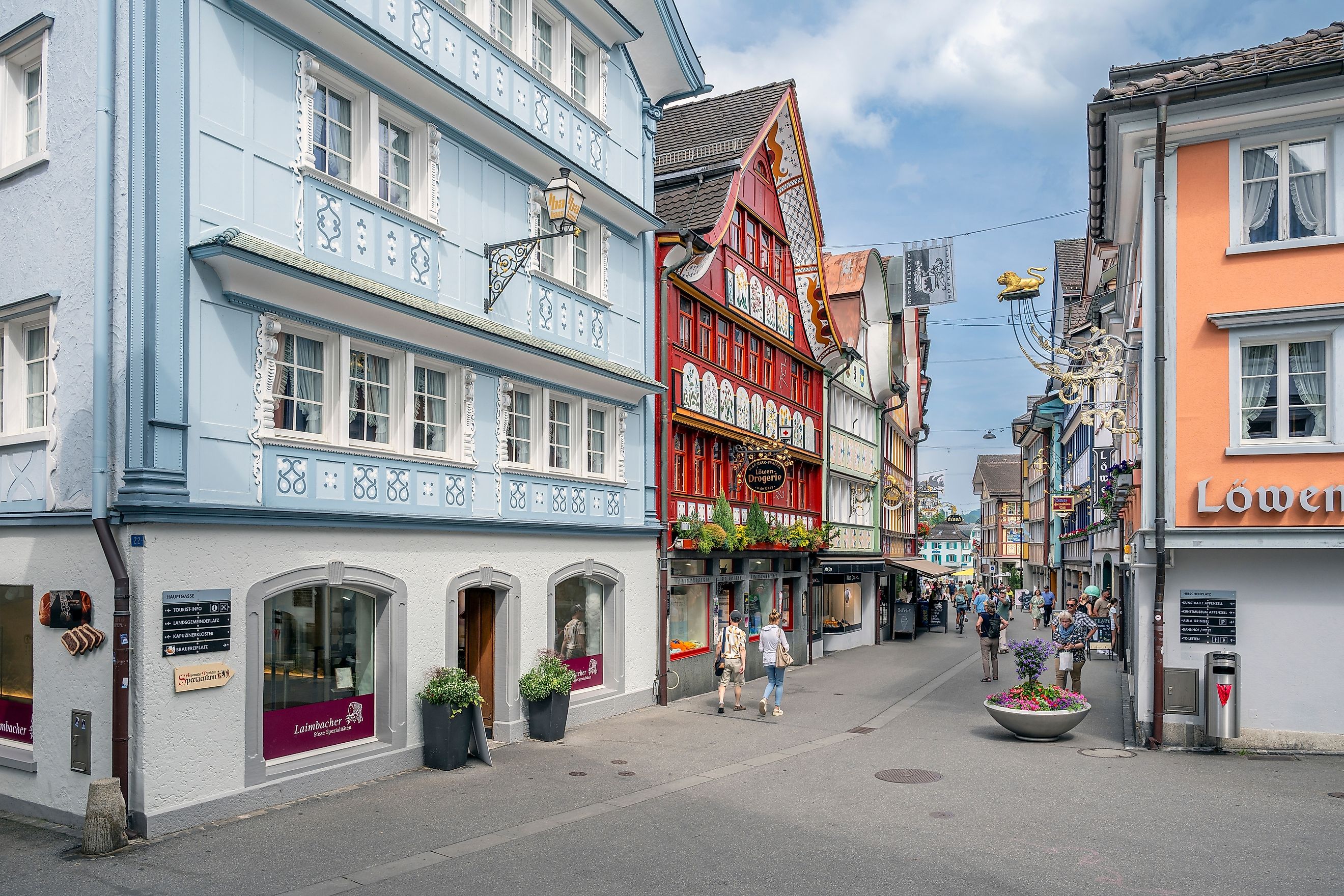
There are some places that preserve their historical character through the tiniest details, like the painted facades lining Hauptgasse and the rhythm of village life unfolding in local shops and cafes. For Appenzell, these details contribute to a sense of continuity in everyday routines, an attractive prospect especially for older adults who want their retirement years to include independence and social integration into a greater community. Museum Appenzell offers the opportunity to discover regional history and traditions, while local craft shops and cheese outlets provide laid-back retreats in the village center.
Healthcare arrangements only add to the town's layers of well-being infrastructure, with the Kantonales Gesundheitszentrum Appenzell maintaining an ambulance base and offering after-hours care for urgent medical needs through its Medizinische Erstanlaufstelle (initial points of medical care, or MEAS) service. Its canton also boasts a favourable crime profile with about 3 violent offenses per 1,000 residents, making the town of about 6,200 residents appear fairly peaceful. As the years pass, the meaning of home can often gather around places that remain constant and the neighbors who make a typical day feel shared. Appenzell affords older residents the chance to preserve that sense of belonging, with living customs woven into routines and essential support always within reach.
Glarus, Glarus

For seniors particularly concerned about property crime, Glarus paints an encouraging regional portrait, alongside having the reassurance of emergency medical care close at hand. The canton recorded roughly 2 burglaries per 1,000 residents, half of Switzerland's modest national average rate of about 4, and an impressive figure for a population of around 13,000. Kantonsspital Glarus strengthens the town's senior-friendly environment by operating a 24/7 emergency department year-round. Beyond its essential services, the town's main hub provides a place to maintain an active routine without necessitating any major excursions. Seniors can browse the Kunsthaus Glarus to explore contemporary Swiss art within a dedicated exhibition space, browse the public library for community activities, or take a restful break in the conveniently located public garden, Volksgarten. The traditional Landsgemeinde ambiance imparts an extra layer to the locale, offering visitors insight into Glarus' time-honored custom of civic assembly and direct democracy. Glarus consequently combines a positive regional profile of property crime with direct access to emergency care and accessible sociocultural spaces, helping senior residents maintain autonomy while keeping vital services and avenues for social involvement within reach.
Murten, Fribourg

The idyllic lakeside town of Murten has lived between two tongues for centuries. Known as Morat to French speakers, this municipality's principal language was once French, but by the late seventeenth century, German prevailed. Today, both names remain integral parts of the city's identity, reflecting a settlement shaped by the meeting of two cultures with no clean divide between them. This sense of continuity carries into its medieval district, where arcades shelter local shops and fortified walls preserve traces of historic conflicts. The Museum Murten is located in a former mill right beside these old defenses, and beyond the old streets, a lakeside promenade gives way to quieter outings with benches and a relatively flat path.
HFR Meyriez-Murten offers the practical advantage of accessible Medicare, providing walk-in treatment for conditions that need prompt attention with or without an appointment, and a medical team that serves patients in German and French as needed. Although these services operate only during an established daily schedule, serious emergencies can be handled by the regional ambulance services available throughout the canton. The broader regional crime picture is encouraging, recording roughly 46 criminal offenses and fewer than 3 burglaries per 1,000 residents. Murten itself has about 9,500 inhabitants, offering a living environment where history remains seamlessly woven into daily life. Here, a sense of home can emerge from experiencing a place that has endured, cultures that can coexist, and above all, the reassurance of knowing there is somewhere to turn when help is needed.
Aarau, Aargau

Aarau is a unique retirement setting compared to Switzerland's smaller Alpine communities, offering the cultural variety of a regional capital and a thoroughly developed network of emergency and healthcare services. The city has approximately 22,900 residents, and its surrounding canton recorded roughly 47 criminal offenses per 1,000 residents, with violent crime and burglary figures all falling below their corresponding national rates. Kantonsspital Aarau operates an emergency center around the clock, and a 24-hour emergency coordination service organizes any subsequent rescue responses. Beyond its healthcare infrastructure, Aarau provides retirees with multiple ways to spend their time locally, whether that looks like a leisurely walk through the old town, an indoor exploration of the region's natural history at Naturama Aargau, or a general exploration of regional lore at the Stadtmuseum Aarau. The Aare riverside offers a change in pace, with paths available for those with limited mobility. Pro Senectute Aargau delivers additional support to older residents through organized exercise and movement classes that encourage proactive wellness and social interaction. For seniors who value the convenience of a highly connected metropolitan area, Aarau integrates medical care, cultural attractions, and structured activities into the same day-to-day landscape, offering practical ways to remain active and access support as needs evolve with age.
Monthey, Valais

A community reveals its character not just through the places that people gather, but in the care available when daily life encounters problems. In Monthey, this support takes shape through a web designed to help older residents stay socially connected and access support as their needs change, without having to move out of their homes and into care facilities. Bureau Régional d'Information et de Coordination Seniors (BRIC) provides free, confidential advice on retirement, finances, housing, care, and mobility, while Centre médico-social (CMS) Bas Valais coordinates practical assistance, meal delivery, and home nursing. These resources offer elderly residents a wide range of options for managing post-retirement life without becoming isolated from the community. Outside of healthcare, Monthey's old town centre houses local shops and stands as an easy starting point for a town outing, while Parc du Crochetan presents a nearby green space to spend a quiet afternoon, and Monthey's Carnival brings a livelier atmosphere to the locale in February for those who enjoy its crowds and celebration. In 2025, the town recorded 824 criminal offenses, equivalent to roughly 43 per 1,000 residents. With approximately 19,350 inhabitants, Monthey has comparatively low crime rates and substantial senior support. It is a town where getting older does not mean stepping aside but instead encourages the elderly to put down roots in the landscape and the community that shapes it.
Mendrisio, Ticino

Mendrisio looks after its elderly residents in ways that extend beyond routine medical care and even a responsive emergency support system. Since 1990, the town has operated Servizio Anziani Soli, a service for seniors who live alone that provides regular courtesy visits from assistants or police officers after an initial assessment and offers direct connections to municipal social services. Its aim is to prevent senior isolation, taking a personal approach that is well integrated into the town's overall safety strategy. Hospital care is also available at Ospedale Regionale di Mendrisio Beata Vergine, which provides specialist care and emergency treatment for elderly patients. Day-to-day life brings unique opportunities for connection, with ongoing activities like the Wednesday Market, where local produce and homemade goods attract residents to the town center. The Museo d'arte Mendrisio houses exhibitions containing modern and historical artistry, while Galleria Baumgartner showcases a collection of model trains and railway displays. The population stands at roughly 15,000 residents, with crime statistics reporting about 60 criminal offenses per 1,000 residents, a figure indicative of an active, urbanized border region that remains well supported by robust municipal services. Between quiet galleries, lively market squares, and an ever-present safety net, this town delicately balances the vibrancy of a bustling urban hub with the reassuring comfort of enduring social and medical care.
Final Thoughts
Across these distinct Swiss communities, a fulfilling retirement is primarily defined by the strength of the surroundings that sustain it. Whether set beside placid waters or scattered through mountain villages and historic streets, each town demonstrates that quality of life and well-being require balancing responsive care, active community ties, and uncompromising safety infrastructure. Beyond their striking landscapes, these municipalities illustrate how aging can remain a journey of freedom and connection if the location where it takes place is secure and proactive enough to be intentional about providing for it.