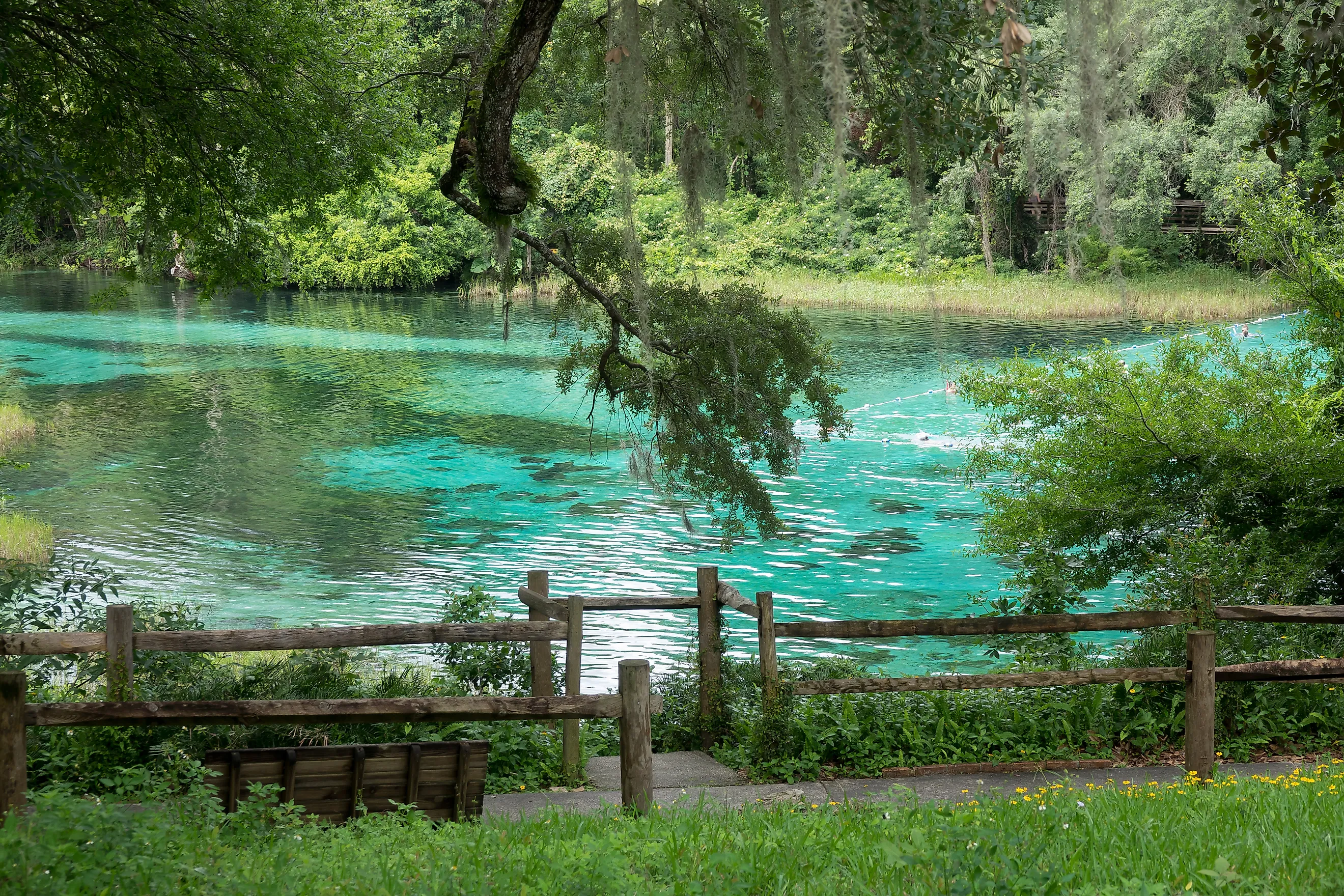
The Clearest Spring In America
Underwater visibility at Rainbow Springs near Dunnellon, Florida, can exceed 250 feet, almost the length of a football field. Clarity like that has drawn sightseers for generations. In the 1930s, passengers rode in boats with underwater viewing compartments, watching fish swim past without getting wet. Today, swimmers can still see the sandy bottom and aquatic plants far below the surface. Yet the reason for this exceptional visibility begins miles away, where rainwater seeps into the ground and travels through limestone before emerging at the springs. Despite its remarkable clarity, the water carries pollutants that no one can see.
How Limestone Keeps Rainbow Springs Clear

That clarity begins with the Floridan Aquifer, a vast underground system of porous limestone that stores and carries groundwater beneath a large part of Florida. Rainwater falling across a 770-square-mile area soaks into the ground and passes through layers of soil and rock before reaching the aquifer. Along the way, sediment gets filtered out. The groundwater then moves through cracks and underground channels in the limestone until it rises to the surface through openings at Rainbow Springs.
The limestone beneath Rainbow Springs is why Florida has so many sinkholes. Slightly acidic rainwater slowly dissolves the rock, creating underground passages and cavities. Sometimes the ground above these cavities collapses, leaving a sinkhole. The same process helps create the underground channels that carry water to the springs.
Unlike a river that picks up mud and sediment as it flows across the land, the water at Rainbow Springs has already been filtered underground. With so few particles floating in it, light can travel through the water without being scattered as much. Sunlight reaches the sandy bottom, making it easy to see aquatic plants and fish swimming below.
Rainbow Springs has the fourth-highest spring flow in Florida as well, according to Florida State Parks. An average of nearly 500 million gallons of water flows from the springs each day, feeding the Rainbow River.
A Long History Of Clear Water

Rainbow Springs has attracted people for thousands of years, long before Florida built its first roadside attractions. Archaeologists have found stone tools indicating that Native Americans visited the Rainbow Springs area more than 10,000 years ago, along with pottery and other artifacts left by later generations.
Developers turned Rainbow Springs into a commercial attraction in the 1930s. One of its more unusual features was a fleet of submarine boats. These boats did not dive underwater. Instead, passengers climbed down into compartments about five feet below the waterline, where windows gave them a fish's-eye view of the spring basin without getting wet. Glass-bottom boats offered another way to view the underwater scenery.
The attraction featured landscaped gardens, artificial waterfalls, and wildlife exhibits. It closed in the 1970s, and Florida acquired the property in 1990, eventually reopening it as Rainbow Springs State Park.
The water may not have stayed equally clear over the years. Rainfall, groundwater conditions, and algae growth can all affect visibility. Historical accounts show that Rainbow Springs has been famous for its clear water for generations, but there are no consistent measurements showing exactly how its clarity has changed.
A Pollution Problem Hidden In Clear Water

The water may look pristine, but its transparency hides a serious pollution problem. According to the Florida Springs Council, nitrate levels have reached seven times the state's water quality limit. Nitrates dissolve in water, so they do not make it cloudy. Too many nutrients can encourage algae growth, and the algae can cover aquatic plants and disrupt the habitat that fish and other animals depend on. The council reports that the Rainbow River's flow has declined about 25% since the 1960s as well.
A lot of the contamination comes from outside Rainbow Springs State Park. Agriculture, septic systems, and lawn fertilizers all contribute nitrogen that can seep into groundwater. According to a 2024 Florida Springs Council analysis, agriculture accounts for a little over 35% of the nitrogen entering the spring system, and septic systems contribute about 30%. Once these pollutants enter the aquifer, they can travel underground and eventually emerge at the springs.
Florida lists Rainbow Springs and the Rainbow River as impaired waters, meaning they do not meet certain water quality standards. The state has a plan to reduce nitrogen pollution, including improvements to wastewater treatment and septic systems. Protecting Rainbow Springs requires addressing what happens on farms, lawns, and properties miles away from the water.
Rainbow Springs Today

Rainbow Springs is open to the public as part of Rainbow Springs State Park, and swimming is one way to experience the clear water. The temperature stays around 72°F throughout the year. The designated swimming area at the headsprings is 10 to 18 feet deep, and the bottom looks much closer than it is. Snorkelers can watch turtles and fish moving through thick beds of underwater grass that provide food and shelter for the animals living in the springs.
The water emerging at Rainbow Springs forms the Rainbow River, a stream that flows about 6 miles before joining the Withlacoochee River. From a kayak or canoe, people can see submerged plants and fish from the surface, and tubing is popular as well. The river has rules to protect its clear water and aquatic habitat, including a ban on disposable food and drink containers.
The Clarity Worth Protecting

For nearly a century, people have come to Rainbow Springs to see what is usually hidden underwater. The submarine boats are gone, but swimmers and snorkelers can still watch fish and turtles moving through the clear spring water. How clear that view remains in the future depends partly on what happens miles away from the park, where rainwater enters the ground and eventually makes its way to the springs. Rainbow Springs is famous for what people can see, but its future depends on what they cannot.