Why The Atlantic Ocean Is Getting Wider
The Atlantic Ocean separating the United States from Europe is growing wider, although this change is too small for anyone standing on the East Coast to notice. Thousands of feet underneath the water's surface, tectonic plates are steadily pulling away from each other along a vast underwater mountain range.
According to the National Oceanic and Atmospheric Administration (NOAA), the Mid-Atlantic Ridge expands about 0.8 to 2 inches yearly. The movement is slow, but it has altered Earth's geography over millions of years. Scientists have established how new seafloor emerges and are still investigating the forces deep within the planet that help drive the process.
Plate Tectonics Are Pulling the Atlantic Apart

The Atlantic Ocean is becoming wider due to plate tectonics, the constant movement of the huge slabs of rock that form Earth's rigid outer layer. These slabs, known as tectonic plates, contain the crust and the uppermost portion of the mantle. They move gradually over deeper mantle material that, despite being solid, can deform and flow over geological timescales.
The North American and Eurasian plates are separating from each other in the northern Atlantic, and the South American and African plates are moving apart farther south. The movement happens along a divergent plate boundary, where neighboring plates gradually move away from each other.
The continents are not sliding across an unmoving ocean floor. North America and Europe move with their respective tectonic plates. Scientists attribute plate movement to multiple interacting forces, including the gravitational pull of sinking sections of tectonic plates and processes inside Earth's mantle.
The Mid-Atlantic Ridge Is Creating New Ocean Floor

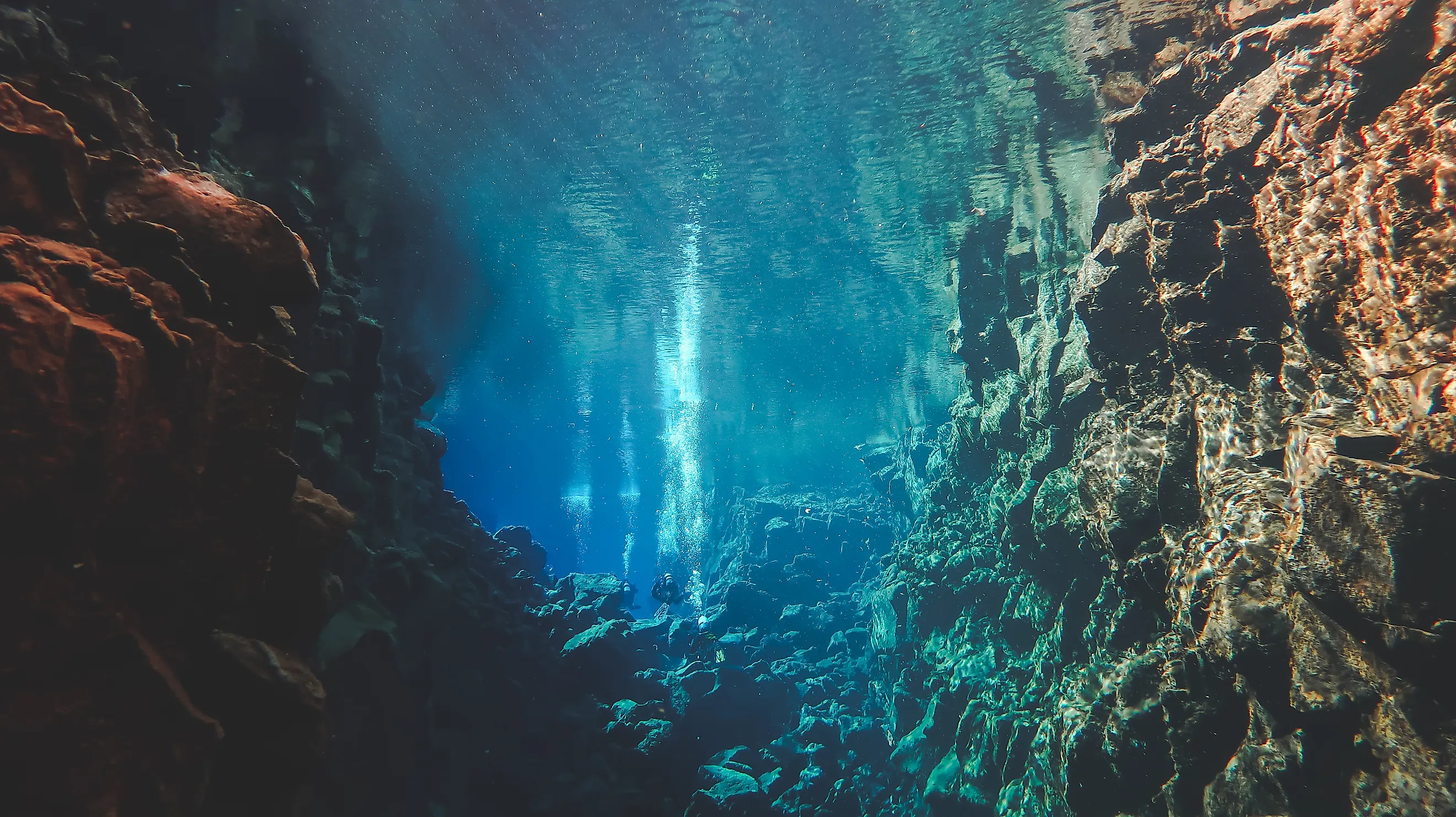
The geological activity mainly responsible for the Atlantic's ongoing expansion takes place along the Mid-Atlantic Ridge, an underwater mountain range extending through most of the ocean. According to NOAA, the ridge forms part of a worldwide mountain system underneath Earth's oceans. Its steep slopes, volcanic formations, and central rift valley demonstrate an active spreading boundary.
The ridge's central valley is comparable in depth and width to the Grand Canyon. Unlike the Grand Canyon, the Mid-Atlantic Ridge largely lies underwater, far from the view of people traveling across the Atlantic.
The formation of new ocean floor happens through a process referred to as seafloor spreading. As neighboring tectonic plates move away from each other, hot mantle material rises beneath the ridge. A reduction in pressure allows some of the rock to melt, creating magma. The magma can then rise through openings in the crust and erupt onto the ocean floor. When the molten rock cools, it forms solid volcanic rock, mainly basalt. Continuous plate movement carries older crust away from the ridge as new crust forms at the spreading boundary.
The outcome is a gradual expansion of the ocean basin. Even though new crust is produced along the ridge, Earth does not grow larger because older oceanic crust is recycled into the mantle at other plate boundaries.
The Atlantic Widens About As Fast As Fingernails Grow
The Atlantic Ocean's expansion is far from a quick process and becomes noticeable when measured across vast periods of time. The precise speed differs along the mountain range because tectonic plates move at various rates.
The US Geological Survey (USGS) compares the movement of tectonic plates to how fast human fingernails grow. One or two inches looks tiny next to the Atlantic's width, but the distance adds up over millions of years. At a constant rate of one inch per year, separation would total almost 16 miles in a million years. This illustrates the effects of geological time rather than predicting a fixed future rate.
The Atlantic's Beginnings Are Visible on the East Coast

The ocean began opening about 200 million years ago as the supercontinent Pangaea broke apart. North America gradually separated from Europe and Africa, making space for a widening Atlantic basin.
Evidence of those early changes survives near New York City. The New Jersey Palisades, towering above the Hudson River, formed when magma pushed between older rock layers and hardened underground. Erosion later exposed the cliffs. According to the US Geological Survey, this activity occurred during Pangaea's breakup. The Palisades are evidence of the Atlantic's beginnings, not a part of today's Mid-Atlantic Ridge.
How Scientists Know the Seafloor Is Spreading

The shape of the seafloor helped change scientists' understanding of Earth. During the 1950s, American cartographer Marie Tharp analyzed measurements taken by research ships and mapped a vast ridge and central valley underneath the Atlantic.
Researchers then discovered matching magnetic stripes in rocks on either side of underwater spreading ridges. When lava cools, minerals preserve the direction of Earth's magnetic field, a field that has reversed repeatedly over time. The matching patterns show that new rock forms near the ridge and travels outward.
Scientists find younger crust near spreading centers and older crust farther away. Present-day satellite-based GPS measurements provide an additional way to track tectonic movement.
What Researchers Found Deep Beneath the Ocean

University of Southampton researchers reported evidence of unexpectedly deep mantle upwelling underneath the Mid-Atlantic Ridge in 2021. The team placed 39 seismometers on the seafloor to record earthquake waves passing through Earth's interior.
Their findings suggested that material could be rising from more than 370 miles below the surface, possibly helping separate the plates. The study did not establish that deep mantle upwelling is the only force responsible for expanding the Atlantic.
Scientists can observe signs of plate movement above ground as well, allowing them to compare processes deep beneath the ocean with changes visible on land.
Iceland Reveals Plate Movement Above Water

Parts of the Mid-Atlantic spreading system reach land in Iceland. A 2026 study of the Reykjanes Peninsula reported almost 13 feet of local extension across 14 rifting episodes between 2021 and 2025. These measurements describe a particular region, not the amount the entire Atlantic widened.
Earthquakes, ground fractures, and volcanic activity there demonstrate how plate movement can sometimes occur in noticeable bursts. Iceland provides a visible example of the geological activity that mostly takes place beneath the Atlantic.
An Ocean That Is Still Changing
For Americans living along the East Coast, the expansion is undetectable from year to year. Yet far offshore, new oceanic crust continues to form along the Mid-Atlantic Ridge, gradually increasing the distance between North America and Europe. The Atlantic is getting wider because this spreading process has continued over millions of years. The rate may change in the future, but the ocean's present growth shows that the continents on either side are still slowly moving apart.