Lake Powell and Lake Mead See Dramatic Rebound After Floods
Lake Powell has risen about 22 feet since late September, reaching 3,539.48 feet on November 11 after setting a record low of 3,517.24. Lake Mead, 300 river miles downstream, has risen 2.7 feet over the same period. Both reservoirs set record lows in October and both are now climbing, but the gap between those two figures is the whole story. The rain helped enormously in one place and barely at all in the other, and neither gain is the kind that lasts. That depends on snow.
The Numbers As Of This Week

Both reservoirs are rising from record lows set within the last six weeks.
Lake Powell stood at 3,539.48 feet on November 11, holding 6,416,244 acre-feet, around 26 percent of capacity. That is 22 feet above its late-September record low and 21.4 feet up since the water year began on October 1.
Lake Mead read 1,039.86 feet on November 9, about 26.6 percent full. Its record low of 1,037.16 feet was set on October 22, barely three weeks ago.
Powell Gained Eight Feet For Every One At Mead
The asymmetry in those two rises is not a measurement quirk. It is deliberate.
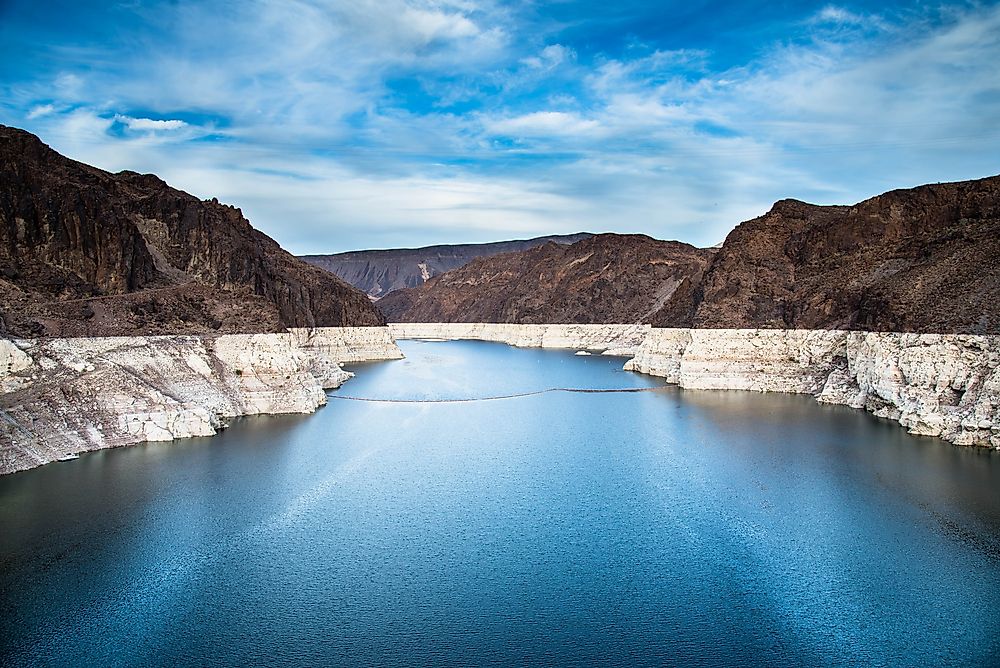
Powell is up 22.2 feet from its low and Mead is up 2.7, a ratio of better than eight to one. The storms fell on the Upper Basin, which drains to Powell, and Reclamation has been holding that water rather than releasing it downstream.
Glen Canyon outflow sat steady around 6,600 cubic feet per second throughout the event while inflow spiked past 50,000. Everything above the release rate stayed in the reservoir.
The Inflow Has Already Collapsed

This is the part that separates a flood pulse from a recovery, and it has taken a week.
Inflow to Lake Powell peaked at 53,324 cubic feet per second on November 4. By November 7 it was 22,209. By November 11 it was 13,097. That is a 75 percent decline in seven days.
Rain arrives and leaves. The reservoir caught what it could while the water was moving, and the window has essentially closed.
It Crossed Back Over A Threshold That Matters

The rise did achieve something concrete in operational terms.
Powell climbed back above 3,525 feet, the boundary of Reclamation's Upper Elevation Balancing Tier, which restores some flexibility in how much water can be sent downstream. It now sits roughly 49 feet above minimum power pool at 3,490.
Before the storms that margin was under 30 feet. Hydropower generation at Glen Canyon is considerably less precarious this month than it was in September.
Both Are Still Down On The Year
The twelve-month comparison is the one that puts the rebound in proportion.
Despite gaining 22 feet in six weeks, Lake Powell is still 5.12 feet lower than it was a year ago. Lake Mead is 17.88 feet lower than a year ago.
The autumn rain has recovered part of one year's decline at one reservoir. It has not touched the structural deficit underneath either of them.
Powell Is 160 Feet From Full

Scale matters here, because 22 feet sounds transformative until it is set against the whole.
Full pool at Lake Powell is 3,700 feet, so the reservoir remains 160.5 feet below it. Lake Mead's full pool is 1,229, leaving it 189 feet short.
At 26 percent of capacity each, both reservoirs are approximately three-quarters empty after the best autumn inflow in decades.
Snowpack Is What Actually Refills Them

Everything above explains why the coming winter matters far more than the past month.
Rain runs off within hours, passes a basin and is gone unless a reservoir happens to be downstream to catch it. Snow accumulates from late autumn, peaks in April, then releases over weeks and months. It is a storage system nobody had to build, and the entire water infrastructure of the West is designed around its schedule.
Colorado's own climate assessment states it directly: precipitation that falls and is stored as snow is more likely to end up as runoff than precipitation that falls as rain. Same water, different delivery, different outcome.
Last Winter Showed What Failure Looks Like
The reason both reservoirs reached record lows in October is the winter that preceded it.
Snow water equivalent across the Upper Colorado Basin reached only 62 percent of normal. Utah and Colorado both recorded their lowest snowpacks on record at 57 and 59 percent, and the runoff forecast for Lake Powell came in at 36 percent of average.
An autumn of rain cannot substitute for that. It can only soften the landing.
The Soil Takes Its Share First

There is one way the recent rain genuinely helps the spring, and it is indirect.
Dry soils absorb snowmelt before it reaches a stream, which is why the Upper Basin had near-normal snowpack in 2025 and a runoff forecast of only 67 percent of average. Denver Water describes it as nature getting first claim on the water.
Wet autumn ground means less of next spring's melt disappears into the dirt. That is the lasting contribution of these storms, and it will not show up in a reservoir reading until May.
The Short Version

Lake Powell is at 3,539.48 feet and Lake Mead at 1,039.86, both climbing from record lows set in the past six weeks, both around 26 percent full, and both still lower than they were a year ago. Powell took 22 feet of the gain and Mead 2.7, because the rain fell upstream and Reclamation is holding it there.
Inflows have already fallen 75 percent from their peak. The rebound is real, it bought Glen Canyon about 20 feet of hydropower margin, and it is not a recovery. That requires a winter where the precipitation arrives as snow, stays on the mountain until spring, and finds soil wet enough to let it through.