What Happens If Lake Okeechobee’s Dike Fails
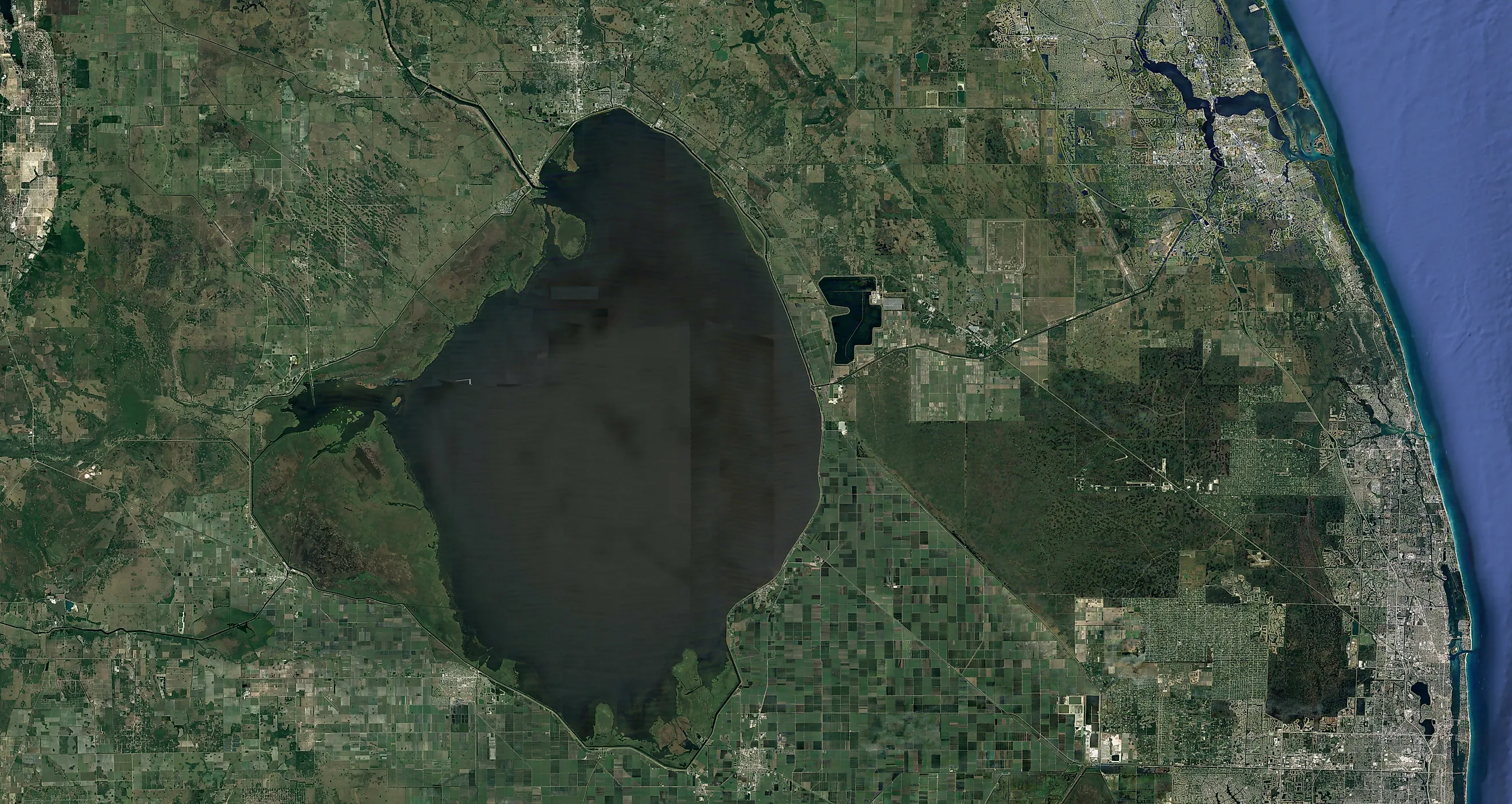
Lake Okeechobee feels more like a giant swimming pool, where the water never reaches more than 13 feet in depth. Yet this swimming pool can quickly turn into a major hazard when hurricanes or heavy rainfall overwhelm it, causing it to flow outward into residential areas and the Everglades. In order to keep the lake under control, the US Army Corps of Engineers has it surrounded by an earthen dike. But if this dike were to fail, a flood from Lake Okeechobee has the potential to kill thousands of people and cause vast amounts of damage.
However, Lake Okeechobee was not always so prone to flooding, and the history of why it became so has everything to do with a Floridian effort to drain the Everglades.
Why is Lake Okeechobee so prone to flooding?

Lake Okeechobee is a large lake, at 730 square miles. In fact, the name itself means Big Water. It is a relatively young feature, geologically speaking, as the lake formed about 6,000 years ago, when rainfall filled a shallow depression in old seafloor.
At first, this depression was largely saline, but gradually became a freshwater lake due to rainfall. During wet seasons, the lake's wetland zone would bulge and expand towards the Everglades. This created a natural ecosystem and flow of water. However, in the late 19th century, Florida made a significant decision to reshape the lake and drain the Everglades.
First, industrialist Hamilton Disston built a canal connected to Lake Okeechobee, the Caloosahatchee’s headwater, to the river in the 1880s. In the following decades, the Everglades Drainage District built a series of canals to move water away from Lake Okeechobee and drain the northern section of the Everglades. To prevent flooding, a small levee built of sand and muck was established at the southern end of the lake.
What these efforts did was cause water to pool at the southern end of the lake alongside the dike, rather than flowing out to wetlands. This created the perfect conditions for a disaster, which occurred in 1928.
A dike failure would look a lot like 1928

In order to figure out what would happen if the dike failed, we need only look back to a time when Lake Okeechobee's dike did fail: during the hurricane of 1928. This Category 4 hurricane formed off Africa, crossed through the Atlantic, striking the Virgin Islands and Puerto Rico, killing more than 300 people in Puerto Rico alone.
On September 16, 1928, the hurricane struck Palm Beach and moved upward towards Lake Okeechobee. The rain combined with the winds caused waves to concentrate on the southern end of the lake, which overwhelmed the former dike and caused the waters to flood downward, killing many migrant workers.
The water flowed out at least 75 miles away from its shoreline, spreading several feet of water over the land. This event caused a massive loss of life, with some estimates putting it at more than 2,500 deaths due to drowning.
The 30-year Herbert Hoover Dike project

To prevent such a devastating flood from happening again, the US Army Corps of Engineers was sent in to build a more expansive dike that could control water levels. They were authorized by the Rivers and Harbors Act of 1930. Signed by President Herbert Hoover, it aimed to build a series of canals and waterways for flood prevention and commerce, with the aim of constructing 12,000 miles of waterways.
For Lake Okeechobee specifically, the Army Corps of Engineers was tasked with building 57.8 miles of levee on the south shore, where the hurricane had struck, and 15.7 miles on the north shore. This initial construction was done during the Great Depression from 1932 to 1938, and was designed to handle crest heights of up to 35 feet.
However, this dike would experience its first test in 1947 when another hurricane slammed into southern Florida, causing millions of dollars in damage and putting the lands south of Lake Okeechobee under several feet of water. The dike did not break, but the devastation around the lake prompted additional federal spending, via the Flood Control Act of 1948.
Furthermore, Congress authorized the Central and Southern Florida Project for Flood Control and Other Purposes, providing funding for more than 1,000 miles of water control systems, including levees and canals. Part of the project included an expansion of the Lake Okeechobee dike, raising the levees to a crest of 41+ feet, which was completed in 1960.
What if this dike failed?

This dike was a big improvement over the makeshift muck dike from the early 20th century, but it was not without weaknesses. For example, an investigation in the 1990s found that there were key issues with seepage at water control structures known as culverts, and the foundation of the dike itself had weaknesses.
In addition, the dike is in essence a large earthen mound. In the event of a Category 5 hurricane, the waters and wind could breach the dike, alongside tornadoes that could emerge in such a weather event.
In an apoctalyptic scenario, the US Highways 98 and 441 would be completely washed out, and people from Miami-Dade, Palm Beach, and Broward Counties would have to evacuate, totaling millions of people. The runoff water would not stop until it reached the Atlantic. Even after it receded, it would leave behind sediments filled with toxic phosphorus and other chemical runoff.
An 18-year project to improve the Herbert Hoover Dike

The US Army Corps of Engineers has not been unaware of the weakness of the dike, and worked from 2005 to 2023 to repair and improve the dike.
This project cost $1.5 billion and was completed three years ahead of its estimated completion date in 2026. Its biggest feature was 56.2 miles of a seepage barrier, located 50 to 70 feet underground to prevent water and sediment seepage from undermining the integrity of the dike. It added several improvements such as 90,000 cubic yards of concrete, 28 water control structures, nine pumping stations, and nine navigation locks.
One primary purpose was providing armoring embankments at several key locations around the dike to prevent a collapse in the event of a major tropical storm.
More preparation, greater risks
In many ways, the Lake Okeechobee area is in a better position than it was in 1928, as it has a larger reinforced dike that has mostly stood the test of time. However, if it were to break, the damage and consequences could be far greater, as the population and infrastructure of Southern Florida have expanded significantly since the 1920s, growing from less than 50,000 people to 6.39 million people in Broward, Palm Beach, and Miami-Dade County as of the most recent US census numbers.
With this increased population comes new problems of evacuating people quickly and dealing with the fallout from the damage and the toxic waste left behind by the water.
In the end, this flooding potential was created largely due to human activity of reshaping Lake Okeechobee, and it will take further maintenance and vigilance to minimize the impact of flood events in the future.