The Great Lakes Wrecks Discovered In The Last Ten Years
A car with its license plates attached. A lifeboat that never got free. Wheat packed inside a freighter lost in 1913. The Great Lakes have produced some remarkably specific finds since 2017, helped by side-scan sonar, remotely operated vehicles, and better historical research. Several searches reached water 600 feet deep, far beyond ordinary recreational diving. Others worked surprisingly close to shore. Some vessels had been sought for decades. A few appeared during unrelated survey work. The wrecks below were physically located between 2017 and 2025, even when their discovery remained private for years afterward. NOAA, state archaeologists, independent wreck hunters, Canadian researchers, and the Great Lakes Shipwreck Historical Society have since documented the sites. Their footage shows upright masts, boilers, anchors, deck machinery, cargo, and pieces of everyday life that went down with the ships.
James Carruthers, Lake Huron, 2025

A load of wheat remains inside James Carruthers, 112 years after the freighter vanished in the Great Storm of 1913. Undersea Research Associates found the 529-foot Canadian vessel on May 26, 2025, about 20 miles east of Harbor Beach, Michigan. The wreck is upside down in roughly 190 feet of water. Part of the stern is buried, and the rudder and propeller are recognizable. All 22 people aboard died, leaving no eyewitness account of the final minutes.
Searchers had spent years concentrating farther north because contemporary reports placed Carruthers on a different route through Lake Huron. Its position near Harbor Beach showed the ship traveled farther south before sinking. Debris and bodies had washed ashore well south of its known course in 1913, an old clue that suddenly made much more sense. The wreck now sits almost 70 miles from some of the areas previously associated with its expected track.
Western Reserve, Lake Superior, 2024

Harry Stewart said Western Reserve broke apart in the storm that sank it on August 30, 1892. He was the only survivor; 27 other people died. The Great Lakes Shipwreck Historical Society found the 300-foot steel steamer in late summer 2024, roughly 60 miles northwest of Whitefish Point. ROV footage from about 600 feet down showed exactly how violently the vessel came apart. Two large sections occupy the bottom, and the bow landed on top of the stern. Western Reserve had been only two years old when it sank and belonged to an early generation of all-steel Lake Superior freighters. Its modern construction had attracted plenty of attention before the disaster. Stewart's account remained the principal description of the breakup for more than 130 years. The lakebed now holds the bow and stern in the extraordinary position he said the storm had left them.
Margaret A. Muir, Lake Michigan, 2024

Wisconsin Underwater Archaeology Association members found Margaret A. Muir off Algoma on May 12, 2024. The schooner had sunk in 57 feet of water in September 1893 after an enormous wave swept across its deck during a southeast gale. Its crew escaped. Captain David Clow's dog was lost with the ship. Authorities later dynamited the wreck because it posed a navigation hazard.
Plenty survived the blast. Wisconsin Historical Society archaeologists documented an upright hull with its sides fallen outward at the turn of the bilge. Sand covers portions of the lower structure, and exposed areas reveal framing normally concealed inside a wooden schooner.
Muir was built at Manitowoc in 1872 and spent its career moving grain, lumber, salt, and other bulk cargo. At the wreck site, researchers recorded hand pumps, anchors, a windlass, and other deck fittings among the timbers.
Trinidad, Lake Michigan, 2023
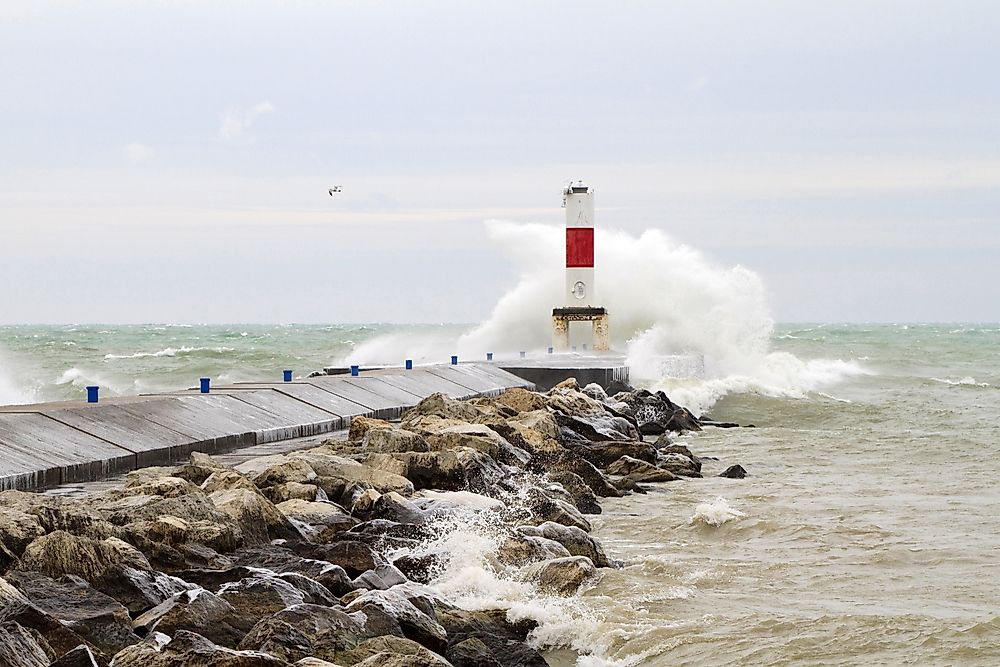
The dimensions of the Welland Canal shaped Trinidad before the schooner ever touched water. Built in 1867, the 140-foot canaller was designed to fit the locks connecting Lakes Erie and Ontario. Brendon Baillod and Robert Jaeck found the vessel on July 15, 2023, about 9.5 miles east of Algoma, Wisconsin. It was 270 feet below them.
Trinidad sank in 1881 after years of demanding service and persistent leaking. Its captain and crew escaped in a small yawl. The Wisconsin Historical Society later documented a remarkably complete wreck. The bow, hull, stern cabin, and deck machinery remain identifiable. Sections of wire rigging are also present. The narrow hull belongs to a period when Great Lakes shipbuilders worked around canal locks only a few feet wider than the vessels passing through them. Those proportions remain plainly visible on the bottom of Lake Michigan.
Arlington, Lake Superior, 2023

Captain Frederick Burke stayed aboard Arlington after everyone else abandoned the sinking freighter on April 30, 1940. The wheat-loaded ship had run into a Lake Superior storm, and the nearby Collingwood took the crew to safety. Burke was last seen near the pilothouse. His reason for remaining aboard was never established.
Shipwreck researcher Dan Fountain later noticed a deep anomaly in remote-sensing data and brought it to the Great Lakes Shipwreck Historical Society. A 2023 sonar survey picked up a vessel about 35 miles north of Michigan's Keweenaw Peninsula. ROV footage confirmed the 244-foot Arlington more than 600 feet below the surface. Robotic cameras now provide the practical way to inspect a wreck at that depth. Eighty-three years after Burke disappeared from view, Arlington had finally appeared on a screen above Lake Superior.
Africa, Lake Huron, 2023

Yvonne Drebert and Zach Melnick were filming invasive quagga mussels when an unexplained feature on Lake Huron's floor drew their attention. In June 2023, they lowered an underwater robot roughly 85 metres and encountered a large wooden steamer. Thick mussel colonies covered much of the exterior, including areas where a painted name could have assisted identification. Measurements, coal scattered around the wreck, and historical records pointed to Africa, lost in October 1895 with Captain Hans Larsen and ten others. The scene fit the filmmakers' original subject almost perfectly. Quagga mussels filter enormous amounts of lake water, contributing to greater underwater clarity in many areas. They also attach themselves densely to submerged structures. The cameras could see Africa clearly through the water, then found much of its nineteenth-century timber hidden under layers of mussels.
Lac La Belle, Lake Michigan, 2022
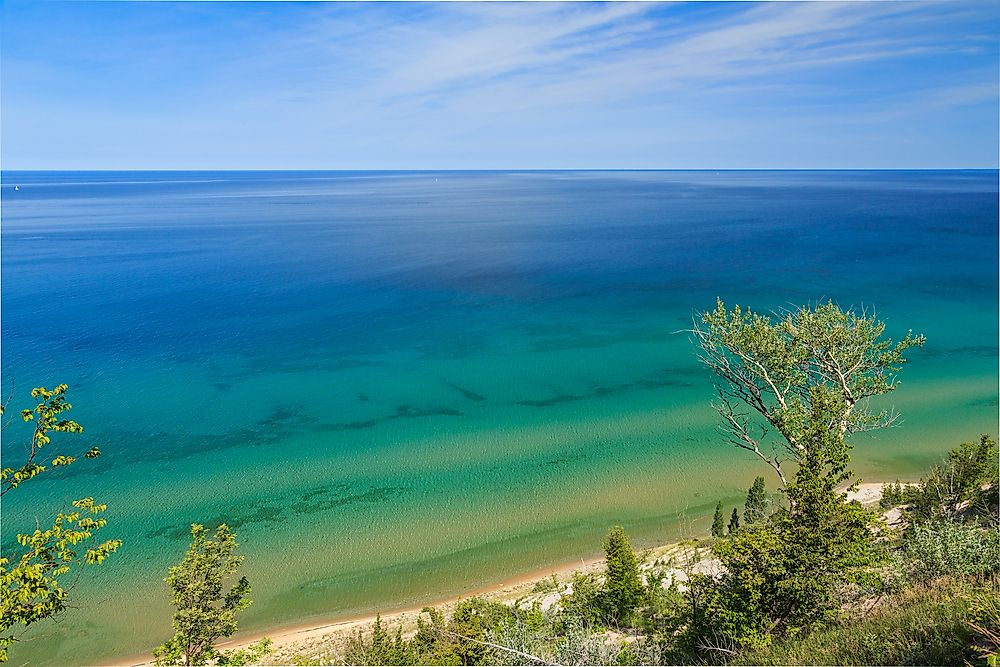
Paul Ehorn began searching for Lac La Belle in 1965. A newly uncovered historical clue finally narrowed his search area in October 2022. Side-scan sonar found the 217-foot passenger steamer roughly 20 miles offshore between Racine and Kenosha, Wisconsin. Ehorn had been looking for it for 57 years. His successful search that day lasted about two hours.
Lac La Belle had sunk during an October 1872 gale on a voyage from Milwaukee toward Grand Haven. Water entered the engine room and extinguished the boilers. Those aboard moved into lifeboats, and one overturned. Eight people died.
Ehorn's team did not announce the discovery immediately. They spent the following years documenting the site and developing a 3D model before the news became public in 2026. The hull is largely upright on the lakebed. The elaborate upper cabins visible in nineteenth-century images have disappeared.
Iona, Lake Ontario, 2022

Fire left a clear mark on Iona. NOAA first detected the unidentified wreck about 15 miles off Oswego during an October 2022 Lake Ontario survey. Tim Caza and Dennis Gerber later relocated the site and helped establish the vessel's identity. NOAA returned with an ROV in 2025.
Iona caught fire near the boiler room in May 1912. Captain Paul Hammond and his 12-person crew escaped in a boat and reached Henderson Harbor the following morning. The stern now contains extensive fire damage around the upright boiler and steam engine.
Conditions change toward the bow. NOAA documented surviving deck structure, an intact forecastle, a capstan, a windlass, and two anchors in their stowed positions. One mast remains upright. Iona is more than 330 feet deep, putting the wreck outside the reach of most divers. NOAA's robotic footage instead carries the view across the burned machinery and forward to the standing mast.
Barge 129, Lake Superior, 2021

Barge 129 has a shape few other Great Lakes wrecks can match. The 292-foot vessel was a whaleback, part of Alexander McDougall's experiment with rounded, low-profile cargo ships. The Great Lakes Shipwreck Historical Society found it in 2021 about 35 miles off Vermilion Point, at roughly 650 feet. It was one of nine wrecks the society located that season. Barge 129 had been hauling iron ore behind the steamer Maunaloa in October 1902 when a storm snapped the towline. Maunaloa returned, and heavy seas drove the vessels together. The steamer's anchor tore into Barge 129's starboard side. Captain Josiah Bailey and his crew got away before the damaged vessel sank. More than a century later, sonar picked up the broad curved hull characteristic of McDougall's unconventional design.
Adella Shores, Lake Superior, 2021

Adella Shores disappeared without an eyewitness. The 195-foot wooden steamer fell behind Daniel J. Morrell in ice and a northeast gale near Whitefish Point on May 1, 1909. Fourteen sailors vanished with it, and no bodies were recovered. Its general loss area was known. Its position was not.
In summer 2021, Darryl and Dan Ertel of the Great Lakes Shipwreck Historical Society ran sonar grids more than 40 miles northwest of Whitefish Point. A target appeared in water deeper than 650 feet. Its dimensions fit Adella Shores, and ROV imagery showed construction features consistent with the missing steamer. Contemporary reports proposed that ice may have punctured the wooden hull, though nobody survived to describe the sinking. Before the sonar find, the disaster could be traced through departure records, weather reports, and the ship's failure to arrive. The 2021 survey added a precise patch of Lake Superior bottom.
Ironton, Lake Huron, 2019
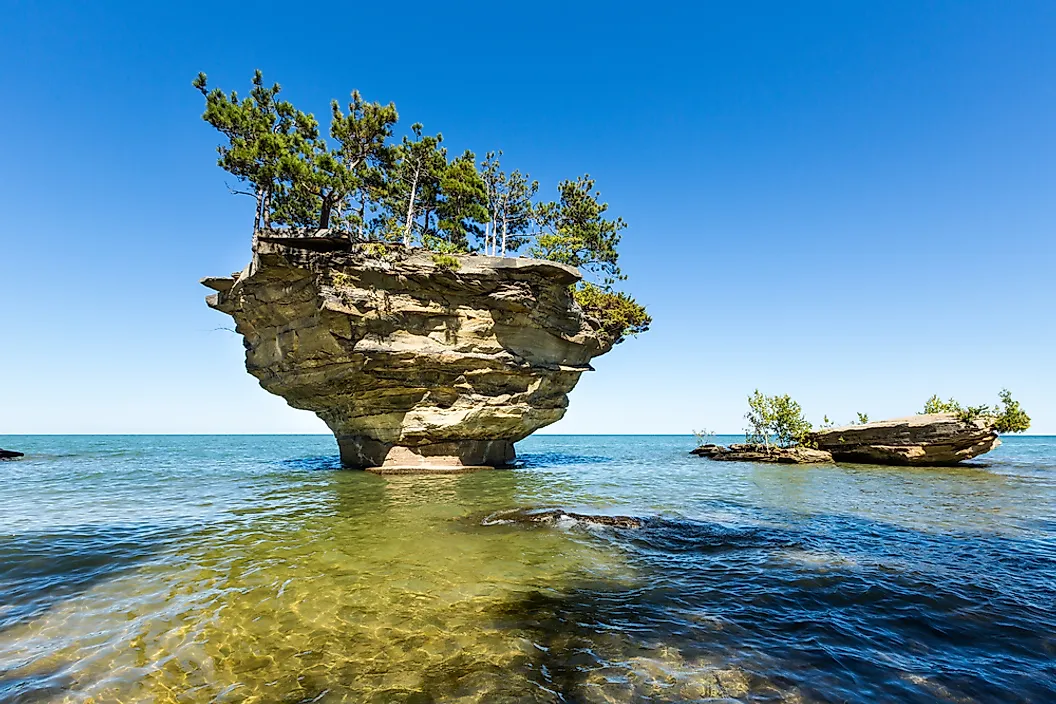
Three masts rise from Ironton on the floor of Lake Huron. Rigging remains attached in places, and the long bowsprit extends from the bow. NOAA and its partners found the 191-foot schooner-barge in 2019. The known position of Ohio and historical accounts of their 1894 collision helped narrow the search.
Ironton broke free from its tow on September 26, 1894, and struck Ohio in rough water. Five of its seven sailors died. The two survivors reported entering a lifeboat without releasing the line securing it to Ironton.
ROV cameras later reached the stern. The lifeboat was beside the wreck. Its location closely matches the account given by the men who escaped. Newspaper readers could only picture that tethered boat in 1894. NOAA's footage recorded it 125 years later, lying beside the ship that pulled it under.
Manasoo, Lake Huron, 2018

A 1927 Chevrolet coupe sits inside Manasoo, with its license plates attached. The package freighter is about 210 feet below the surface off Griffith Island in Georgian Bay. Ken Merryman, Jerry Eliason, and Cris Kohl found it on June 30, 2018, after four days of sonar searching. An old newspaper account had pushed their search closer to shore.
Manasoo sank during a September 1928 storm carrying passengers, crew, more than 100 cattle, and the Chevrolet. Livestock shifted as the vessel developed a worsening list. The ship eventually rolled over. Sixteen people died, and five survivors were rescued by the steamer Manitoba.
The stern is embedded in the bottom and the bow angles upward. The wooden pilothouse and helm remain recognizable. Lifeboats and the collapsed funnel occupy the wreck as well. Inside is the Chevrolet once owned by livestock broker Donald Wallace, one of the people who survived.
Choctaw, Lake Huron, 2017

Choctaw carried the rounded lines of a whaleback without being a true example of Alexander McDougall's famous design. The 267-foot steel semi-whaleback was hauling coal on July 12, 1915, when dense fog led to a collision with the Canadian steamer Wahcondah. All 22 people aboard Choctaw survived the sinking.
NOAA researchers encountered the wreck in 2017 during survey work in Thunder Bay National Marine Sanctuary. The investigation used high-resolution sonar and an autonomous underwater vehicle before ROVs and technical divers examined the site. Choctaw is more than 250 feet below the surface. Researchers recorded surviving rigging, deck hardware, and damage to the hull associated with the collision. Its unusual outline also survived well enough to connect the wreck with a short period of experimentation in Great Lakes freighter design.
Ohio, Lake Huron, 2017

Two masts stood upright when NOAA's sonar crossed Ohio in 2017. A third had fallen across the wreck, and the pilothouse cast a clear acoustic shadow. The 202-foot wooden bulk freighter was in roughly 300 feet of Lake Huron water.
Ohio sank on September 26, 1894, after Ironton broke loose from its tow and struck it in rough conditions. All 16 people aboard Ohio escaped. NOAA's later work recorded grain cargo, rigging, deck fittings, and substantial portions of the vessel on the bottom.
Its coordinates also gave investigators something they had never possessed before: an exact starting point for reconstructing the collision. They combined Ohio's position with nineteenth-century weather information and survivor accounts, then searched the area where Ironton could have drifted afterward. That work led to Ironton in 2019. Its three masts and bowsprit appeared only a short distance from a wreck found two summers earlier.