The Oldest Freighter Still Working The Great Lakes
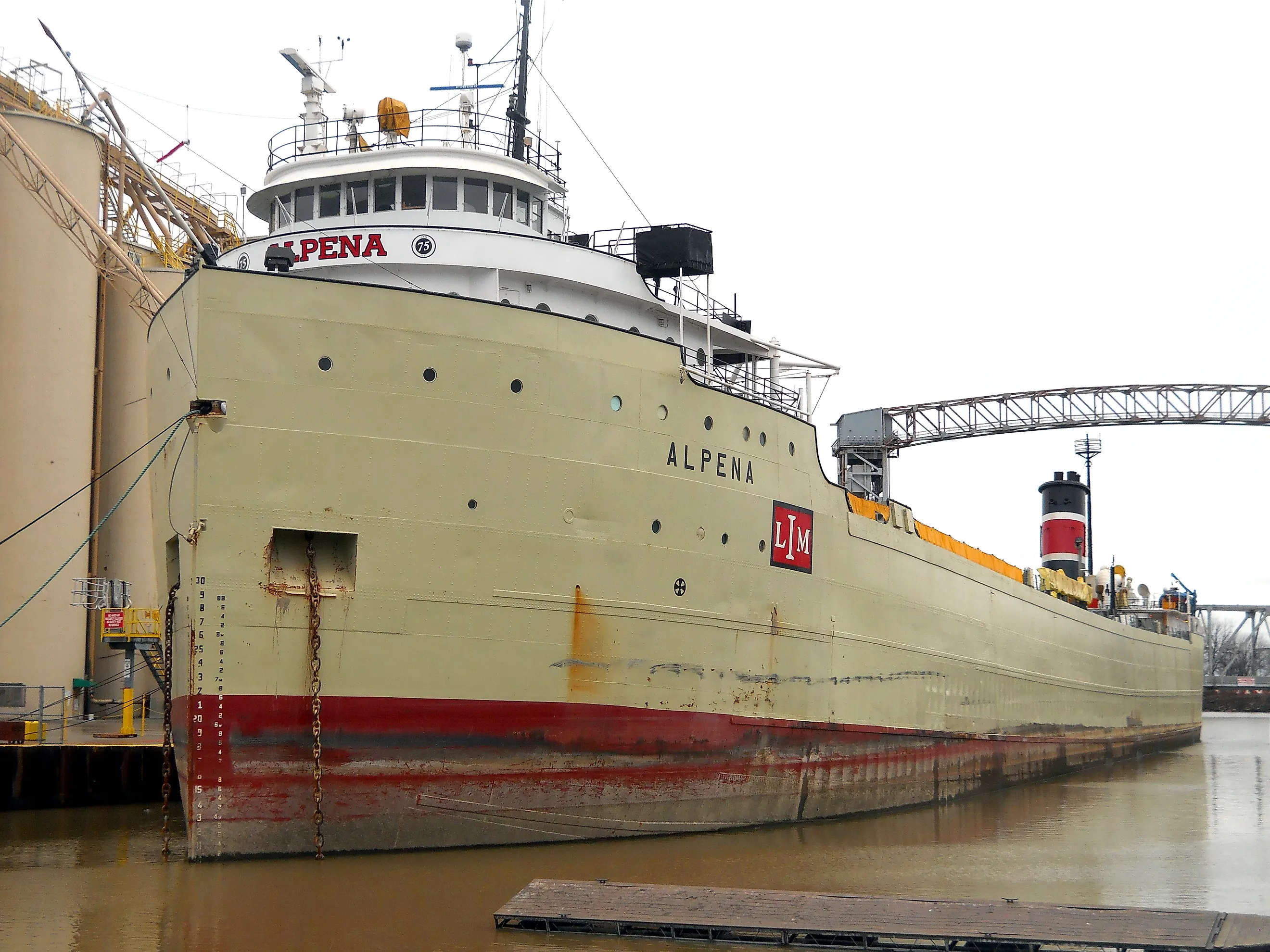
The oldest freighter still working the Great Lakes under its own power is the SS Alpena, a steamship launched just downriver from Detroit on February 28, 1942, less than three months after Pearl Harbor. It is still working at 84 because it was rebuilt for a different job. The ship began as the Leon Fraser, one of five identical ore carriers built for U.S. Steel's wartime fleet, and all four of its sisters were scrapped in the 1980s. In 1990, a drydock crew in Superior, Wisconsin, cut 120 feet out of the Fraser's middle and turned the shorter hull into a cement carrier sized for smaller harbors.
The Alpena stayed a steamship through that rebuild, so a steam turbine still turns the propeller of a hull launched 16 years before the Edmund Fitzgerald. Every season it loads powdered cement at its namesake city in northern Michigan for terminals in ports such as Chicago and Duluth.
The Leon Fraser Was the First of Five Identical Wartime Ore Carriers

Great Lakes Engineering Works laid the keel on June 5, 1941, at its River Rouge yard in Ecorse, Michigan, for the Pittsburgh Steamship Company, the Great Lakes fleet of U.S. Steel. As the lead ship of five matching ore carriers, the Leon Fraser measured 639 feet, 6 inches, which put the class among the longest ships on the lakes, and it could hold about 18,600 long tons of cargo.
The Fraser sailed for Duluth and its first load of iron ore in June 1942, and in that first year it took on 17,033 tons there, a record for the port's ore docks. Over the next four decades it carried iron ore to steel ports such as Gary, Indiana, and Conneaut, Ohio, adding grain cargoes in the 1960s and 1970s.
Cutting 120 Feet From the Middle Gave the Ship a Second Career

U.S. Steel laid the Leon Fraser up at Lorain, Ohio, for the last time in December 1981, and the ship stayed there through most of the decade while its four sisters were sold for scrap. Spitzer Marine bought it in 1985 for a proposed casino and entertainment complex that never materialized. In 1989, Fraser Shipyards of Superior, Wisconsin, purchased the ship for conversion to a cement carrier and had it towed to Superior that October.
During 1990, crews in the shipyard's drydock cut out a 120-foot midsection, then flooded the drydock so the bow and stern sections could float together for welding into one hull, and a self-unloading system went in at the same time. The rebuilt ship measured 519 feet, 6 inches, with its capacity cut to 14,000 long tons, about 4,600 fewer than it carried as an ore boat.
The shorter hull could reach cement terminals in smaller ports that a 639-foot ore carrier could not easily use. The ship, at that time the largest cement carrier on the lakes, went to work for Inland Lakes Management and was rechristened on June 10, 1991, in Alpena, the city on Lake Huron's Thunder Bay that is home to the cement plant it serves.
Cement Comes Aboard From Silos and Goes Ashore by Compressed Air

Roughly 90 percent of the cement made in Alpena leaves the plant by water, which keeps the ship busy all season. The plant, which began making cement in 1907 and was the largest cement plant in the world until the 1970s, turns out about 2.2 million tons of portland cement a year and has been run by Amrize since June 2025. At the dock, loading booms hang from the silos and pour cement into the Alpena's holds at close to 1,000 tons an hour, so a typical load of around 12,000 tons takes roughly half a day.
At terminals in ports including Green Bay, Chicago, Detroit, and Toledo, the cement goes ashore through the self-unloading system installed in 1990. Inside the hull, cement drops out of the holds onto a conveyor belt running the length of the ship, and buckets on a vertical conveyor scoop it up. A large screw then packs the powder into plugs that compressed air shoots through pipes into silos on shore, a process plant manager Jeff Scott likened to sending a spit wad through a straw.
Steam Still Turns the Alpena's Propeller

The Alpena runs on a DeLaval steam turbine fed by two Babcock and Wilcox water-tube boilers, the same makes of machinery the Leon Fraser was fitted with in 1942. Each boiler stands about four stories tall, and the steam they produce spins the turbine, which in turn drives the propeller. The boilers burned coal until the winter layup of 1969 and 1970, when they were converted to oil and a bow thruster was added to help the ship maneuver in harbors.
The original 1940s compass and a 1940s ship-to-ship telephone remain in the wheelhouse at the bow. A narrow storm tunnel runs alongside the cargo holds for the length of the hull, giving crew members a way to cross between the stern and the bow without going out on deck when waves are breaking over the side. About 21 people crew the Alpena, and the steward cooks three meals a day for all of them, sometimes for 60 to 90 days at a stretch. Steve Stanek, who had been the Alpena's captain since 1997, said in 2022 that a blast from its whistle would frighten anyone within earshot.
Repairs After a 2015 Drydock Fire Kept the Alpena Sailing

A fire broke out on December 11, 2015, while the Alpena was in drydock at Fincantieri Bay Shipbuilding in Sturgeon Bay, Wisconsin, for its five-year inspection. It started in the electrical control room for the aft winches and caused millions of dollars in damage to the stern. The ship was 73 years old, and that same year it had become the oldest active steam-powered commercial vessel on the Great Lakes. Inland Lakes Management decided to repair it, and the Alpena returned to service in 2016 with steam driving its propeller as before.
The 1906 Challenger Hauls Cement as a Tug-Pushed Barge

The St. Marys Challenger has a hull 36 years older than the Alpena's, and it now moves only when a tug pushes it. Great Lakes Engineering Works, the same company that later built the Leon Fraser, launched it in February 1906 as the William P. Snyder. It remained the oldest self-propelled freighter on the lakes until November 2013, when it made its final voyage under steam, out of Chicago and bound for the shipyard in Sturgeon Bay.
At Bay Shipbuilding, workers removed its engine and boiler and rebuilt the hull as a barge for a dedicated tug, the Prentiss Brown. The pair still carries powdered cement and made more trips to Owen Sound, Ontario, than any other vessel in 2025. In Superior, Wisconsin, the J.A.W. Iglehart, a 1936 ocean tanker hull, has served as a stationary cement storage barge since 2006. Both of those older hulls depend on tugs or stay moored, so since the Challenger's conversion the Alpena has been the oldest freighter on the lakes that sails under its own power.
Only Three Big Steamships Are Left in Regular Service

Besides the Alpena, the only large commercial steamships in regular Great Lakes service in 2026 are the Wilfred Sykes, a freighter launched in 1949, and the Badger, a coal-fired car ferry launched in 1952 that crosses Lake Michigan between Ludington, Michigan, and Manitowoc, Wisconsin. That makes the Alpena the oldest of the three by seven years. Other steam-powered freighters, including the Arthur M. Anderson and Cason J. Callaway, were laid up this season.
Diesel repowering is the more common path for old steamers that kept working. The Lee A. Tregurtha, four months younger than the Alpena, served the Navy in World War II as the oiler USS Chiwawa and became a Great Lakes freighter in 1961, and Interlake Steamship Company replaced its steam plant with diesel engines in 2006. The Herbert C. Jackson and John G. Munson were repowered the same way during the winter of 2015 and 2016.
Boat watchers in the Twin Ports see the Alpena often, and it came through the Duluth ship canal loaded with cement on November 11, 2025. On Father's Day 2026, it passed the South Pierhead Lighthouse on its way out of Muskegon Lake, bound for Alpena, while a history cruise on the Aquastar tour boat was out on the lake. Muskegon is also home to Andrie Transportation Group, which owns the ship together with Inland Lakes Management. The Alpena spends each winter laid up in Cleveland, and its season runs into January. When the 2026 season opened at the Amrize plant in March, the plant manager said the Alpena was coming out of Cleveland and was expected at the dock within days to take on its first cement of the year.