This Great Lakes Town Dives Into Maritime Heritage
Half way up Lake Huron's "Sunrise Coast," at the base of "Shipwreck Alley," Alpena, Michigan fully embraces its maritime heritage. Glass-bottom boats regularly seek out the sunken vessels of Thunder Bay National Marine Sanctuary before returning to dock right outside of the Great Lakes Maritime Heritage Center. Throughout town, marine-themed murals decorate spirited, if slightly weathered streets, and no less than eight lighthouses dot the beach and forest-lined vicinity. I recently visited Alpena on the way up the Sunrise Coast Pure Michigan Byway, spending the night in order to catch the sought-after sunrise, and again on the way back down to experience the glass-bottom boat tour. The same capricious climate responsible for the nearly 200 shipwrecks in and around Thunder Bay derailed some of these plans. But thankfully, Alpena's balance of indoor and outdoor recreation allowed me to stay on theme no matter the weather.
Thunder Bay National Marine Sanctuary

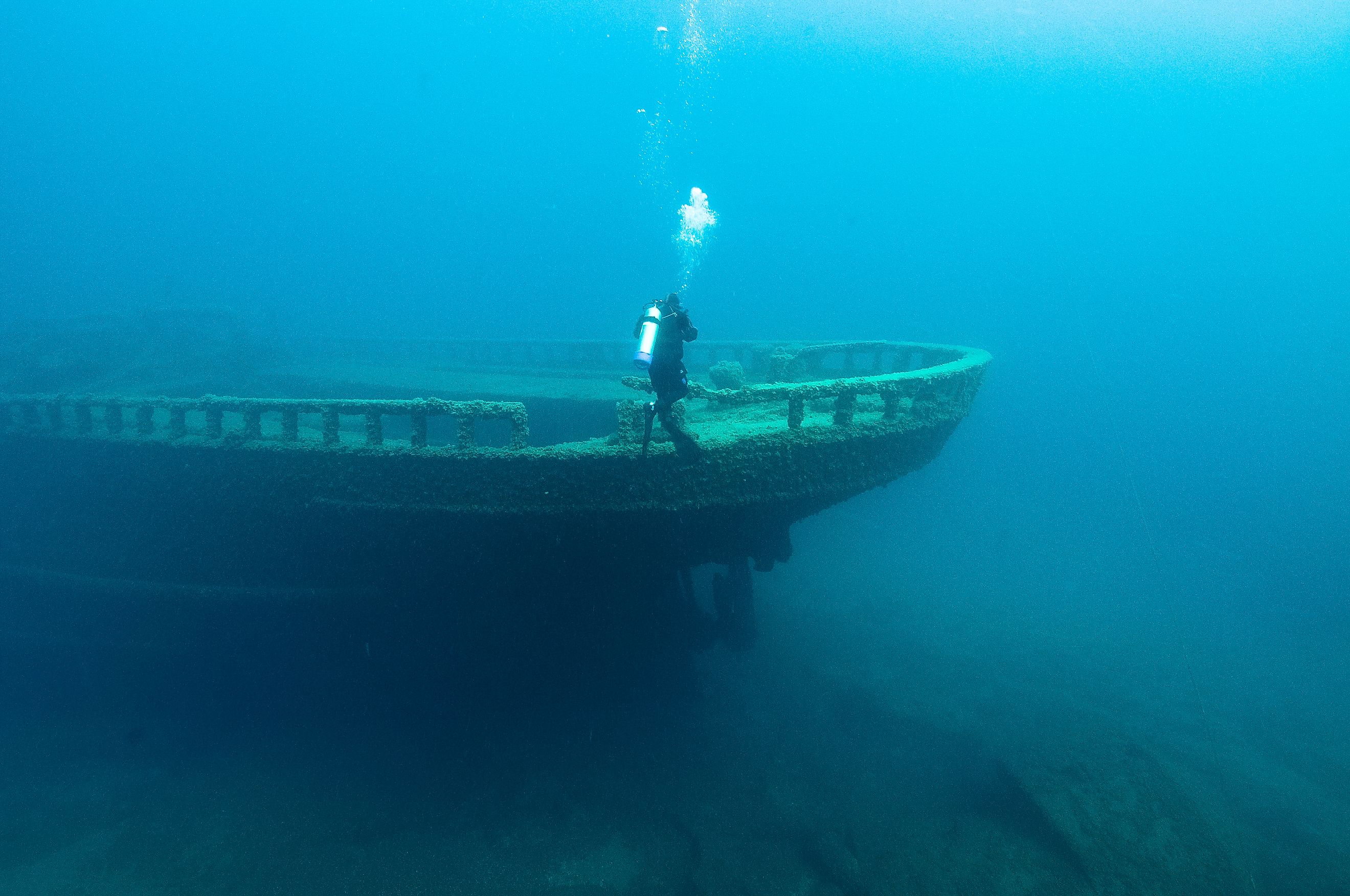
Alpena's primary asset goes unseen to the naked eye, at first. Designated in 2000 by the National Oceanic and Atmospheric Administration (NOAA), Thunder Bay National Marine Sanctuary, aka "Shipwreck Alley," spans some 4,300 square miles from its namesake bay deep into Lake Huron. The first of its kind in the Great Lakes, TBNMS acts as a sort of underwater national park, protecting an estimated 200 shipwrecks, one of the best-preserved collections in the United States, keeping Lake Huron clean, concocting artificial reefs and other conservation projects, and educating the upwards of 100,000 annual visitors about the history, biodiversity, and economic potential of the second largest Great Lake.
There are a number of ways to explore Thunder Bay National Marine Sanctuary. Paddleboarders and snorkelers can investigate the shallowest of shipwrecks, some between 30 and 65 feet. SCUBA divers have the unique ability to get up close and personal to even more schooners and freighters, thanks to the clear and cold, and therefore preserving, freshwaters of Lake Huron.
Wanting to stay dry, but also to get a broad overview of the area, I chose the 2-hour glass-bottom boat tour aboard the Lady Michigan. Sadly, minutes before departure, the Coast Guard reported an incoming storm, and the tour had to be cancelled. Frustrating though this was, there was a poetic irony to a shipwreck tour getting cancelled because of the same conditions that wrecked said ships in the first place. So if you're visiting Alpena for this specific experience, I recommend scheduling a backup day in case of inclement weather.
Great Lakes Maritime Heritage Center

Whether it's a tour-cancellation re-route, or a destination unto itself, the Great Lakes Maritime Heritage Center is Alpena's top dry-land attraction. This 10,000 square-foot, free-admission facility features a life-sized schooner in the midst of an audio-visual storm, a theatre that hosts the annual Thunder Bay International Film Festival, in addition to daily showings, and profiles of most significant shipwrecks around Thunder Bay. Here's an example of one that caught my eye.
Shipwreck: Isaac M. Scott
This 504-foot freighter wrecked in the winter of 1913, during a 3-day storm known as a "white hurricane." The white-out snow squalls, 90 mile-per-hour wind gusts, and 35-foot waves proved too much for the Isaac M. Scott to handle. Bound for Milwaukee from Cleveland, the lake freighter and all 28 sailors aboard perished a few miles east of Thunder Bay. The ghost ship now rests, upside down, 180 feet beneath the surface. This same storm sank seven other ships on Lake Huron, resulting in nearly 200 fatalities. Shortly thereafter, the Lake Carriers Association characterized the nightmare as such:
"No lake master can recall in all his experience a storm of such unprecedented violence with such rapid changes in the direction of the wind and its gusts of such fearful speed."
Maritime Heritage Trail

Walking out the back door of the Great Lakes Maritime Heritage Center, I was inadvertently introduced to the Maritime Heritage Trail. This paved path along the Thunder Bay River links the facility with the aforementioned glass-bottom boats, some scattered artifacts, and interpretive displays. Crossing the Rotary Island Pedestrian Bridge or the Second Avenue Bascule Bridge at either end of the trail then connects this maritime enclave with the rest of downtown Alpena.
Mural Trail

Strolling the streets of downtown Alpena, my gaze was sporadically drawn to enormous and rather inventive murals. In total, the Mural Trail connects 28 works of art, and counting, on all things Alpena, but above all, its maritime heritage. The standout creation has to be the Make a Splash fish mural outside of Mangos Restaurant, where I enjoyed some seafood-based Mexican cuisine. This colorful 3D mural speaks to Alpena's reputation as a 19th-century fishing village, before it leaned into the logging boom, but also its 21st-century creative spark.
Presque Isle Side Quest

Alpena has its "Little Red" at the mouth of the Thunder Bay River, but for those classic Great Lake lighthouses, a short trip up to Presque Isle will suffice. Just 20 miles north on the Sunrise Coast Byway brings maritime enthusiasts to a quadfecta of lighthouses. First, you've got the Rear Range Lighthouse and the Front Range Light Beacon Station. This same turnout unfurls the unspoiled Range Light Beach, reminiscent of those wild and free Upper Peninsula beaches.
Feet in the sand, looking northeast, the Old Presque Isle Lighthouse next presents itself. Built in 1840, this whitewashed tower and keeper's house also boasts a bronze bell that, when I gave it a ring, nearly made me jump out of my shoes. A gentle tap, evidently, will do the trick for any of you prospective visitors. Finally, the New Presque Isle Lighthouse caps off the isolated peninsula, offering sweeping views from atop its 113 steps. Just don't go too early, for even though this is a prized stop on the Sunrise Coast, the lighthouse doesn't actually open until 10 a.m.
The Sun Rises on Alpena

Standing at the tip of the Blair Street Pier, sun rising over Thunder Bay's industrial skyline, I could feel Alpena's past and present colliding, and its future as uncertain as those Great Lake storm fronts. What started as a humble offshore fishing village threw itself into the 19th century logging boom with marked success. During those peak years, between 1,500 and 2,000 ships sailed into this Michigan port.
Having visited the Great Lakes Maritime Heritage Center, I knew that some of those imposing vessels lay beneath the shimmering waters I was now scanning, waiting for the next tour boat, paddler, or scuba diver to pay them a visit. And that's exactly what Alpena is about these days. The timber scene has long since fallen, and fishing has floundered as an economic engine, so this Great Lakes town dives into its maritime heritage to stay afloat. Judging by the storefront vacancies in its downtown core, this may or may not prove sufficient. But given the scale and rich history of "Shipwreck Alley," I'd say there is still untapped potential in Alpena.