The US Rivers With The Most Invasive Fish
Most of the invasive fish that now dominate America's rivers were stocked there on purpose. Carp were shipped in to scrub algae from fish farms and sewage ponds; other species were hauled across the country to build new fisheries or to hand anglers a bigger trophy.
The plans backfired badly. Those fish bred and spread beyond any control, stripping out native species, collapsing food webs, and drawing billion-dollar efforts to beat them back. On some rivers the natives are already nearly gone; on others, crews haul out millions of pounds a year just to hold even. What follows is a look, river by river, at how far the problem has already spread.
Illinois River

In mid-August 2026, several hundred silver carp just 4 to 6 inches long were pulled from the Marseilles Pool of the Illinois River, about 80 miles from Lake Michigan. Carp that small had never been found that far upriver since monitoring began in 2010, and state biologists said adult carp may have spawned farther up the river or in one of its tributaries.
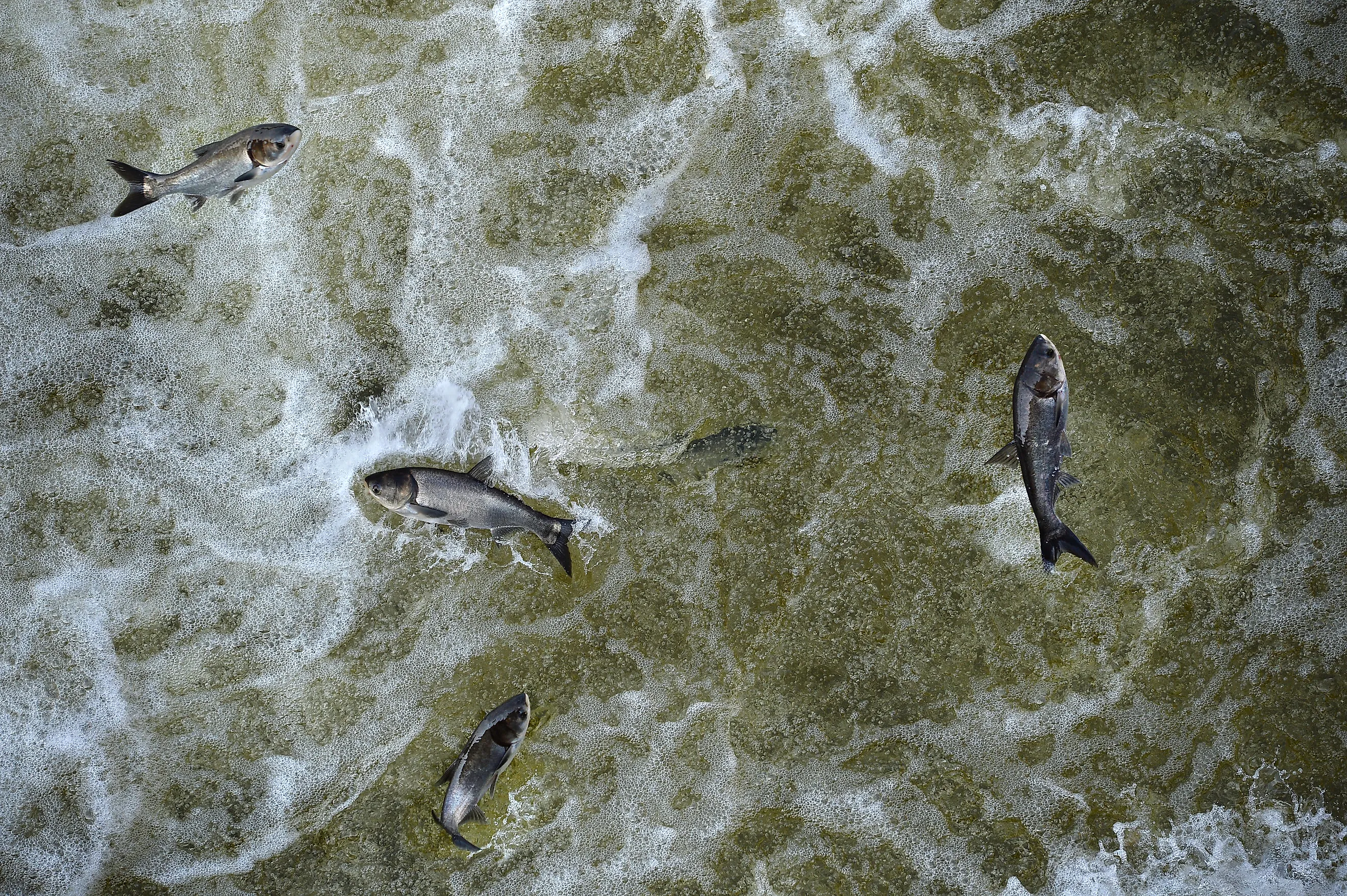
Reproducing populations fill the lower 240 miles of the river up to Peoria. Silver carp leap when passing boats frighten them, sometimes more than 8 feet into the air, and near Havana most boats moving through set off five or more jumpers.
Contract fishers and a state harvest-incentive program removed more than 7 million pounds of invasive carp from the Illinois in 2025. Near Joliet, the roughly $1.15 billion Brandon Road Lock and Dam project is designed to keep carp out of Lake Michigan with an electric barrier, underwater sound and an air bubble curtain, but work there has been halted by federal stop-work orders three times since February 2025. The latest order, issued in July 2026, was lifted on September 2.
Columbia River

More than 7 million American shad had climbed the fish ladders at Bonneville Dam by late August 2019, in a year when fewer than 250,000 wild adult salmon and steelhead made the same trip. Shad crowd ladders built for salmon and can delay salmon passage. The species is native to the Atlantic coast, and its Pacific run traces back to 1871, when fish culturist Seth Green shipped young shad west by train and released about 10,000 into California's Sacramento River. By around 1876, shad were being caught in the Columbia.
Anglers on Lake Roosevelt, the reservoir behind Grand Coulee Dam, get $10 from the Colville Tribes for every northern pike head they turn in, and tribal and state crews pulled just over 20,000 pike from the lake between 2015 and late 2024, after the species was first documented there in 2010. Salmon in the lower Columbia already face introduced walleye and smallmouth bass, which eat young salmon in reservoirs such as John Day, and pike could harm salmon too if they get past the dam, according to the National Park Service. In 2018, one pike was caught just 10 miles from Grand Coulee Dam.
James River

A 102-pound blue catfish came out of the Dutch Gap area of the James River near Richmond in 2009, the kind of trophy the stocking program was started to produce. Since January 1, 2026, there has been no daily limit on blue catfish in the James below the freshwater-saltwater line.
Near Turkey Point, about 99 percent of the roughly 2,200 fish longer than a foot picked up in a Virginia Commonwealth University sonar survey, in a patch of water the size of an Olympic swimming pool, were blue catfish. Blue catfish in a roughly 124-mile section of the James eat about 400 metric tons of blue crab a year, according to a U.S. Geological Survey estimate, along with menhaden and American eel. Medium-sized blue cats, which are especially numerous, account for much of that crab predation, based on stomach studies at the Virginia Institute of Marine Science.
Colorado River in the Grand Canyon

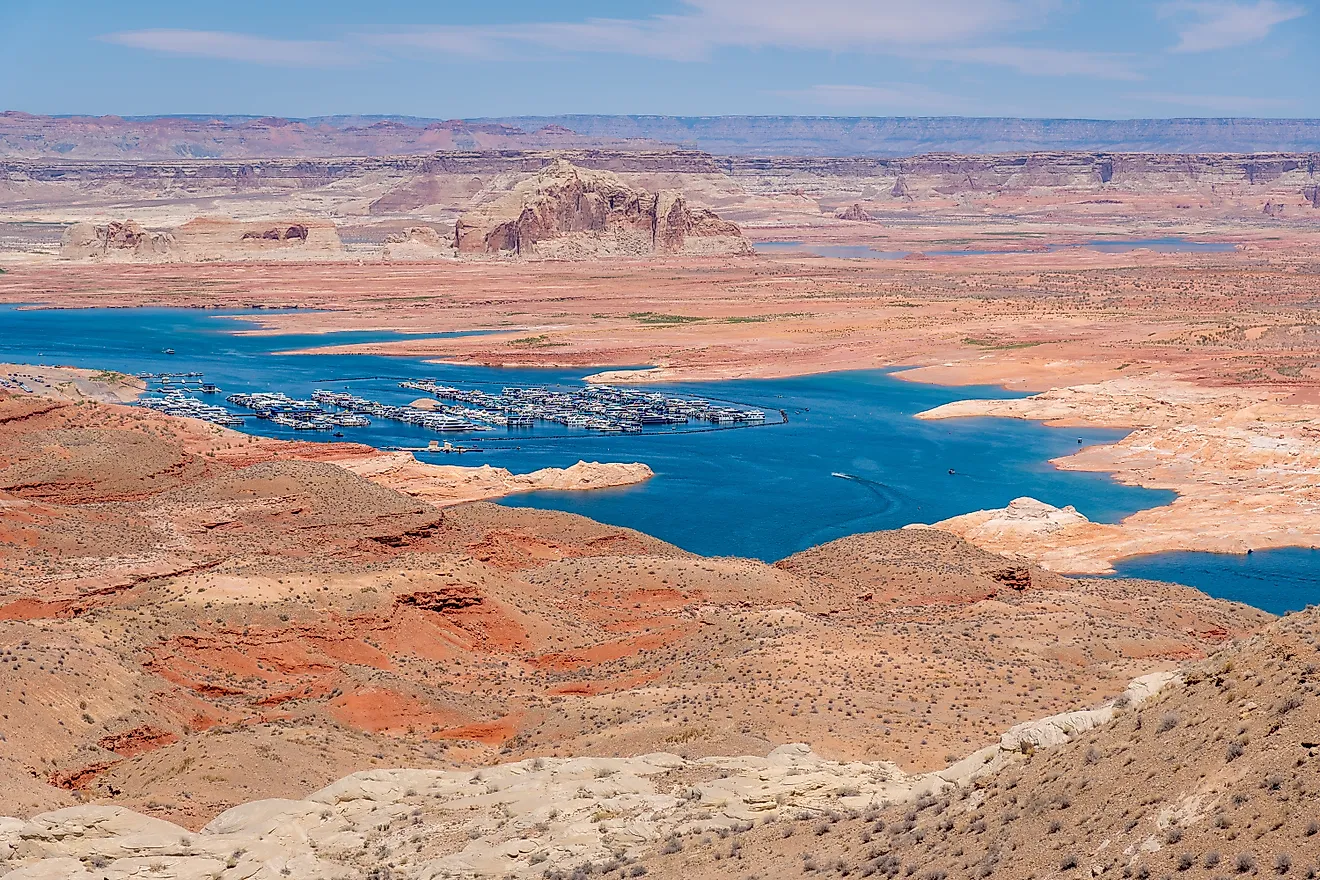
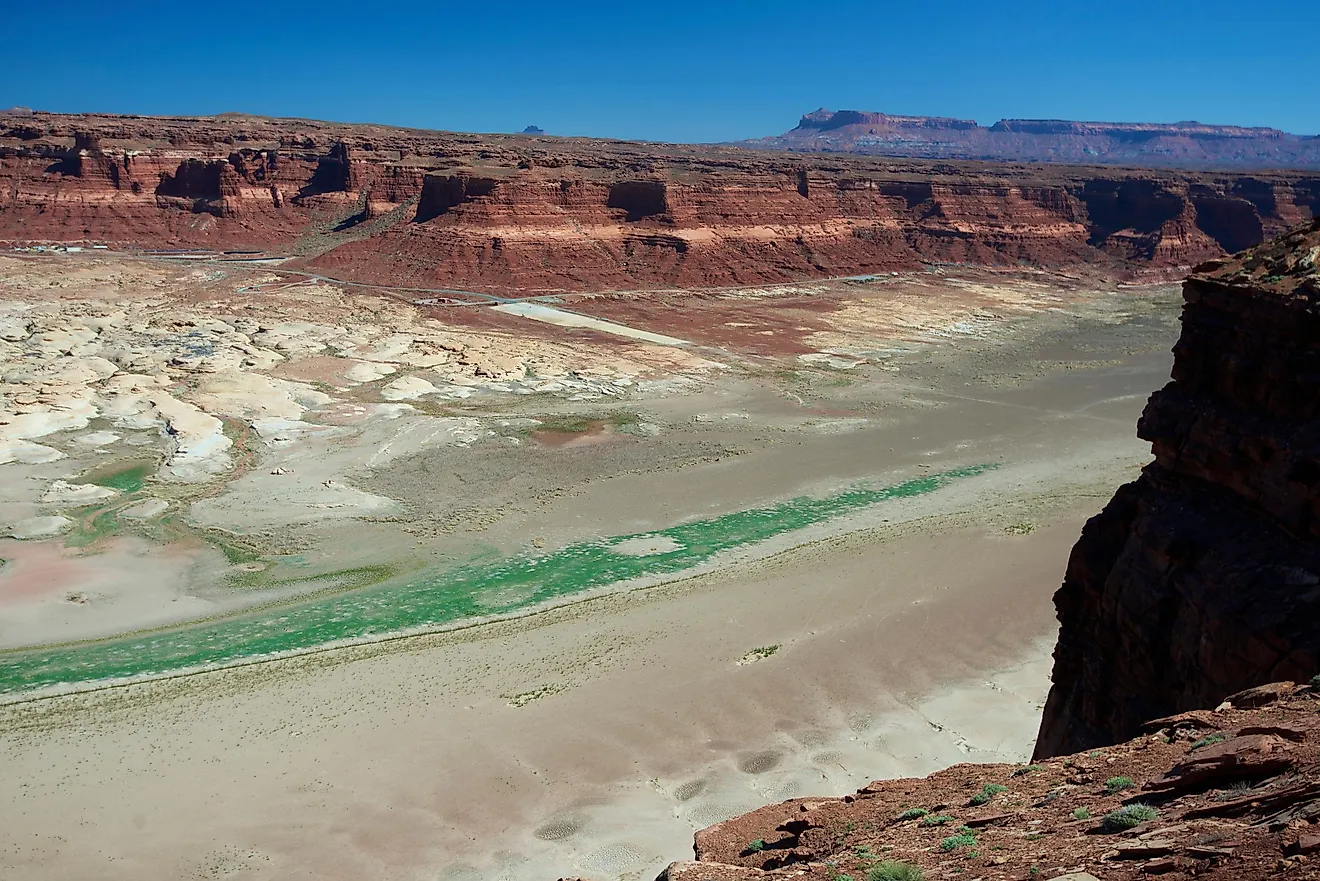
For decades, cold water released from deep in Lake Powell kept the Colorado River below Glen Canyon Dam too cold for smallmouth bass to spawn, even though the fish had lived in the lake since it was stocked with them in 1982. As the lake dropped during the drought, warmer water passed through the dam, and on July 1, 2022, a National Park Service biologist caught three juvenile smallmouth in a shallow slough a few miles downstream.
The humpback chub long survived by spawning in the Little Colorado River, a warm tributary that enters the Colorado well below the dam, and its population in the western Grand Canyon had rebounded to roughly 70,000 adults by 2024. Five of the Grand Canyon's eight native fish species still live in the canyon.
The Bureau of Reclamation's "cool mix" releases began in July 2024, sending water through outlets about 100 feet below the turbine intakes to disrupt bass spawning. The lost hydropower cost roughly $1 million a week, and the releases were repeated in 2025, while the slough itself was treated with fish poison and rebuilt into a flowing channel. In 2026, with Lake Powell about 23 percent full, the releases were called off over hydropower concerns. The river's temperature passed the 60-degree spawning threshold in June, and by September the water at Lees Ferry was running about 70 degrees.
Missouri River

"They hit our boats, they hit our people, they hit our faces," the chair of South Dakota's wildlife commission said of silver carp in 2023. The fish now reproduce along the entire free-flowing stretch of the Missouri River, and on the main river their path ends at Gavins Point Dam near Yankton, South Dakota. A Nebraska fisheries manager has said carp have no natural way past the dam, and South Dakota officials fear that carp above it would cut into the walleye fishery. Carp have pushed up the Big Sioux River, which forms part of the Iowa and South Dakota border, as far as Falls Park in downtown Sioux Falls. With help from the floods of 2010 and 2011, they also spread up the Dakotas' James River as far as Jamestown, North Dakota.
Sacramento-San Joaquin Delta

No delta smelt were caught in California's fall midwater trawl survey in 2025, the eighth straight year without one of the small native fish. Researchers have found delta smelt DNA in the guts of Mississippi silversides, which were brought to Northern California's Clear Lake in 1967 to control gnats. By 1975 the silversides were well established in the Sacramento-San Joaquin Delta, and they have become one of the most abundant fish in the San Francisco Estuary.
Along the Delta's shallow shorelines, 96 percent of the roughly 39,000 fish caught in sampling between 2001 and 2003 belonged to nonnative species, led by bluegill. California's striped bass arrived much earlier, in 1879, when 132 young fish from New Jersey's Navesink River were released at Carquinez Strait.
Potomac River

The Potomac's first confirmed northern snakehead was caught in Little Hunting Creek, an inlet near Mount Vernon, in May 2004, and by that fall anglers had landed 19, including females carrying eggs. Snakeheads reached the river above Great Falls in 2011, and by 2016 they ranged along more than 120 river miles, with no size or creel limit for Maryland anglers. Two decades of tracking in Virginia's Potomac tributaries have found them less damaging than biologists first feared, according to longtime Virginia researcher John Odenkirk.
Blue catfish, probably moving up from Virginia's stocked rivers, were in the Potomac by the late 1980s, and about 4.2 million pounds of them were landed commercially in the Potomac and Maryland waters in 2023, nearly seven times the 2013 total. Flathead catfish arrived later, appearing in upper Potomac surveys in 2012 and tripling in relative abundance between 2016 and 2021, a rise Maryland biologists say may explain a slight drop in young channel catfish.
Gila River

In 2012, federal biologists named the Gila River near Cliff, New Mexico, as one of only two places where the spikedace, a small silvery minnow native to the Gila basin, was still common. More than three dozen established nonnative fish appear on the Bureau of Reclamation's list for the Gila basin, including flathead catfish and northern pike, and the agency names nonnative species as the most significant factor preventing native fish in the Southwest from recovering.
In New Mexico's Lower Box canyon, channel catfish and red shiner turned up at all 10 sites sampled in May 2024. A month later, crews on the river's West Fork caught just six spikedace and 323 smallmouth bass, the West Fork's most common nonnative fish along with yellow bullhead.
Susquehanna River

At Conowingo Dam in northern Maryland, fish lifts carry migrating shad and herring over the dam, and between March and June 2024, 2,106 northern snakeheads, 746 flathead catfish and 36 blue catfish were removed from the lifts. The snakehead count was more than double that of any year since 2021.
Some flatheads in Pennsylvania's stretch of the river now top 4 feet and nearly 70 pounds, more than two decades after the first one was found at Safe Harbor Dam in 2002. Penn State researchers found 47 prey species in the stomachs of flatheads from the river, including blueback herring, smallmouth bass, walleye and channel catfish, and rusty crayfish, another invader, were in almost half of the fish sampled. Below Conowingo, Maryland biologists have documented flatheads feeding on gizzard shad stunned by the dam's turbines. Under Pennsylvania guidance, anglers should eat no more than one meal a month of flathead catfish from the lower Susquehanna because of PCB contamination.
Putting Invaders On The Menu
Illinois carp now go to market as Copi, and in Maryland the snakehead was renamed Chesapeake Channa under a 2024 state law. A 2025 U.S. Department of Agriculture pilot set aside up to $2 million to buy Chesapeake blue catfish for food banks, half a century after the species was first stocked in the James for trophy anglers. Commercial fishers working Kentucky Lake and Lake Barkley, on the Tennessee and Cumberland rivers, have been paid 15 cents a pound for invasive carp since January 2026, up from a dime. More than 106 million pounds of invasive carp had been pulled from the Illinois River by the time juvenile silver carp were found in the Marseilles Pool in August 2026.