How Much Water Niagara Falls Moves Compared To The Mississippi
The Niagara River carries 212,000 cubic feet of water per second. The Mississippi at St. Louis, a thousand miles into its run and already fattened by the Missouri, manages 186,000. A river 36 miles long is moving more water than the Mississippi does at the Gateway Arch. The Mississippi does win eventually, and comfortably, but it takes until Kentucky to pull ahead. Niagara also has an advantage no river should have, which is a tap.
Where The Mississippi Finally Wins

Running the two side by side down the length of the Mississippi produces a scoreboard that stays one-sided for a surprisingly long time.
At Lake Itasca the Mississippi moves 6 cubic feet per second, which is about 45 gallons and roughly a garden hose. At St. Paul it reaches 12,000. At Grafton, after the Illinois joins, 112,000. At St. Louis, after the Missouri, 186,000. Niagara is still ahead of all of them.
The Mississippi finally overtakes at Hickman, Kentucky, where the Ohio has arrived and the flow jumps to 489,000. By Vicksburg it is 679,000, which is 3.2 times the Niagara River and eight times what actually goes over the falls.
Only Half The River Falls

Here is the detail that complicates every comparison involving Niagara, and nothing else among the world's major waterfalls works this way.
The river carries 212,000 cubic feet per second, but the average flow over the falls is 85,000. The difference is diverted through tunnels to hydroelectric plants downstream, which generate over 2.2 gigawatts between the two countries.
On a summer afternoon roughly 112,000 cubic feet per second, more than half the river, is going around the scenery rather than over it.
The Falls Have Operating Hours

The 1950 Niagara Treaty is the strangest piece of water law in North America, and it reads like a theatre schedule.
From April 1 to October 31, between 8am and 10pm, the flow over the falls must not drop below 100,000 cubic feet per second. Outside those hours the minimum halves to 50,000. At night, roughly 76 percent of the river is being diverted.
Niagara Falls is turned up when visitors are watching and turned down when they go to bed. No other waterfall on Earth is operated to a timetable agreed by two governments.
What 100,000 Cubic Feet A Second Looks Like

The tourist-hours figure means nothing until you convert it into something with edges.
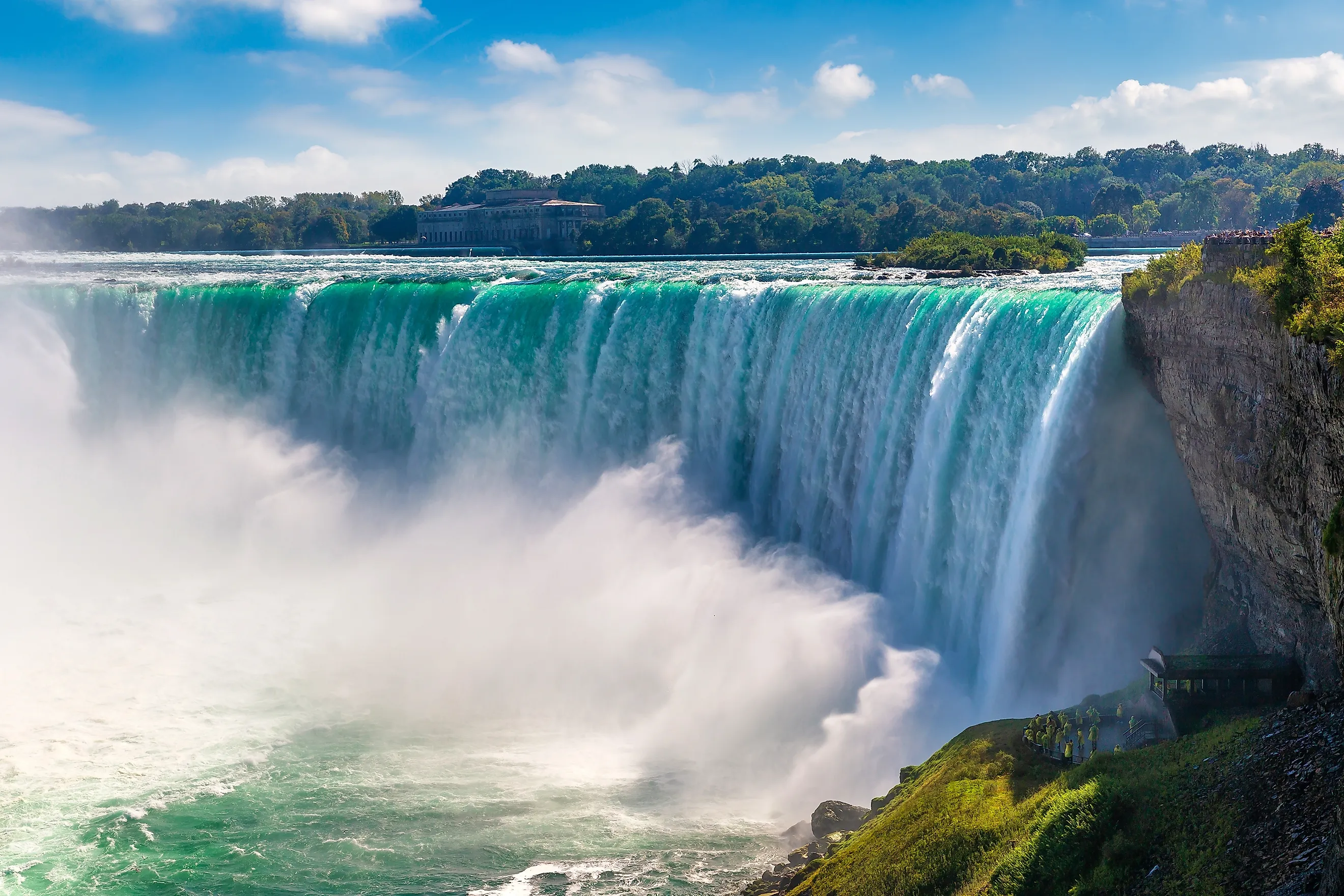
At 100,000 cubic feet per second, the falls deliver about 2,832 tons of water every second, which is roughly an Olympic swimming pool per second. During peak daytime hours more than 5.9 million cubic feet goes over the crest every minute.
The peak flow ever recorded over Horseshoe Falls alone was 225,000 cubic feet per second, which is more than the entire river's long-term average and more than the Mississippi carries at St. Louis.
The Mississippi Changes By A Factor Of 100,000

What Niagara cannot match is the Mississippi's range from one end to the other. The river starts at 6 cubic feet per second and reaches 679,000 at Vicksburg. That is a factor of more than 100,000 between the headwaters and the lower river, accumulated across 31 states and two Canadian provinces.
Niagara does nothing comparable. It is 36 miles long, it has essentially the same flow at both ends, and its job is to move Lake Erie into Lake Ontario without much ceremony.
One Is Fed By An Inland Sea

The reason a 36-mile river competes with a continental one comes down to what sits behind each of them.
The Niagara drains four of the five Great Lakes, around 684,000 square kilometers of catchment, and crucially it drains them through standing water. Lake Erie is a reservoir that releases at a near-constant rate regardless of last week's weather.
The Mississippi has a bigger watershed and no buffer. It depends on rain and snowmelt arriving across a continent, which is why its flow swings and Niagara's does not.
Which Is Why Niagara Never Floods

The consequence of that difference shows up in the extremes rather than the averages. The Mississippi at St. Louis hit 1,080,000 cubic feet per second in the 1993 flood, nearly six times its average there. At Vicksburg the gauge has recorded a high of 990,000 against a low of 177,000 on the same calendar date in different years.
The maximum monthly mean ever measured on the Niagara was 257,000 cubic feet per second, in March 1896, about 21 percent above average. A river fed by lakes simply does not do that.
The Falls Are Also Moving

One more thing the diversion does, and it has nothing to do with scenery. Niagara Falls has retreated about 11 kilometers upstream over 12,000 years as the water undercuts the softer rock beneath the hard cap. Sending half the flow through tunnels slows that erosion considerably.
The regulated flow is described as insufficient to cause major erosion, which means the treaty that dims the falls at night is also the thing keeping them roughly where the hotels were built.
The Honest Comparison

Any answer to this question depends on which two numbers you pick up, so here are all of them.
Mississippi at the mouth against water going over the falls: the Mississippi wins eight to one. Mississippi at the mouth against the whole Niagara River: the Mississippi wins 3.2 to one. Mississippi at St. Louis against the whole Niagara River: Niagara wins.
Anybody quoting a single ratio has chosen a gauge, and the gauge is doing most of the work.
The Short Answer

Niagara Falls moves about 85,000 cubic feet per second on average, 100,000 during tourist hours and 50,000 overnight. The Mississippi moves 186,000 at St. Louis and 679,000 at Vicksburg, so it wins the headline by eight to one at the bottom end and loses to the Niagara River entirely until Kentucky.
The more useful fact is that one of these is a river and the other is a tap. The Mississippi does whatever the weather across 31 states tells it to. Niagara does 100,000 cubic feet per second from eight in the morning, because two governments signed a document in 1950 saying it had to.