10 Unforgettable Small Towns to Visit in the Great Lakes Region
The ten small towns below each open onto a piece of the Great Lakes worth a weekend in its own right. Niagara-on-the-Lake sits at the mouth of the Niagara River with the densest concentration of vineyards in Ontario. Munising opens onto the western end of Pictured Rocks on the south shore of Lake Superior. Petoskey runs the best-known fossil-hunting beach in the country for chain-coral specimens around 380 million years old. Cheboygan sits at the eastern terminus of a 40-mile inland boating route through three rivers and three lakes. Each town earns its weekend on a specific anchor.
Niagara-on-the-Lake, Ontario

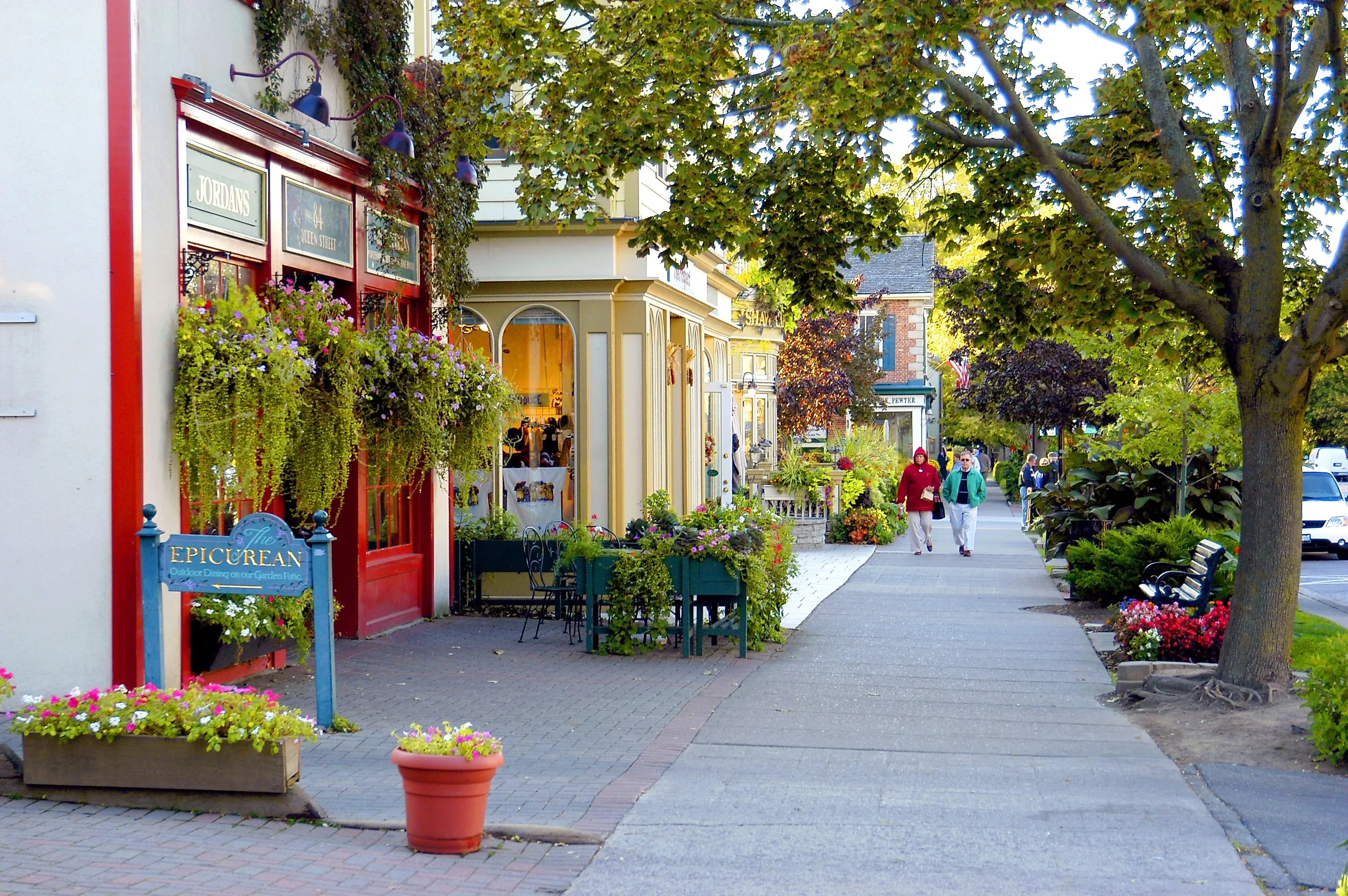
Niagara-on-the-Lake sits at the tip of the Niagara Peninsula where the Niagara River meets Lake Ontario. Fort George National Historic Site preserves the British post that anchored the Canadian side of the river during the War of 1812; the original fort was built in the 1790s and reconstructed in the 1930s. The town was burned during the war and rebuilt in the years that followed, which is why so much of the architecture along Queen Street dates to the 1820s and 1830s.
The surrounding countryside is one of Ontario's main wine regions, with more than 30 wineries clustered within a few minutes' drive of town. Icewine is the local specialty, made from grapes left on the vine through the first hard freeze. The Shaw Festival runs from April through December at the Festival Theatre on Queen's Parade, with productions tied to the era of George Bernard Shaw and his contemporaries.
Midland, Ontario

Midland sits on Georgian Bay at the southern end of Lake Huron's 30,000 Islands. Downtown holds more than 30 outdoor murals, most of them painted by the late Fred Lenz starting in the 1990s. The largest covers the side of the ADM grain elevator on the harbor and runs 80 feet high by 250 feet wide, making it the largest historical outdoor mural in North America. It depicts a Huron-Wendat man and a Jesuit priest looking down on the 17th-century mission of Sainte-Marie among the Hurons, which sits a few minutes east of town and is reconstructed as a living museum.
The Midland Butter Tart Festival lands every June and draws around 60,000 visitors for a single day of vendors, music, and tasting flights of a Canadian dessert that locals take seriously. Wye Marsh Wildlife Centre, just east of town, runs trails and boardwalks through 3,000 acres of wetland and is one of the better trumpeter swan viewing spots in southern Ontario.
Munising, Michigan

Munising sits on the south shore of Lake Superior at the western end of Pictured Rocks National Lakeshore, a 42-mile run of sandstone cliffs that take their name from the mineral-stained streaks of red, green, and orange running down the rock face. Boat tours leave from the Munising city dock for two- to three-hour trips along the cliffs, which can only be seen properly from the water. Bridalveil Falls, one of the named waterfalls inside the lakeshore, drops about 140 feet near Miners Castle.
The Alger Underwater Preserve covers 113 square miles of Lake Superior bottom around Munising and protects more than a dozen well-preserved 19th-century shipwrecks. The cold fresh water keeps the wood and metal in remarkable condition, and several wrecks sit shallow enough for divers and even snorkelers in calm weather. Glass-bottom boat tours run for visitors who want to see the wrecks without getting wet.
Petoskey, Michigan

Petoskey sits at the top of Michigan's Lower Peninsula on Little Traverse Bay, a deep inlet on the northeast side of Lake Michigan. The Gaslight Shopping District anchors downtown with around 100 independent shops and restaurants, including Grandpa Shorter's, a souvenir and Native American crafts store running on Lake Street since 1946. Ernest Hemingway spent his summers in nearby Walloon Lake as a boy, and the Little Traverse History Museum covers his early years through letters, photos, and first editions.
The town's other claim is the Petoskey stone, a fossil from a coral colony that lived in a warm shallow sea covering Michigan about 380 million years ago during the Devonian period. The stones turn up along the Lake Michigan shore and are easiest to find at Petoskey State Park just north of town, especially after a storm has churned up the gravel beach.
Bayfield, Wisconsin

Wisconsin's Bayfield is the gateway to the Apostle Islands National Lakeshore, a cluster of 22 islands and 12 miles of mainland Lake Superior shoreline known for sea caves, lighthouses, and old-growth forest. The Apostle Islands Cruises ferry runs sightseeing trips out of the Bayfield city dock, and the Madeline Island ferry crosses 2.5 miles to the largest of the islands several times a day.
The Bayfield Apple Festival happens the first weekend in October and brings around 50,000 people to a town of 530, with 60 fruit and craft vendors and a parade through downtown. Bayfield's hillside orchards run a self-guided trail called the Bayfield Fruit Loop, with apple, berry, and cherry farms open seasonally for picking and tasting.
Cheboygan, Michigan

Cheboygan sits at the mouth of the Cheboygan River where it empties into Lake Huron, near the Straits of Mackinac. The town is the eastern terminus of the Inland Waterway, a roughly 40-mile route through three rivers (Cheboygan, Indian, Crooked) and three lakes (Mullett, Burt, Crooked) that lets boaters cross most of the northern Lower Peninsula on inland water. Two locks (at Cheboygan and Alanson) handle the elevation changes, and the route was originally a Native American canoe path that avoided the rough water at the Straits.
The Black Mountain Recreation Area, a few miles south of town, runs more than 80 miles of trails on state forest land for hiking, mountain biking, snowmobiling, and off-road vehicles. Cheboygan State Park covers about three miles of Lake Huron shoreline northeast of town, with sandy beaches, a campground, and the ruins of the original Cheboygan Point Light, built in 1859 and abandoned in 1930.
Oregon, Ohio

Oregon is a Lake Erie suburb of Toledo and shares the bay with Maumee Bay State Park, a 1,336-acre park that runs trails through marsh and meadow, a beach on Lake Erie, two campgrounds, and an 18-hole golf course. The park is the host site of The Biggest Week in American Birding, a 10-day festival in early May timed to spring warbler migration; the marshes along the western shore of Lake Erie are one of the best stopover points for songbirds in eastern North America, and birders come from across the continent.
Pearson Metropark, also in Oregon, preserves a remnant of the Great Black Swamp, the dense wet forest that once covered most of northwest Ohio before 19th-century drainage opened the land to farming. The park has boardwalks through the wet woods and a small interpretive center on the swamp's natural and cultural history.
Michigan City, Indiana

Michigan City sits at the south end of Lake Michigan in LaPorte County and runs the eastern boundary of Indiana Dunes National Park, a 15,000-acre park that protects 15 miles of dunes, beaches, prairie, and bog along the lakeshore. The 3 Dune Challenge takes hikers up the park's three tallest dunes (Mount Tom, Mount Holden, and Mount Jackson) on a 1.5-mile loop with about 552 feet of elevation gain in the sand. The park has documented more than 350 bird species, which puts it in the top tier for biodiversity in any national park.
Washington Park covers the city's lakefront with a beach, a marina, and the Old Lighthouse Museum in the 1858 lighthouse keeper's dwelling, which is open seasonally with exhibits on the harbor's history. The current East Pierhead Light at the end of the breakwater dates to 1904 and is still active. The Barker Mansion downtown was completed in 1905 for railroad-car magnate John H. Barker and is now a public museum.
Ashland, Wisconsin

Ashland sits on Chequamegon Bay on the south shore of Lake Superior and was a major iron-ore shipping port through the early 20th century. The downtown is anchored by an outdoor mural project that has produced more than a dozen large historical murals, mostly along Main Street, depicting the town's logging, shipping, and brownstone-quarrying past. Several of the murals appear on the Self-Guided Mural Walk brochure available at the visitor center.
The Lake Superior Waterfront Trail runs about three miles between Maslowski Beach on the west and Bayview Park on the east, paralleling the lake. Inland, Copper Falls State Park is about 25 miles south and protects a series of waterfalls along the Bad River, including Copper Falls, Brownstone Falls, and Tyler Forks Cascades; Morgan Falls inside the park drops about 70 feet and is one of the highest waterfalls in northern Wisconsin.
Leland, Michigan

Leland sits on the Leelanau Peninsula on the northwest corner of Michigan's Lower Peninsula, between Lake Michigan and Lake Leelanau. Fishtown is the historic Leland River fishing district, a working cluster of weathered shanties, smokehouses, and charter boats run by a nonprofit that bought the property in 2007 to keep commercial fishing alive on the river. Carp River whitefish, smoked on site at Carlson's, has been a Leland export for more than a century.
The Manitou Island Transit ferry runs from Leland Harbor to North and South Manitou Islands inside Sleeping Bear Dunes National Lakeshore, with day trips and longer backpacking drop-offs from late spring to early fall. Whaleback Natural Area, a few minutes north of town, covers a 375-foot bluff on Lake Michigan with a 1.5-mile trail that climbs through hardwood forest to a Lake Michigan overlook.
The ten towns above each open onto a different piece of the Great Lakes story: a wine peninsula on Lake Ontario, a sandstone coastline on Lake Superior, a fossil-coral beach on Lake Michigan, a 40-mile inland boating route on Lake Huron, a Devonian sea bottom turned tourist economy. Pick a lake and a long weekend and start there.