How Many Lakes Are Big Enough To Be Seen From Space?
Earth has roughly 117 million lakes, and almost every one of them is invisible from orbit. To make the cut, a lake has to be big, big enough that an astronaut can spot it by eye through a window on the International Space Station without any help from a zoom lens. A handful pull it off, and the trick is often light rather than size alone: hit a calm lake at the right sun angle and it flares into a bright mirror called sunglint, while a frozen one glows white against the dark land in winter. Dozens of lakes qualify once you count them all, but the standouts below are the easiest to find, and the biggest few, like the Caspian and the Great Lakes, hold their shape even from the Moon, some 238,900 miles (384,400 km) away.
The Caspian Sea
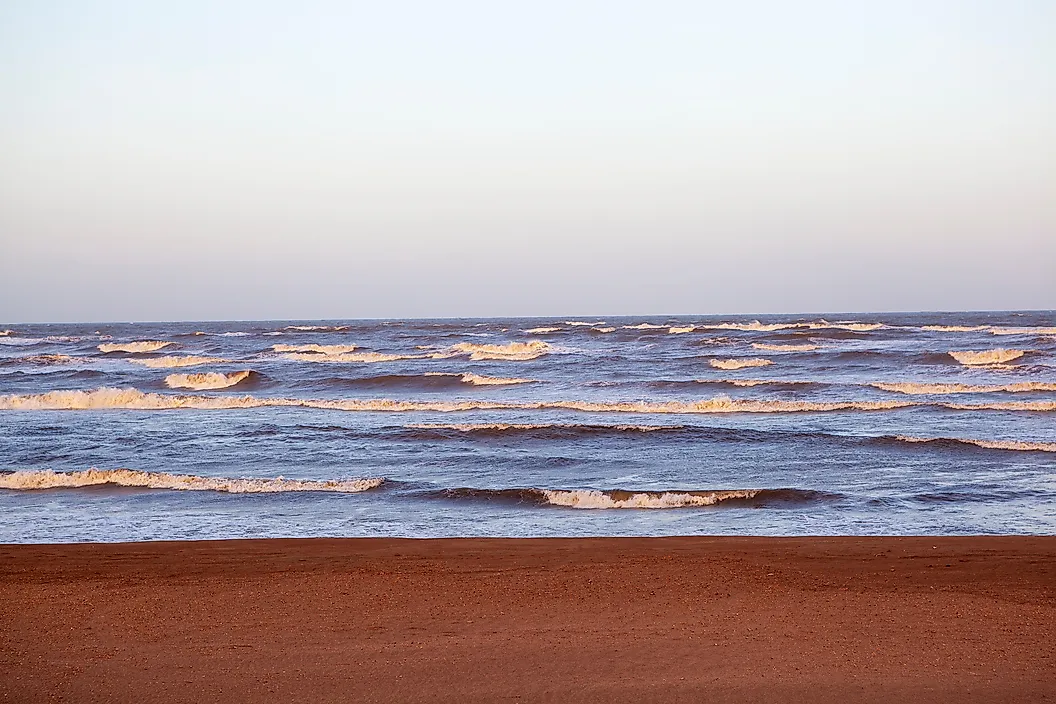
No inland body of water is easier to find from space than the Caspian Sea, the largest lake on Earth by a wide margin. An ISS crew photographed the whole basin on a single pass in June 2018, and NASA's Terra satellite has imaged it many times, its water darkening from the shallow north to the deep south. At roughly 143,000 square miles (371,000 sq km), the Caspian is about the size of Montana, and it is one of the few lakes whose scale carries the same way the Great Lakes do toward the Moon.
Its status as a lake comes with an asterisk. The Caspian is brackish, its water about a third as salty as the ocean, a legacy of its origin as a cut-off remnant of the ancient Tethys Sea some 5 to 11 million years ago. It sits in an endorheic basin, meaning it has no outlet to any ocean: the more than 130 rivers that feed it, chief among them the Volga, leave only through evaporation. Its shoreline is divided among five countries, Russia, Kazakhstan, Turkmenistan, Iran, and Azerbaijan.
The Great Lakes

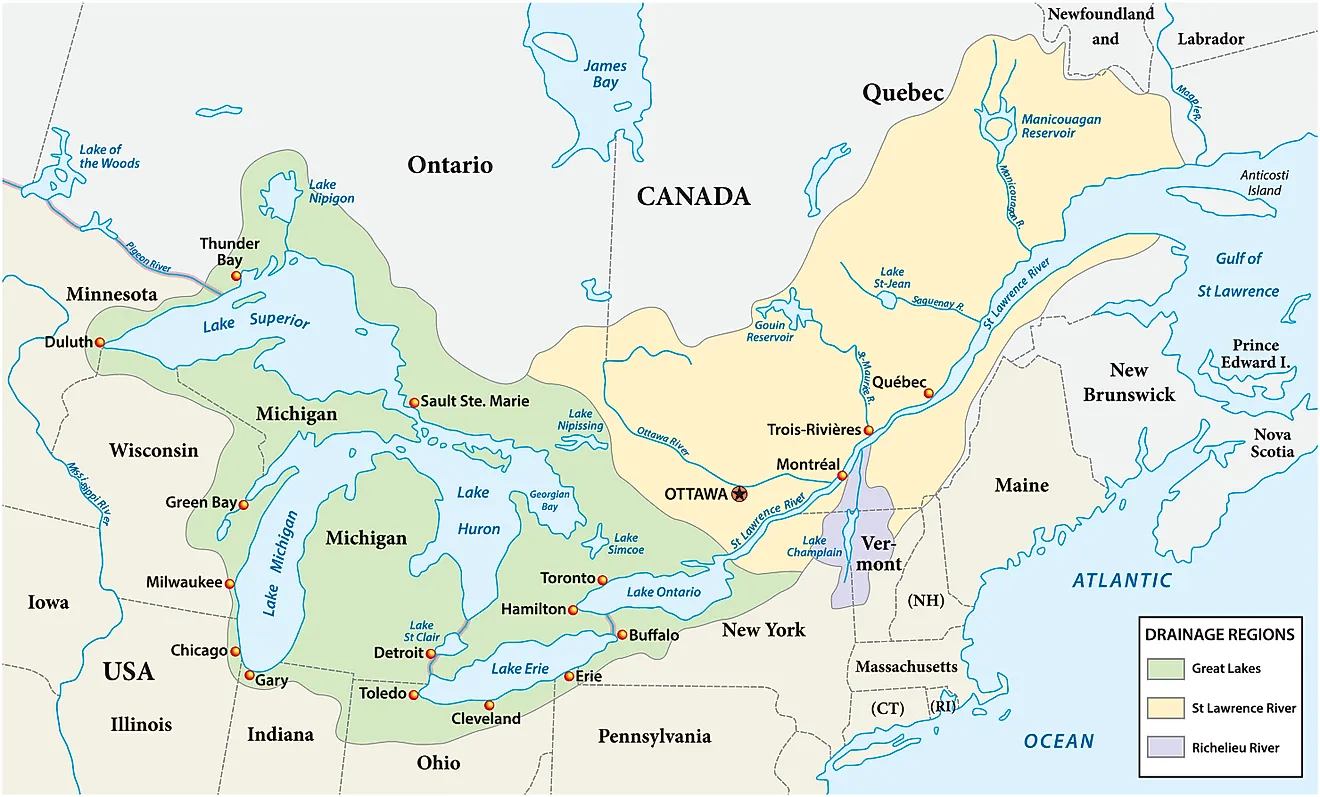
The five American Great Lakes are among the few lakes an astronaut can identify from both the ISS and the Moon. From the station's vantage point about 250 miles up, all five appear in a single frame, and NASA crews have photographed them together many times, including oblique shots taken from the Space Shuttle. At night the outlines of the water show up in negative, ringed by the lights of Chicago, Detroit, Cleveland, and Toronto. By day, sunglint turns whole lakes into bright reflective sheets.
Together the five lakes form the largest group of freshwater lakes on Earth by total area and the second largest by volume, trailing only Lake Baikal, which holds more water than all five combined. Their combined surface area is 94,250 square miles (244,106 sq km), a sheet of fresh water larger than the United Kingdom, and they contain more than 20 percent of the world's surface fresh water. That scale is what carries them across the quarter-million miles to the Moon: when Neil Armstrong looked back at Earth, the features he could still make out were continents and open water, not anything smaller.
The Finger Lakes

In June 2012, an astronaut on the ISS captured the Finger Lakes lit by sunglint, the 11 narrow lakes flashing bright against the surrounding hills while nearby Lake Ontario and Lake Erie glowed in the same frame. The lakes are far smaller than most on this list, but their shape works in their favor: long, thin, and roughly parallel, they read like a set of bright streaks when the light catches them. Seneca and Cayuga rank among the deepest lakes in the United States, with Seneca reaching 618 feet (188 m).
The lakes took their present form through glacial carving. During the Pleistocene ice ages, lobes of the advancing ice sheet gouged out a set of north-south stream valleys, and meltwater filled them as the ice pulled back roughly 10,000 to 12,000 years ago. Cayuga is the longest at about 38 miles (61 km), and none of the 11 exceeds 3.5 miles (5.6 km) in width. That narrowness is also their limit: from much beyond low orbit, the thin ribbons blur into the terrain, so unlike the giants on this list, the Finger Lakes drop out of sight well before the Moon.
Lake Victoria

Lake Victoria is the largest lake in Africa and the largest tropical lake on Earth, and its sheer breadth makes it an easy target from orbit. The MODIS sensors aboard NASA's Terra and Aqua satellites image the lake routinely, and ISS crews have photographed it on passes over East Africa. Because it straddles the equator, its northern shore never freezes, so it presents open water year-round.
Victoria spans roughly 26,600 square miles (68,800 sq km), a surface exceeded among freshwater lakes only by Lake Superior. It is comparatively shallow, reaching a maximum depth of about 270 feet (82 m), and its area is divided among three countries: Tanzania and Uganda hold the largest shares, with Kenya bordering the northeast. Its waters feed the White Nile, which drains northward from the lake's only outlet at Jinja, Uganda.
Lake Tanganyika

The elongated form of Lake Tanganyika is what gives it away from space. Envisat's MERIS instrument imaged the lake as a single long blue stroke across the continent, a shape produced by the rift valley it sits in. Running north to south along the borders of Tanzania, the Democratic Republic of the Congo, Zambia, and Burundi, it stretches about 418 miles (673 km) end to end while averaging only around 30 miles (50 km) wide, with a maximum width near 45 miles (72 km).
That length makes Tanganyika the longest freshwater lake in the world, and its depth of 4,820 feet (1,470 m) makes it the second deepest, after Baikal. It is also one of the planet's oldest lakes, formed between 9 and 12 million years ago, and one of only about 20 lakes worldwide with an age measured in millions of years. Its surface covers roughly 12,700 square miles (32,900 sq km), and it holds an estimated 16 percent of the world's available fresh water.
Lake Malawi

The southernmost of the African Great Lakes, Lake Malawi shares Tanganyika's rift-valley shape, a long, narrow blade of water that stands out clearly in satellite imagery of southeastern Africa. Also called Nyasa in Tanzania and Niassa in Mozambique, it runs up to 363 miles (584 km) north to south while reaching only about 47 miles (75 km) at its widest.
Malawi covers roughly 11,400 square miles (29,600 sq km), which makes it the third largest lake in Africa and the ninth largest on Earth by surface area, and it plunges to 2,316 feet (706 m), the second deepest in Africa after Tanganyika. It holds more fish species than any other lake in the world, most of them cichlids found nowhere else, the product of millions of years of isolation in a rift that first filled with water on the order of two million years ago.
Lake Baikal

In January 2024, an astronaut aboard the ISS photographed Lake Baikal at night, its frozen surface reading as a bright white mass against the dark forested land around it. The ice sheet that covers the lake for months each winter gives it a high contrast from orbit that open water lacks. Baikal runs about 395 miles (640 km) long and is the world's largest freshwater lake by volume, holding close to one-fifth of the planet's unfrozen surface fresh water.
The lake covers 12,248 square miles (31,722 sq km) and lies in Siberia, Russia, between Irkutsk Oblast to the northwest and the Republic of Buryatia to the southeast. It formed roughly 25 million years ago as a continental rift pulled the crust apart, which also makes it the oldest lake on Earth and, at a maximum depth of 5,387 feet (1,642 m), the deepest. Like the Finger Lakes, Baikal is easier to spot from the ISS than from the Moon, where its long, narrow profile becomes harder to separate from the surrounding land.
Great Bear Lake

Great Bear Lake is the largest lake lying entirely within Canada and the eighth largest on Earth, covering 12,028 square miles (31,153 sq km) just south of the Arctic Circle in the Northwest Territories. Its size alone would make it an orbital landmark, and its setting adds contrast: the lake freezes from about November into July, and for those months its white ice cover reads starkly against the surrounding boreal forest and tundra.
The lake filled a basin scooped out by Pleistocene ice sheets roughly 12,000 years ago, and it holds some of the clearest, coldest fresh water on the continent, in part because almost no one lives along its shores. Its single small community, Deline, sits near the outlet of the Great Bear River, which drains the lake westward into the Mackenzie. At its deepest the lake reaches about 1,463 feet (446 m).
Great Slave Lake

Southeast of its larger neighbor, Great Slave Lake covers about 10,500 square miles (27,200 sq km), the tenth largest lake in the world, and like Great Bear it spends much of the year under ice that makes it vivid from orbit. What sets it apart is depth: at 2,014 feet (614 m) it is the deepest lake in North America, deep enough that an underwater canyon in its eastern arm could swallow a skyscraper.
The lake is central to the geography of the Northwest Territories, with Yellowknife, the territorial capital, on its northern shore and Hay River at its southern end. It sits between the Slave and Mackenzie rivers, part of the great Mackenzie waterway that drains northwest to the Arctic Ocean. Its frozen surface becomes a winter ice road, and it stays ice-bound for roughly eight months of the year.
A Short List Among Millions
These lakes are standouts, not the whole roster. Out of roughly 117 million lakes, dozens are broad enough to be picked out from orbit by eye, and the count climbs further once sunglint lights up water that would otherwise blend into the land. What separates the entries here is that each one is easy to identify from the ISS, and a handful, the Caspian and the Great Lakes above all, hold their outlines across the distance to the Moon. Size is the deciding factor, but shape and setting matter too: the round bulk of the Caspian and Victoria carries farthest, the winter ice of Baikal and the Canadian lakes sharpens their contrast, and the rift-valley narrowness of Tanganyika, Malawi, and the Finger Lakes makes them vivid up close but quicker to fade with distance. What unites them all is scale on a geological order, the kind that took ice sheets and continental rifts millions of years to produce.