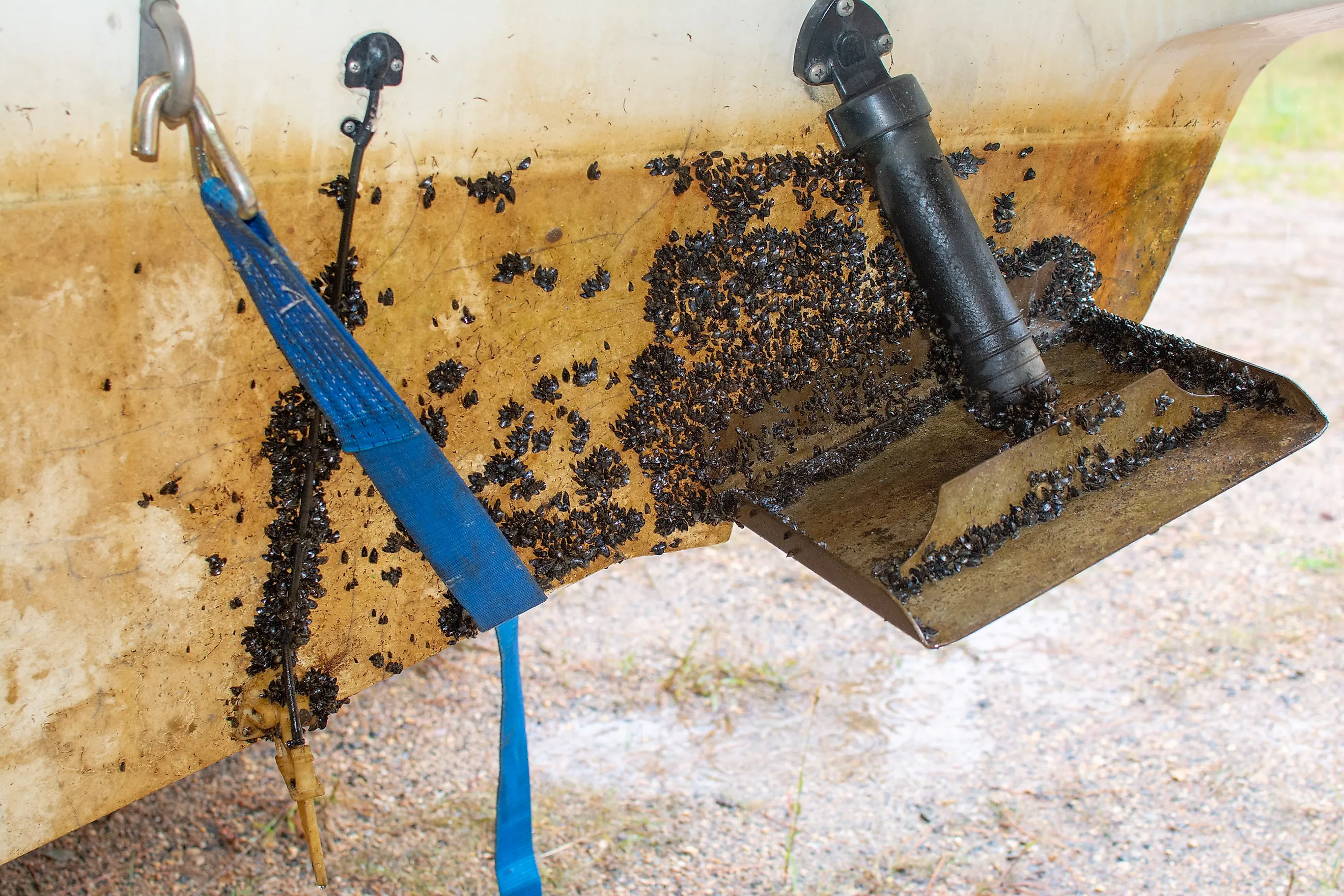
How A Single Boat Can Infest An Entire Lake
Ballast water from ocean freighters brought zebra mussels into the Great Lakes in the late 1980s. That part of the story is well known. What moved them into thousands of inland lakes afterward was smaller and far more ordinary: a trailered fishing boat pulling out of one ramp and backing down another the same weekend.
The reason one boat is enough comes down to arithmetic. The founding population does not need to be large, or visible, or even fully alive when it arrives. It needs to be a few teaspoons of water in a place nobody drains.
The Founders Are Too Small To See

Adult zebra mussels are obvious. You can feel them on a hull, a ladder, an anchor chain. They are not the main problem.
A female zebra mussel produces somewhere between 100,000 and 500,000 eggs in a year, according to the Minnesota Department of Natural Resources. Those eggs hatch into veligers, free-swimming larvae that drift for two to three weeks before settling and attaching with byssal threads. A veliger is microscopic. It is smaller than the dot over a lowercase letter i, and no inspection by eye will find one.
That is the whole mechanism. An adult mussel on a trailer is a visible risk that a boater might notice and scrape off. A few hundred veligers in engine cooling water are invisible, weightless, and completely unremarkable.
The Water Is Measured In Milliliters

The best data on this comes from a University of Minnesota study by Adam Doll, who sampled residual water from recreational boats at Gull Lake and Lake Minnetonka across two summers. Residual water is what stays behind after a boater has pulled the plug and done everything right.
More than 300 samples were collected from ballast tanks, live wells, sterndrive engines, and other compartments. Sterndrive engines held the most water, a median of about 4,945 milliliters, which is roughly 1.3 gallons. Ballast tanks came second at about 2,650 milliliters.
Then the counts. Ballast tank samples carried the highest median number of veligers at 247 per sample. Two of the 38 sterndrive engines sampled contained around 4,500 veligers each.
The encouraging half of the finding is that about 48 percent of samples had no veligers at all, and 75 percent had five or fewer. Most boats on most days carry nothing. The study's blunter conclusion is the one that matters for policy: removing all water from a boat is impractical. Drain plugs do not reach sterndrive cavities. That is why Minnesota law requires plugs to stay out during transport rather than simply asking boaters to drain at the ramp.
Plants Need Even Less Than That

Mussels at least require water. Eurasian watermilfoil requires a scrap of stem.
Minnesota's DNR states it plainly: all it takes is a single plant fragment to start a new population. Milfoil breaks apart easily, tangles in propellers, wraps around trailer bunks and axles, and hooks on keels and rudders. Once it lands in a new lake it can grow around two inches a day and form surface mats that shade out native plants.
The plant reached North America in the 1940s and now occupies most of the country. Boat traffic is credited with the majority of introductions into new water bodies. Hydrilla behaves similarly, overwintering as tubers that survive rough handling, and starry stonewort spreads through fragments in the same way.
They Survive The Drive

A boat trip between lakes is usually measured in hours. The organisms have far more time than that.
Adult zebra mussels survive under five days in dry conditions, but up to 21 days when conditions stay wet, such as inside the pipes of a dock or a boat lift. Veligers persist in whatever water is left in bait buckets, live wells, bilges, ballast tanks, and motors. Warm sun and highway airflow kill them quickly, which is the entire logic behind the drying step, but a cool overcast drive with the plug still in undoes that protection.
Golden mussels are tougher still. They can last around ten days out of water.
The Newest Passenger

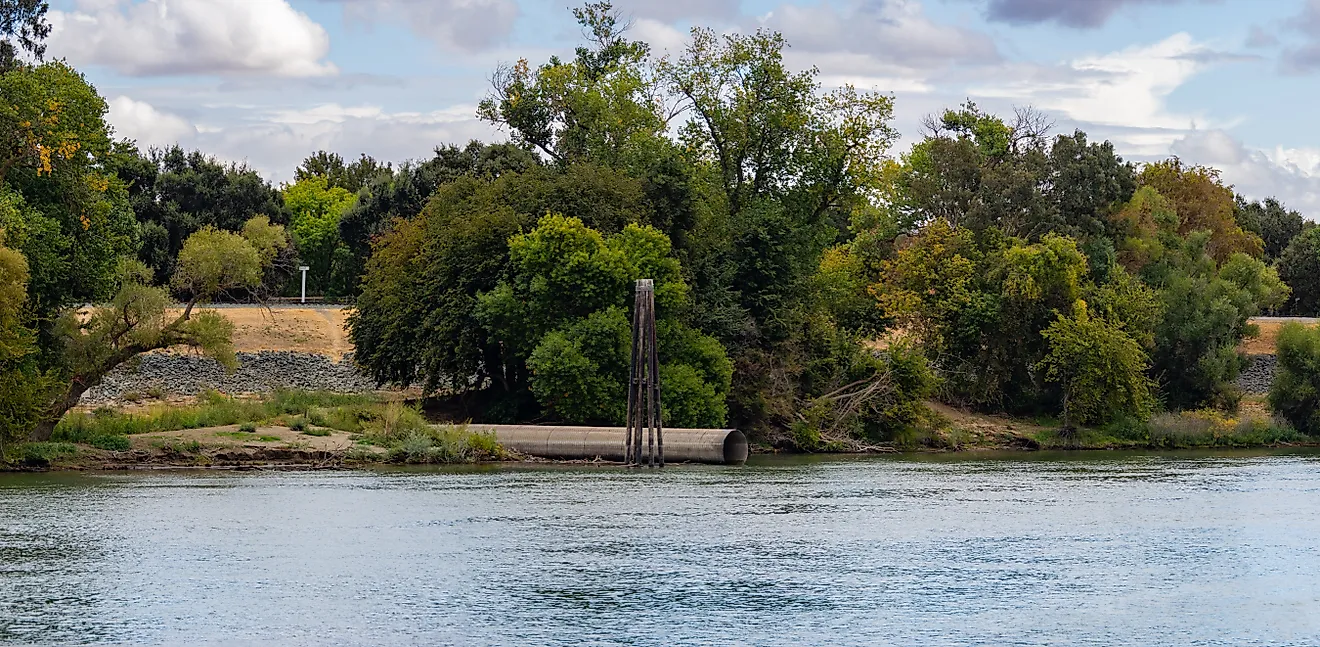
On October 17, 2024, staff from the California Department of Water Resources found unfamiliar mussels attached to a monitoring float near the Port of Stockton, in the Sacramento-San Joaquin Delta. Genetic work at UC Davis and the state agriculture lab confirmed the identification within a week. It was golden mussel, native to China and Southeast Asia, and it was the first detection anywhere in North America.
One detail from that discovery deserves attention. The same float had been inspected the previous month and showed nothing. The colony established between two routine checks.
Golden mussels almost certainly arrived on a ship. What happened next was not shipping. Within the first several months of 2025 they turned up in roughly 30 locations around central California, and by 2026 they had been reported as far south as San Diego County. They tolerate brackish water and lower calcium levels than zebra or quagga mussels, which widens the range of lakes they can colonize.
What Actually Stops It

Lake Tahoe is the clearest proof that the boat vector can be closed. The Tahoe Regional Planning Agency and Tahoe Resource Conservation District have run mandatory watercraft inspections since 2008, and quagga mussels have never established in the lake.
After golden mussels appeared in the Delta, a few hours' drive away, the agency went further. On March 26, 2025, its governing board required decontamination for every visiting motorized vessel, not just inspection. Boaters pay an annual registration fee plus a per-visit decontamination charge, with a discount for arriving clean and dry.
It has already worked twice. Inspectors at the Alpine Meadows station found a golden mussel on the propeller shaft of a boat that had been in the Delta days earlier. A second vessel was intercepted at the Meyers station the following year. Both boats would otherwise have launched.
The standard is stricter than most boaters expect. At inspection stations, a wet cupholder or a damp life jacket is enough to send a boat to decontamination. Folsom Lake requires either a verified decontamination or a 30-day quarantine before launch.
Not everyone is holding that line. In 2026 California ended the inspection program at Lake Oroville, betting that cold water will limit golden mussel establishment. Managers at Folsom, Tahoe, and Berryessa are continuing theirs, and one regional water official warned that an infested Oroville raises the risk for every other lake in reach. Prevention is only as strong as the least protected ramp.
The Math Of One Boat

Not every lake is vulnerable. Lake Superior has stayed largely free of dreissenid mussels because cold, calcium-poor water starves them of shell material. Chemistry and temperature still decide whether an arrival becomes an infestation.
But arrival is the step humans control, and the numbers are unforgiving. One female, hundreds of thousands of eggs. One stem fragment, a whole colony. Roughly 1.3 gallons of water hiding in an engine that a boater genuinely believes is empty.
Eradication is possible, but only at a scale that proves the point. Virginia cleared zebra mussels out of Millbrook Quarry in 2006 by dosing the entire 16-acre pit with 174,000 gallons of potassium chloride solution over three weeks, at a cost of roughly $365,000. It worked, and it held. Maryland repeated the approach at a quarry in Carroll County in 2019. Those are enclosed pits measured in acres. On Lake Mead or Lake Powell, the same method is not on the table. Attempts in real lakes have mostly failed or succeeded only inside a treated zone while mussels persisted elsewhere, as happened at Christmas Lake in Minnesota and at a marina on Lake George in New York.
That asymmetry is the reason inspection stations exist. Cleaning, draining, and drying a boat takes a few minutes at the ramp. The cheapest known fix on the other side of the ledger cost a third of a million dollars and only worked because the water had nowhere to go.