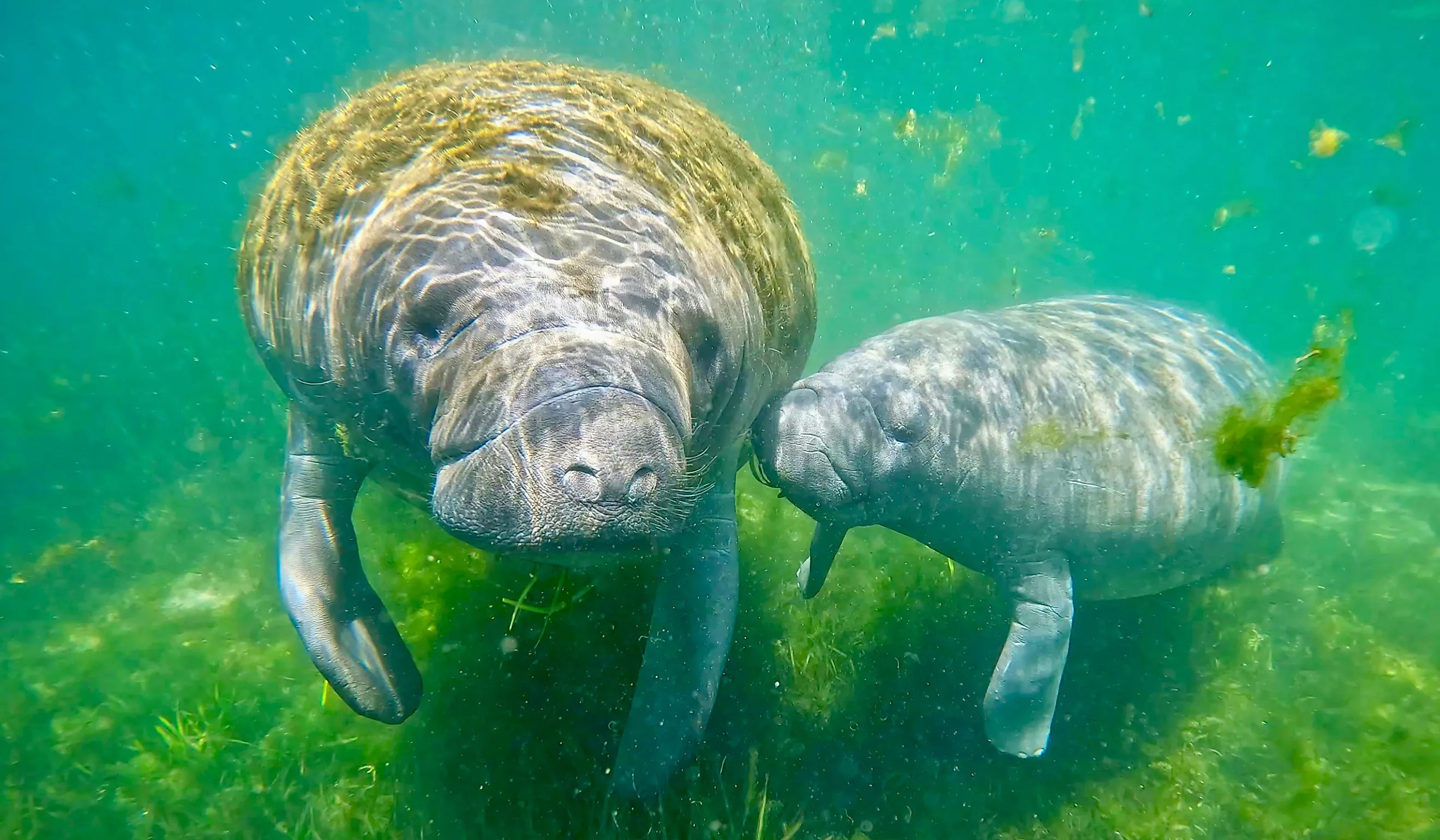
Where Manatees Go When The Water Gets Cold
When water temperatures drop, manatees swim closer inland to natural warm-water springs and artificial refuges, such as heated power plant discharge canals. While they are found primarily in Florida, manatees have been observed as far west as Texas and as far north as Massachusetts during the summer. From November through April, many migrate to Florida's warmer waters, where they gather in locations that provide refuge from colder temperatures.
Manatees have only about an inch of fat and a very slow metabolism, which provides limited natural insulation against cold water. Prolonged exposure to temperatures below 68 degrees can cause cold stress syndrome, which is similar to hypothermia and can affect their health and ability to survive. Places like Blue Spring State Park offer access to 72-degree spring-fed water, while Tampa Electric Company has established an entire campus for manatee habitats and viewing platforms at its Big Bend Power Station.
A subspecies of the West Indian manatee, the Florida manatee population is managed by the US Fish and Wildlife Service (FWS) and the Florida Fish and Wildlife Conservation Commission (FWC). Conservation efforts help protect the population and preserve essential winter habitats. The following five locations offer opportunities to observe manatees, learn about their behavior, and explore the conservation efforts supporting these threatened marine animals while ensuring their health and safety.
Blue Spring State Park

A safe haven and designated manatee refuge, Blue Spring State Park is one of the largest winter gathering sites for Florida manatees. Located on the St. Johns River in Orange City, the park has a first-magnitude spring, a natural spring that discharges at least 100 cubic feet of water per second. The constant 72-degree spring-fed water provides a warm habitat, with more than 700 manatees counted in 2023.
A boardwalk stretches about one-third of a mile from the St. Johns River to the headsprings, allowing visitors to observe manatees without interfering with their natural habits. The park also serves as a release site for rehabilitated manatees, allowing researchers and care personnel to monitor their progress as they adapt back into the environment.
Crystal River National Wildlife Refuge

Crystal River National Wildlife Refuge, established in 1983, is the only national wildlife refuge in the US specifically created to protect Florida manatees. Set in Crystal River on Florida's West Coast, the refuge preserves the 57-acre Three Sisters Springs and other federal manatee sanctuaries within the refuge in Kings Bay, including King Spring, Miller Creek, and Magnolia Shores. The area is estimated to have as many as 600 Florida manatees in the winter. Three Sisters Springs has a boardwalk for observing the manatees, and the Visitor Center features interactive exhibits and educational opportunities. Kayaks and paddleboards are banned in the springs during the manatee season, which runs from about November 15 through March 31.
Tampa Electric Company (TECO)

Further south on the West Coast, in Apollo Beach, the warm-water discharge at Tampa Electric's (TECO) Big Bend Power Station serves as a designated sanctuary for wintering manatees. The plant circulates water from Tampa Bay for cooling, then releases clean, warm water back into the bay. In 2024, approximately 1,100 manatees were counted during a particularly cold period.
The TECO Manatee Viewing Center and the Florida Conservation and Technology Center (FCTC) are located within the property, offering a system of boardwalk trails, an environmental education center, and a 50-foot observation tower at the 500-acre facility. A showcase for research, education, and habitat restoration, the campus is the result of a collaboration between Tampa Electric, the Florida Aquarium, and the Florida Fish and Wildlife Conservation Commission.
Manatee Lagoon

Across the state on the Atlantic Coast, manatees congregate in Lake Worth Lagoon, near the warm-water discharge area from Florida Power & Light Company's (FPL) adjacent Riviera Beach Next Generation Clean Energy Center. During particularly cold spells, such as in January of 2026, more than 160 manatees have been observed at Manatee Lagoon.
Dedicated to preserving Florida's environment and educating the public about manatees, the FPL Eco-Discovery Center is a free 16,000-square-foot educational facility with areas for observing manatees. An upper-level observation deck and a first-level platform, near the power plant's warm-water outflow, offer vantage points for viewing. The educational center has exhibits that allow visitors to learn about manatee conservation efforts and take tours of the five-acre property.
Merritt Island National Wildlife Refuge

Merritt Island National Wildlife Refuge, near Titusville, is another winter sanctuary for manatees. The Manatee Observation Deck, located along the Haulover Canal near Kennedy Space Center, provides an accessible viewing area. Situated on the canal's north side, the deck overlooks the waterway connecting the Indian River to Mosquito Lagoon. Bairs Cove Boat Ramp, southwest of the Haulover Bridge, is another popular manatee observation area. Additionally, visitors can explore a seven-mile Black Point Wildlife Drive through the refuge, where manatees, dolphins, and other coastal wildlife can often be seen. During peak activity, observers have reported 10 to 30 manatees at a time.
Established in 1963, the refuge protects approximately 140,000 acres of wetlands, pine forests, and mangrove habitats. Unlike spring-fed parks and power plant discharge areas, its tidal lagoon waters do not maintain a consistently warm temperature in winter. As a result, manatees may move further inland in search of warm water during particularly cold weather.
Manatees in the Winter
These locations serve as important winter habitats for manatees while offering visitors opportunities to learn about their behavior and conservation. According to a 2023 study by the Florida Fish and Wildlife Conservation Commission, Florida manatee populations range from approximately 8,350 to 11,730. Manatees play a significant ecological role by feeding on seagrass and algae, helping to control aquatic vegetation. Designated viewing areas provide opportunities to observe manatees without disturbing them, as approaching or interacting with wild manatees is prohibited by law. Together, these sites highlight Florida's natural resources and conservation efforts, from the protected waters of the Crystal River National Wildlife Refuge to warm-water discharge canals operated by Florida Power & Light Company.