Why The Great Lakes Almost Never Freeze Over Completely
The Great Lakes endure months of subfreezing air and repeated Arctic outbreaks, yet a continuous ice sheet across all five lakes is extraordinarily rare. Before ice can spread across deep offshore water, the atmosphere must remove the heat accumulated during summer and autumn. That process is slowed by the lakes' depth, freshwater's unusual density behavior, and persistent wind, waves, and currents. Ice forms first in sheltered bays and shallow nearshore zones, while the deep central basins remain open much longer. Lake Erie can occasionally reach complete surface coverage, but the other lakes usually retain too much heat and motion for every opening to close.
What "Completely Frozen" Means

A Great Lake described as completely frozen is not frozen from its surface to its bottom. In scientific ice records, complete freezing generally means that ice covers 100% of the lake's surface. Most of the water underneath remains liquid, with deeper layers commonly remaining near 39°F (4°C).
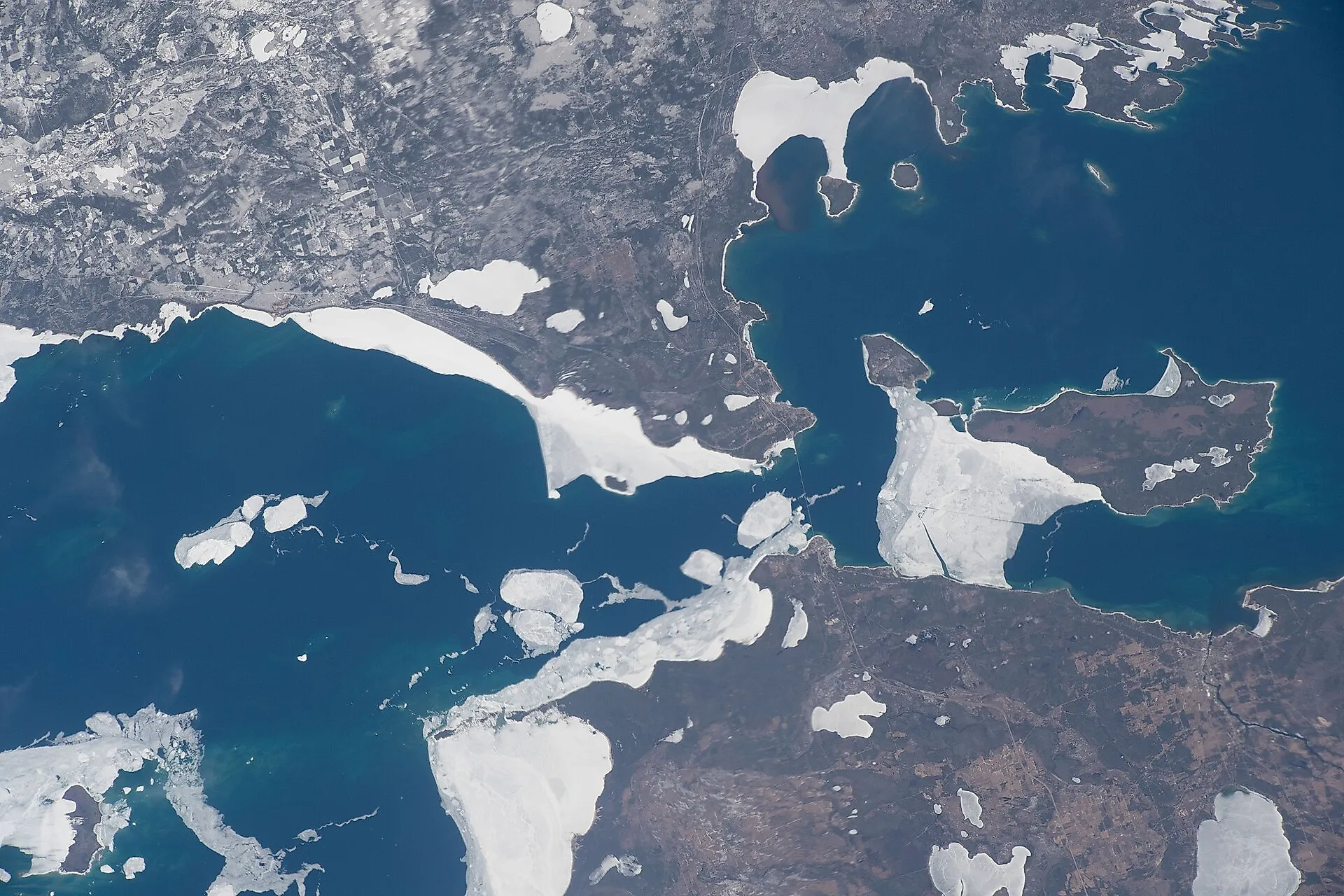
Even complete surface coverage is difficult to achieve. The National Oceanic and Atmospheric Administration's Great Lakes Environmental Research Laboratory has maintained a consistent basin-wide ice record since 1973. The highest recorded maximum was 94.7% in 1979. One of the coldest winters in the modern record therefore still left part of the Great Lakes system open. Narrow leads, current-swept channels, and portions of deep central basins can remain ice-free even when satellite images make the lakes appear almost entirely white.
The Lakes Store an Immense Reserve of Heat

Together, the Great Lakes contain approximately 5,439 cubic miles (22,684 cubic kilometers) of water. Lake Superior alone holds about 2,900 cubic miles (12,100 cubic kilometers) and has an average depth of 483 feet (147 meters). Water has a high specific heat capacity, meaning that it can absorb or release a large amount of energy without changing temperature quickly. The Great Lakes consequently carry heat acquired during summer and autumn far into the winter.
Depth determines how much water can supply heat to the surface. Lake Ontario is the smallest Great Lake by surface area, but its average depth is approximately 283 feet (86 meters). It stores much more heat beneath each square meter of surface than Lake Erie, whose average depth is only 62 feet (19 meters). A strong cold spell can rapidly chill Erie's shallow water column. The atmosphere must remove heat from a much greater volume before offshore ice can stabilize on Ontario, Michigan, or Superior.
This thermal inertia explains why harbors and shorelines may freeze within days while the open lake remains liquid. A brief Arctic outbreak can cool the surface, but several weeks of sustained heat loss may be required to cool a deep offshore water column. A thaw arriving before that process is complete can stop ice growth or reverse it.
Freshwater Must Mix Before It Can Freeze

Freshwater reaches its greatest density at approximately 39°F (4°C) rather than at its freezing point. During autumn, surface water loses heat, becomes denser, and sinks. Warmer water then rises from below to replace it. This seasonal circulation, known as autumn overturn, distributes heat through the water column.
As long as newly cooled surface water continues to sink, heat from deeper water is carried upward and released into the atmosphere. Much of the actively mixed water must first approach 39°F (4°C). Further cooling then creates inverse stratification. Water colder than 39°F (4°C) becomes less dense, remains near the surface, and can eventually reach 32°F (0°C).
Additional heat must be removed as the water changes from a liquid into a solid. The resulting ice floats because it is less dense than liquid water. A stable ice layer can eventually insulate the water below, preventing an entire lake from freezing solid. On a Great Lake, however, the first thin ice must survive waves and wind before it can become a continuous surface sheet.
Wind, Waves, and Currents Keep the Surface Open

The Great Lakes provide long expanses of open water over which wind can travel, a distance known as fetch. Winter storms can therefore generate large waves. Before ice develops, wind deepens the surface mixed layer and brings relatively warm water upward. Because a deeper mixed layer contains more stored heat, the atmosphere must remove more energy before freezing can begin.
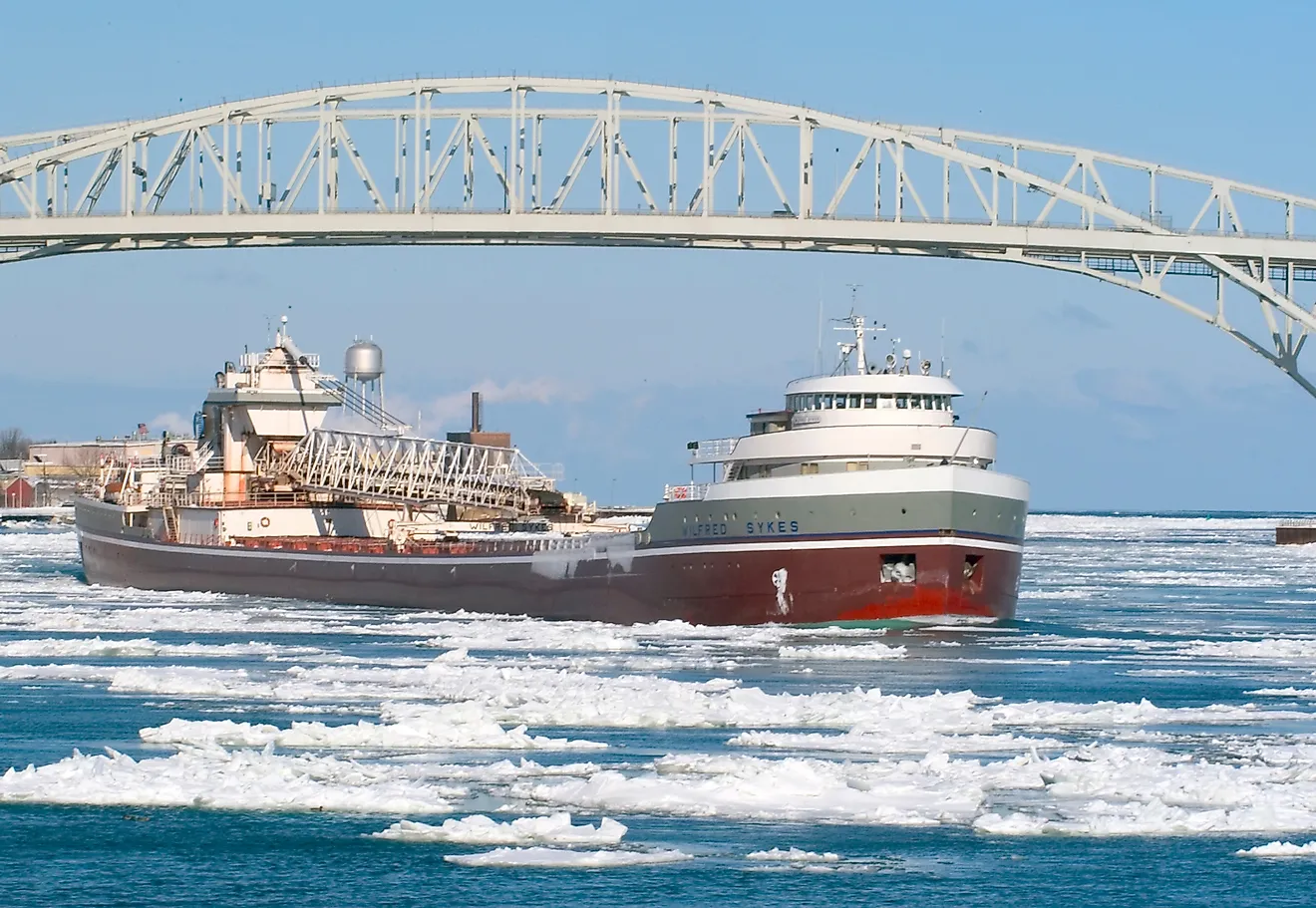
Once thin ice appears, waves can fracture it into moving plates. Turbulent water may produce frazil ice, consisting of loose ice crystals, or rounded pancake ice floes that collide and overlap. Wind can pile ice against one shoreline while opening new stretches of water elsewhere. The result is often a mobile and irregular ice field instead of one unbroken sheet.
Currents create another obstacle. Water moving through connecting channels and straits can disturb newly formed ice or transport heat into colder areas. Upwelling can also bring warmer subsurface water toward the surface. NOAA research has found that areas with greater depth and longer wind fetch tend to retain higher winter water-column temperatures and experience shorter periods of ice cover.
The Last Areas to Freeze Are the Hardest

Ice usually expands first across shallow bays, harbors, river mouths, and protected shorelines. These locations contain less water beneath each square meter of surface, so they have less heat to lose. Shelter from the largest waves also allows newly formed ice to remain in place. Green Bay, Saginaw Bay, western Lake Erie, and protected sections of Lake Superior can therefore freeze while nearby offshore water remains open.
The final openings generally occur over deep water or in areas exposed to wind and currents. Mid-lake zones have deep basins, large heat reserves, and long wind fetch. The remaining open water is therefore not a random portion of the lake. It is concentrated in the places most resistant to freezing. This explains why reaching 90% coverage does not guarantee that a lake will reach 100%. By the time the deepest areas approach freezing, a storm may fracture existing ice, a thaw may arrive, or increasing late-winter sunlight may begin warming the surface.
Why Lake Erie Is the Exception

Lake Erie is the Great Lake most capable of freezing over because it is by far the shallowest. Its average depth is only 62 feet (19 meters), compared with 195 feet (59 meters) for Lake Huron, 279 feet (85 meters) for Michigan, 283 feet (86 meters) for Ontario, and 483 feet (147 meters) for Superior. Erie contains approximately 116 cubic miles (484 cubic kilometers) of water, about 4% of Lake Superior's volume.
Erie's shallow western basin responds especially quickly to sustained cold. NOAA records show that the lake reached 100% maximum surface ice coverage in 1978, 1979, and 1996. Lake Ontario demonstrates why surface area alone does not determine ice coverage. Although it has the smallest surface area, its deep basin stores substantial heat and usually develops much less ice than Erie.
Lake Superior experiences severe northern winters, but its immense volume, great depth, and broad open-water surface delay complete freezing. Shallow bays may close while the central basin continues releasing stored heat. Superior has reached 100% maximum coverage in NOAA's individual-lake records, but complete coverage remains exceptional rather than normal.
Winter Must Stay Cold Long Enough

Ice growth depends more on accumulated cold than on a single exceptionally low temperature. Scientists often measure this accumulated exposure through freezing degree-days. A brief Arctic outbreak can create rapid nearshore ice, but complete coverage requires cold conditions to persist across the basin. Calm weather also helps new ice consolidate instead of being broken apart.
Great Lakes ice usually expands through January and February, with the basin-wide seasonal maximum normally occurring between mid-February and early March. The window for additional freezing then begins to close. Longer days, warmer air masses, rainfall, and changing winds encourage melting and breakup. A late-winter thaw can reverse several weeks of ice expansion.
Large-scale atmospheric circulation explains why ice coverage differs sharply between winters. The position of the jet stream and climate patterns such as the El Niño-Southern Oscillation and North Atlantic Oscillation affect how often Arctic air reaches the Great Lakes. A long-term warming trend can therefore still include individual winters with extensive ice.
Climate Change Is Shortening the Ice Season

NOAA observations since 1973 show an overall decline in Great Lakes ice coverage, although severe winters continue to interrupt the trend. Warmer autumn water leaves the lakes with more stored heat at the beginning of winter. Warmer winter air reduces accumulated freezing degree-days, delays freeze-up, and encourages earlier breakup. NOAA researchers have also documented a general shortening of the winter season within Great Lakes waters.
A peer-reviewed study published in 2026 used long-running weather station records to reconstruct Great Lakes ice conditions back to 1897. Separate NOAA research has linked Great Lakes ice variability to multidecadal patterns such as the Atlantic Multidecadal Oscillation and the Pacific Decadal Oscillation. That longer record provides important context for the pronounced decline observed during the satellite era. Natural atmospheric variability can strengthen or weaken the trend for several decades, but it operates alongside long-term warming rather than replacing it.
Reduced ice affects more than the appearance of the lakes. Open water continues exchanging heat and moisture with the atmosphere and can influence lake-effect precipitation. Winter waves can reach exposed shorelines more easily. Ice coverage also affects water circulation, temperature structure, and the timing of biological processes such as spring plankton development.
The Takeaway
The Great Lakes almost never freeze over completely because winter must overcome enormous stored heat, continuous mixing, and a restless surface. Freshwater's maximum density near 39°F (4°C) causes cooling water to sink, carrying deeper heat upward before a stable cold surface layer can form. Wind enlarges the mixed layer, waves fracture young ice, and currents preserve openings in deep or narrow parts of the system.
Lake Erie can occasionally close because its water column is comparatively shallow, but the deeper lakes usually retain too much offshore heat and motion. The exceptional winter of 1979 reached 94.7% basin-wide coverage without completely closing the system. As regional temperatures rise, the period available for ice formation is becoming shorter, although natural atmospheric variability will continue to produce occasional high-ice winters.