Where Alligators Live In Mobile Bay
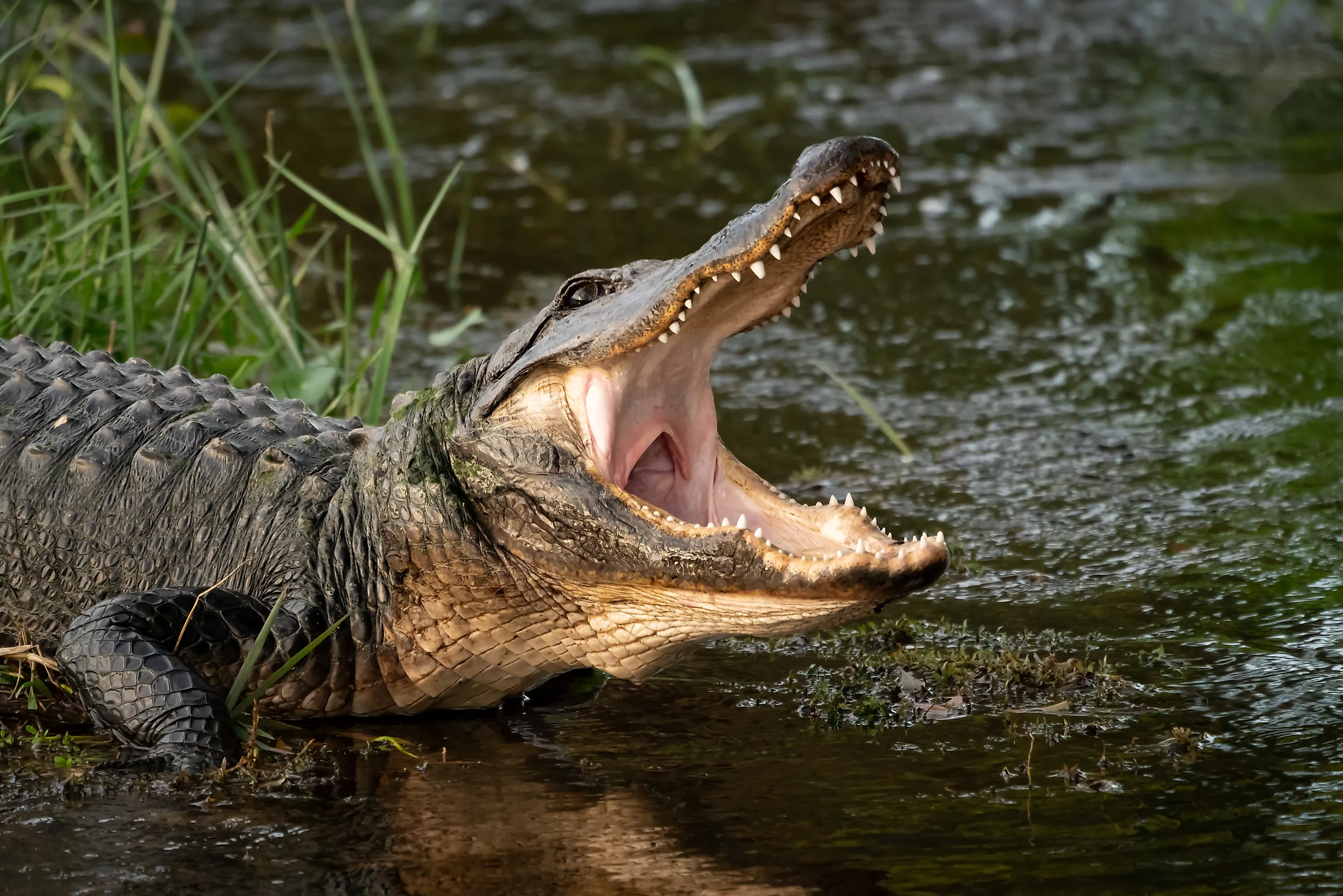
Alabama holds an alligator hunting season on Mobile Bay. The state's Coastal hunting zone takes in the waters of Baldwin and Mobile counties south of I-10, and its wildlife agency says it is not unusual to see alligators in the Gulf of Mexico itself.
They are not spread evenly around the bay. An American alligator can swim into salt water, but it has no glands to get rid of the salt, so sooner or later it has to get back to fresher water. Mobile Bay can run nearly fresh at its top and be dominated by Gulf water near its mouth, and where an alligator lives depends on which end it is closer to. One of those places is a downtown street.
Mobile-Tensaw Delta

North of the bay, the Mobile and Tensaw rivers spread into a tangle of streams, lakes, swamps, and marshes about 10 miles wide and nearly 50 miles long. The Mobile-Tensaw Delta holds the state's largest population of American alligators, and the Alabama Wildlife Federation says there are probably more alligators in the delta now than in all the rest of Alabama. The water here is largely fresh, with brackish water reaching into parts of the delta.
Alligators in Alabama are most active between dusk and dawn, which is when Historic Blakeley State Park's Gator Cruise goes out. The evening trips run in the summer months into secluded reaches of the lower delta, looking for alligators and other nocturnal wildlife from the Delta Explorer, a covered boat that also carries the park's daytime cruises. On the daytime Delta Adventure Cruise, the wildlife to watch for includes eagles, ospreys, and alligators.
The Causeway And Meaher State Park

The Delta Explorer runs from the landing at 5 Rivers, on the Causeway, the seven-mile road across the head of the bay. Most of the restaurants along the Causeway have decks where alligators can often be seen basking in the sun, and in hot summer weather they bask along the road itself. Meaher State Park sits on the Causeway along Ducker Bay, at the junction of Mobile Bay and the Mobile-Tensaw Delta, where a boardwalk juts into the bay and crosses several small islands and alligators sometimes travel through the park's wetlands. Directly across the road, the Alabama Wildlife Federation's 5 Rivers Delta and Bay Conservation Center takes its name from the Mobile, Spanish, Tensaw, Apalachee, and Blakeley rivers, which flow into Mobile Bay there.
Downtown Mobile And The Mobile River

More than 95 percent of the fresh water entering Mobile Bay comes down the Mobile River system, and at the Causeway's west end, the Mobile River runs past downtown Mobile. On May 9, 2024, an alligator officials estimated at 10 to 11 feet long crawled under a fence and onto Water Street, where it meets I-165 and Beauregard Street in front of the GM&O building. Police diverted traffic until the alligator went back under the fence.
Three Mile Creek, which runs through the city, has its own greenway, a 6.5-mile trail connecting several city parks between Tricentennial Park and University Hospital, and Tricentennial Park has a kayak launch for paddling the creek. Back in 2015, before the trail was built, a Mobile Bay National Estuary Program staffer listed an alligator among the wildlife he had seen on the creek, along with jumping mullet and birds. Down on the riverfront, an alligator once walked out onto the dock at the GulfQuest National Maritime Museum, and animal control, working with state wildlife officers, coaxed it back into the river.
Daphne And The Eastern Shore

On summer nights along the Eastern Shore, a Jubilee can drive flounder and crabs into the shallows, and Daphne, across the bay from downtown Mobile, calls itself the Jubilee City. It starts with salty Gulf water trapped beneath the lighter river water. That bottom layer runs out of oxygen, and when an incoming tide pushes it toward shore, the slower fish and crabs flee ahead of it. During one Jubilee, Fairhope outdoorsman Frank Potter photographed an alligator in Daphne eating a flounder, and then another seven or eight in a row.
Alligators work the open water off Daphne as well. In July 2023, one that witnesses put at about 13 feet long, and possibly blind, was spotted between Belrose and May Day parks, and according to Mayor Robin Lejeune, it chased a fisherman in a boat. After heavy rain in October 2021, which a wildlife expert said may have pushed alligators out of their usual habitat, so many turned up in town that the city posted a warning: "Please Beware of Alligators! We have seen a large number of alligators in the Jubilee City."
Gator Lake At Bon Secour National Wildlife Refuge

Seeing Gator Lake, on Bon Secour National Wildlife Refuge on the Fort Morgan peninsula near the mouth of the bay, takes about a mile of walking on the Gator Lake Trail or the Chan West Pine Beach Trail. The Pine Beach Trail runs between a saltwater lagoon on one side and a freshwater lake on the other, and a large observation deck near the bridge at Gator Lake is the place to look for alligators, along with wintering ducks and grebes.
The 40-acre lake is open for fishing, though its freshwater fish populations are low because of saltwater inundation from past hurricanes. Nearby, on Plash Island in Gulf Shores, a 10- to 12-foot alligator was filmed just outside a house during Hurricane Sally's flooding on September 16, 2020.
Dauphin Island

Across the mouth of the bay from Fort Morgan, Dauphin Island faces the open Gulf, and on May 7, 2023, Matt Harvill of Mobile filmed an alligator riding the waves in to the beach there. It "didn't hiss, charge or open its mouth at all," he said.
Alligators can tolerate a variety of salinity levels, Marianne Gauldin of the Alabama Department of Conservation and Natural Resources said after the sighting. Those that show up on the beaches and on Dauphin Island, according to JJ McCool of Alabama Wildlife Solutions, have almost always been run out of wherever they were living.
The island's Audubon Bird Sanctuary runs from swamp and dunes down to the Gulf beach, and an accessible boardwalk leads from its parking lot to a wharf over Gaillard Lake, a freshwater lake where an alligator occasionally appears.
River flow into Mobile Bay generally peaks from February to May, when salinity across the whole bay runs at its lowest, and the bay is saltiest from August to November. Alligator mating season, which brings more alligators into view around Mobile County, falls inside that fresher window, in April and May. Two widely reported sightings came in back-to-back Mays: the alligator that rode the surf onto a Dauphin Island beach on May 7, 2023, and the one that stopped traffic on Water Street on May 9, 2024. In the heat of summer, alligators bask along the Causeway, a short drive from the delta, where the largest number of them live and where the Gator Cruise goes looking after dark. Wherever one appears, feeding it is illegal in Alabama, and state wildlife officials say alligators that learn to link people with food must be euthanized.