Why The Ottomans Expanded So Quickly Across Three Continents
The Ottoman Empire rapidly expanded during its first 300 years. In the 13th and 14th centuries, it established itself as a dominant player in the Balkans and Anatolia. The next centuries then saw the Ottomans further move into Europe and the Middle East, while also establishing a foothold in North Africa. Considering the immense scale of the expansion, it's worth exploring how the Ottomans actually accomplished this. Exploring this topic reveals several crucial elements, including geopolitical advantages, a superior military, a combination of religious authority and tolerance, and pragmatic governance.
Geopolitical Advantages

The first reason why the Ottomans were able to accumulate territory on three continents was the weakness of other powers. In the 1300s, the Anatolian peninsula was divided between many states (known as beyliks). This allowed the Ottoman beylik, one with a strong founding myth and a superior military, to dominate it. The Balkan states were similarly fragmented, letting the Ottomans establish a foothold in the region as well. The final main Ottoman competitor, the Byzantine Empire, was also weak. Despite being the continuation of the Roman Empire, by the 14th century, it had been reduced to a regional power that survived through diplomacy and the misfortune of its adversaries. This came to an end in 1453, when the Ottomans captured the Byzantine capital of Constantinople.
Superior Military

Another reason for the rapid Ottoman expansion was its superior military. Perhaps the most important component of this superiority was the Janissaries, an elite military corps tasked with protecting the sultan. The Janissaries were effective for several reasons. First, they were made up of forcibly collected boys from the Balkans. This meant that they were completely loyal to the sultan, since they lacked biases regarding local Anatolian politics.

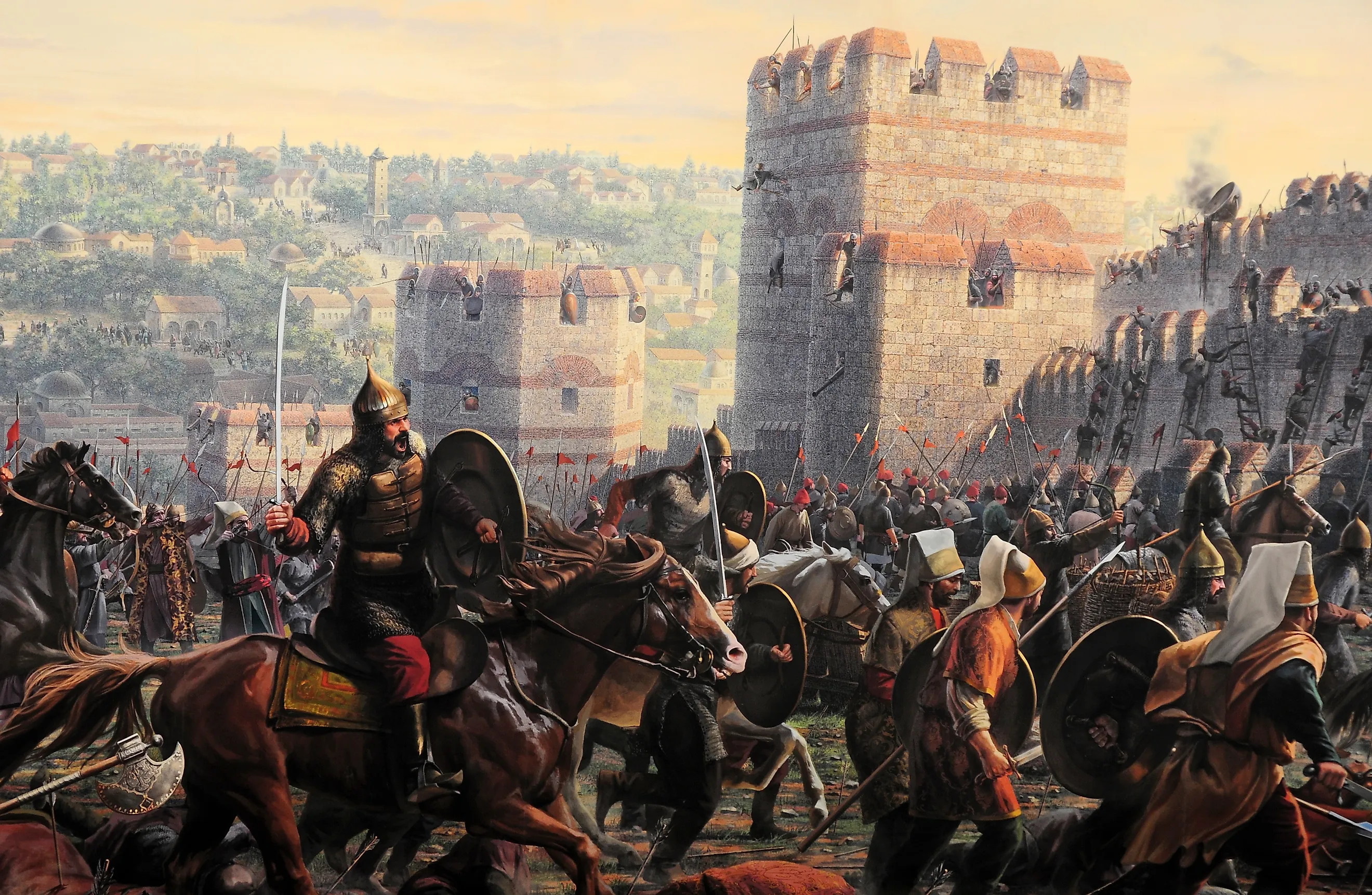
Second, they were trained in elite military institutions, making them superior tactically and physically to other contemporary armies. Third, their use of new technologies, like gunpowder, further improved their efficacy. This was perhaps most clearly exemplified in the 1453 conquest of Constantinople, in which massive cannons were utilised to breach the city walls.
Religious Authority And Tolerance

The Ottomans' handling of religion was also crucial in expanding and maintaining their territorial reach. Indeed, the sheer size of the empire meant that it had to contend with a diverse array of cultures, national identities, and historical perspectives. Islam was thus used as a legitimizing principle, since the majority of Ottoman citizens were Muslim (specifically Sunni). This became especially apparent in the 1510s when the Ottomans took control of Mecca and Medina. Now that the empire included the two holiest cities in Islam, the Ottoman government could credibly claim to be a Caliphate (an Islamic government that leads the global Muslim community). This helped unify Sunni Muslims all the way from the Balkans to North Africa.

Not all Ottoman citizens were Muslims; the most notable religious minorities were Jews and Christians. Rather than expelling or forcibly converting them, like many other contemporary empires, the Ottomans were comparatively tolerant. They allowed Christians and Jews to practice their religions and manage their own laws, education, and taxation, so long as they paid a tax called the Jizya. This tolerance further unified the diverse Ottoman citizenry, allowing the empire to expand into non-Muslim areas without incurring significant long-term resistance.
Pragmatic Governance

The final reason why the Ottomans were able to expand across three continents was their pragmatic approach to governance. This was clearly exemplified in North Africa. Rather than occupying entire states, the Ottomans focused on major power centers and coastal cities. Doing so allowed them to avoid any protracted and costly inland wars. Then, after capturing these key strategic locations, the Ottomans let local leaders control much of the interior. This meant that they did not get bogged down in any administrative challenges. It also helped prevent the emergence of resistance movements, as people's lives were largely unchanged from before Ottoman rule. While it differed somewhat depending on the region, the Ottomans employed this approach to governance throughout the empire, allowing them to acquire vast swaths of territory and then maintain control over it.
Legacy And Importance
The importance of the Ottoman expansion across three continents is difficult to overstate. It shaped the history of millions of people, cultures, and religions. It also influenced other major world powers, with the Habsburg, Russian, Safavid, and Mamluk Empires all being threatened or outright defeated by the Ottomans. Finally, the Ottoman Empire's reach sheds light on the artificial division between geographic regions. Indeed, while the empire encompassed a diverse array of people, the fact that it managed to unify them indicates that people across Africa, the Middle East, and Europe share significant commonalities.