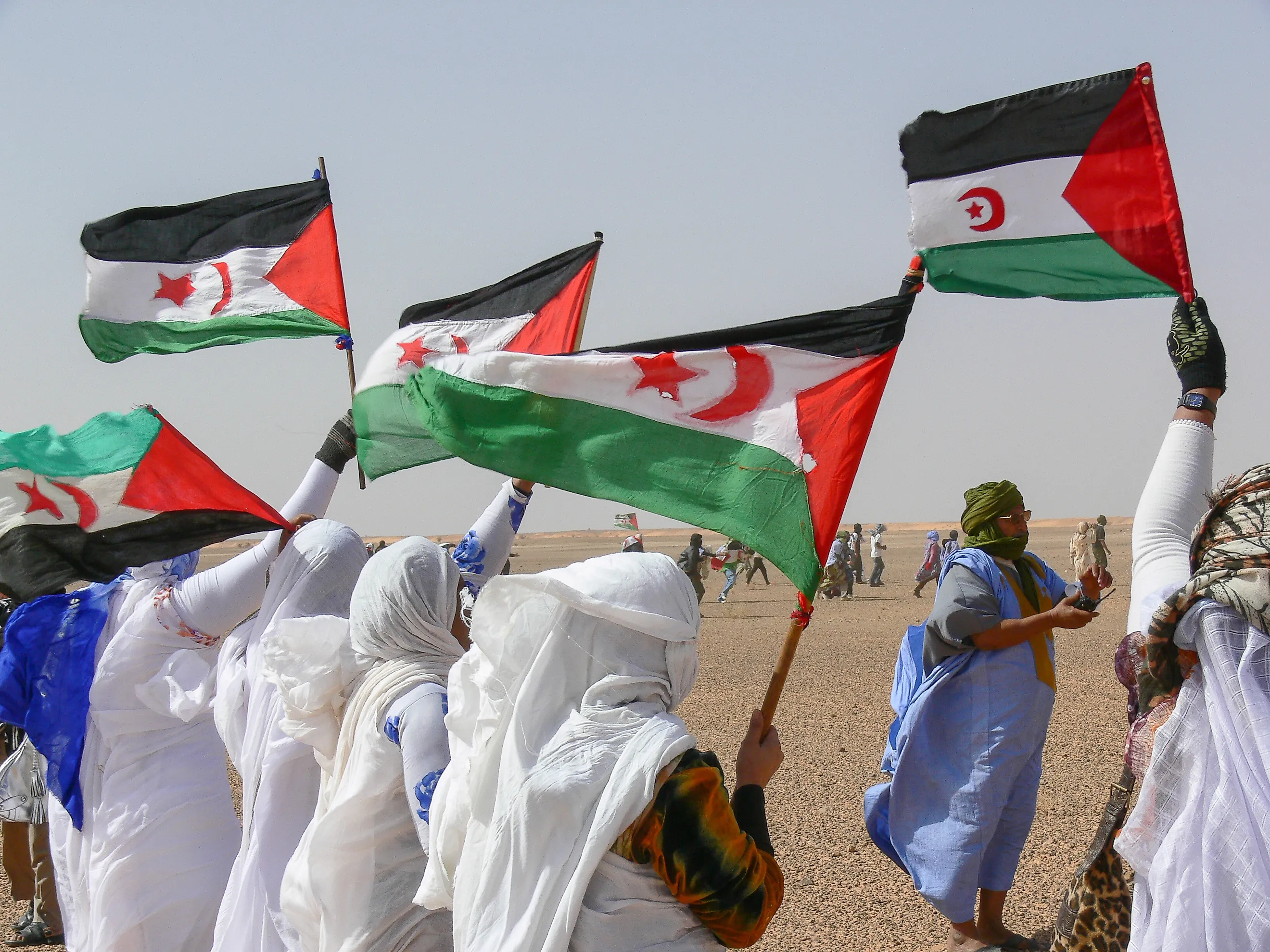
The Forgotten Colony of Western Sahara
Nearly 50 years after Spain gave up its Saharan colony, tens of thousands of Sahrawis are still living in refugee camps in the Algerian desert, waiting on a vote that was promised and never held. Western Sahara sits on the Atlantic coast of northwest Africa, and it remains one of the longest-running unresolved territorial disputes anywhere in the world. The United Nations still classifies it as a non-self-governing territory awaiting decolonization. Morocco holds most of the land west of a fortified sand wall, while the Polisario Front controls the sparsely populated east. The core question has not moved in five decades: who has the right to govern Western Sahara, and whether the Sahrawi people will ever get to decide.
Colonial Beginnings and a Contested Withdrawal
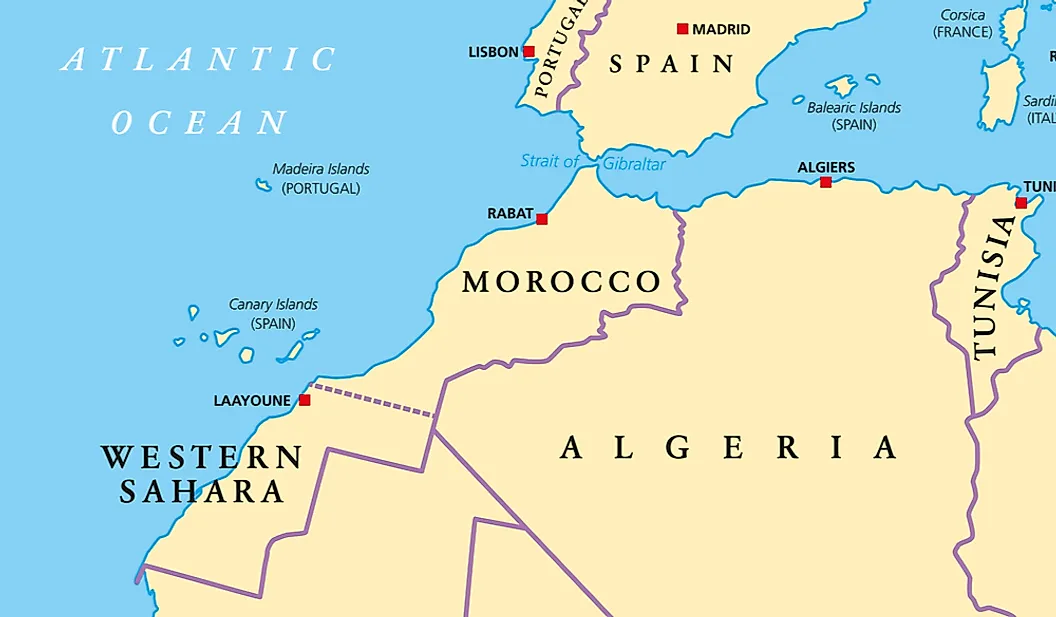
Western Sahara is a thinly inhabited desert region on the Atlantic shore in the northwest part of Africa, surrounded by Morocco, Algeria and Mauritania. Before European colonial influence, Sahrawi groups such as the Reguibat and Tekna moved through the area, adjusting their paths with changes of the seasons along desert tracks used for herding animals and commerce that linked Timbuktu to the sea. Authority was influenced more by tribal chiefs and Islamic scholars than by strict borders or official maps.
That started to change in the 18th and 19th centuries, when Moroccan sultans exercised limited influence through religious and trade ties, but despite that, no sustained administration actually maintained control. Spain's foothold in the Western Sahara began in 1884, when it claimed a strip of Atlantic coastline around the time of the Berlin Conference, where European powers were dividing Africa into colonies without African representation or consent. Over time, the Spanish claim spread inland, though Spanish control remained thin outside coastal towns.

For decades, the area was treated less as a colony with a population and a people, and more like a desert outpost. But the reality was, there were people who lived there, including the Sahrawi. Things like roads and hospitals were sparse, but the fortunes of the area would change dramatically in the 20th century.
The change came from below the surface. Phosphate deposits at Bou Craa had been known since the 1940s, but large-scale mining did not begin until around 1972, and the operation grew quickly from 1974 onward. Phosphate mattered not only for fertilizers but also for producing industrial chemicals needed by manufacturers and food processors. The find suddenly made the region far more valuable to its neighbors.

According to the Western Sahara Resource Watch, large-scale phosphate mining began under Spanish rule and quickly became central to the territory's economic importance. The wealth generated by the mine primarily benefited colonial interests, while the Sahrawi people saw few of the rewards. But the mine's wealth also strengthened Sahrawi demands for self-rule, as many objected to outsiders profiting from their resources. It led Sahrawi communities to call for self-rule and control of their own land.
The Collapse of Decolonization

Around that same time, Sahrawi identity began to take on a stronger political form. Students and workers formed the Polisario Front in 1973 to fight for Sahrawi independence. The movement launched an armed resistance against Spanish rule. Frustration over colonial neglect, combined with a wider wave of African decolonization, helped drive the momentum. Randa Farah points out in the article "Sovereignty on Borrowed Territory: Sahrawi Identity in Algeria" that the movement wanted mass involvement, organizing refugees into local committees to support a national movement. Faced with internal and external pressure, in 1974, Spain announced plans to hold a referendum on self-determination for the people of Western Sahara.
But the promise of a referendum quickly faded away. During the Green March, Morocco organized roughly 350,000 unarmed civilians to enter Western Sahara as a way to enforce its claim to the land if Spain withdrew. Even though they came carrying flags instead of arms, the intention was clear: Morocco wasn't waiting for talks. This march put heat on Spain and pushed it to give up the territory.

Morocco wasn't alone. At the same time, Mauritania was also showing interest. Farouk Sankari explains in "The Western Sahara Conflict: Factors Contributing to the Inevitability of a Settlement" that Morocco's and Mauritania's claims over Western Sahara weren't really rooted in solid historical or legal rights. Instead, their moves were powered by the region's economic pull, like those big phosphate deposits and valuable fishing off the coast. That economic reasoning showed why both countries jumped to grab control after Spain left, driving the conflict past politics or territory.
In November 1975, Spain, Morocco, and Mauritania agreed to the Madrid Accords, which split the administrative authority over Western Sahara between Morocco and Mauritania as Spain left. The Sahrawi had no role in the negotiations or the decision. The agreement was widely disputed, and the United Nations determined that Spain had not legally completed the decolonization. Spain's departure created a vacuum that wasn't filled by independence but by competing claims. Morocco and Mauritania attempted to assume authority. The Polisario Front didn't accept either, saying that Western Sahara was for its people, the Sahrawi.
War and a Divided Land

After Spain left in 1975, the Western Sahara saw open combat. Morocco stormed in from the north, and Mauritania charged from the south. The Polisario Front, already organized and armed, quickly answered with guerrilla tactics. The first round of battles was heated. Taking advantage of the wide desert, Polisario teams moved fast to strike Moroccan and Mauritanian positions. As the fighting intensified, so did the number of refugees. By the end of the 1970s, thousands of Sahrawis had fled to refugee camps near Tindouf, Algeria.
The Polisario's familiarity with the desert gave it an advantage, allowing the fighting to drag on for years. In 1979, Mauritania withdrew from the conflict and abandoned its claim after concluding it could no longer sustain the war against the Polisario Front. Morocco grabbed the region Mauritania left behind. After that, to defend what it had taken, Morocco built a massive sand barrier, known as the berm, over the course of the 1980s. The berm, stretching more than 1,600 miles, sliced the territory into two separate sections. Moroccan forces defended the areas west of the berm, taking control of key towns and the phosphate mine. The Polisario kept control of the east of the wall, facing tough conditions, but out of Morocco's grasp.

The war hit hard, draining the economy and taking a stark human cost. Experts say somewhere between 10,000 and 20,000 people lost their lives during the conflict. More and more Sahrawi refugees were crossing the border to live in Tindouf. This upheaval shifted the nature of the conflict. As warfare turned into hit-and-run attacks, the United Nations (UN) got involved to help end the fighting. In 1991, the UN brokered a ceasefire and proposed a referendum on self-determination. The plan stalled when the parties could not agree on who was eligible to vote.
The Stalemate and Life in Exile

The ceasefire in 1991 provided an interlude to the fighting. The United Nations started to organize a referendum regarding self-determination and self-rule for the Sahrawi; however, disputes about voter eligibility delayed the process. Morocco claimed that Sahrawi communities residing in southern Morocco should be allowed to participate, but the Polisario Front argued that only individuals listed in Spain's 1974 census could vote. There was worry that Sahrawi voters from Morocco might create too much of an advantage for Morocco.
Arguments over the voter list went on for years. As the 1990s wound down, everything had stalled, and the referendum fizzled out. Morocco had other plans to spread its influence, as a large number of Moroccans started to show up in Western Sahara, lured by government deals and job prospects. The idea was to change the demographics of the area. Political tensions remained high. When Sahrawi protesters challenged Morocco's authority in Western Sahara, Moroccan authorities responded with arrests and force.
On top of that, many Sahrawis were still stuck in refugee camps, where the humanitarian conditions remained difficult. According to the U.S. Committee for Refugees and Immigrants, Sahrawi refugees lived in camps near Tindouf for decades, turning temporary exile into a long-term reality. By 2000, refugee numbers remained disputed. The UN aided about 90,000 refugees, although the Polisario Front claimed the camps held more than 150,000 people. Food aid sustained most families, and many children grew up in tents or mud-brick homes, having never seen Western Sahara.
Eventually, frustration seemed to intensify. The natural result of a long line of broken promises and a lack of hope started to appear. Cracks in Sahrawi unity were appearing. Young Sahrawis who only knew life as exiles started to question whether international mediation would ever change anything. The hope that was alive back in 1991 had fizzled out, leaving a group stuck between endless waiting and not knowing what comes next.
Internal tensions grew within the Polisario Front. In 2019, authorities arrested three activists in the Tindouf refugee camps after they criticized the leadership on social media. According to Human Rights Watch, Moulay Abba Bouzid, Fadel Mohamed Breica, and Mahmoud Zeidan faced charges including treason and insulting the Sahrawi state. These arrests showed growing internal divisions. Soon, however, the Sahrawi would once again face renewed conflict from outside.
The Return of Tensions and Diplomatic Shifts

For nearly three decades, the ceasefire largely held until it collapsed in November 2020. Down south in Guerguerat, Polisario supporters placed a blockade, pushing back against Morocco's ongoing hold over Western Sahara. Moroccan forces moved to clear the blockade, prompting the Polisario Front to declare the ceasefire over. Fighting resumed as Polisario forces launched attacks east of the berm and Moroccan forces responded. Morocco increased its security measures, deploying additional patrols and making more arrests throughout Western Sahara. Human rights organizations documented tighter regulation of journalists and political activists imposed by Moroccan officials. And for the Polisario Front, this period of suppression further convinced them that peace negotiations had achieved nothing.
Another wrench was thrown into the mix when, in December 2020, the United States suddenly threw its support behind Moroccan authority in the Western Sahara. Kristen E. Eichensehr, in the American Journal of International Law, argues that the decision marked a departure from decades of US neutrality on the issue.

The recognition was also tied to Morocco's agreement to normalize diplomatic relations with Israel under the Abraham Accords. Eichensehr noted that the U.S. at the time considered Moroccan autonomy the "only feasible solution," which put Washington in disagreement with most of the international community and drew strong criticism, with concerns that the decision violated the Sahrawi people's rights to self-determination.
Morocco considered the recognition to be a major diplomatic success, but the Polisario Front denounced it. Algeria, a long-time supporter of the Sahrawi movement, responded with anger, raising tensions in an already tense region. Most European states did not accept Washington's decision, and many said they would instead support a UN-led approach rather than acknowledging Moroccan authority. At the same time, the African Union continued to be split, as several countries supported Morocco's proposal for autonomy, while others were in favor of Sahrawi independence. When tensions increased at the border and external actors became involved, it was obvious that Western Sahara's destiny was uncertain.
Forgotten or Ignored? The Future of Africa's Last Colony

The Western Sahara has often been described as Africa's last colony. It remains classified as a territory without self-government, still awaiting the process of self-determination. Many Sahrawis remain in refugee camps near Tindouf, dependent on humanitarian aid. A reason there is a lack of global pressure is that Morocco has become an important partner for European countries, especially on migration management and counterterrorism. After 2020, the United States strengthened its ties with Morocco. Several Arab and African countries also avoided taking a clear position, preferring to preserve their regional relationships. These relationships reduced international pressure for a referendum on self-determination.
Despite the lack of clear, consistent support by the governments for the Sahrawi movement, legal courts were still monitoring the situation. In October 2024, the Court of Justice of the European Union (CJEU) made a ruling concerning trade agreements between the E.U. and Morocco, which included Western Sahara. The court found these agreements invalid since they were made without the consent of the Sahrawi people. It also recognized the Polisario Front as having legal standing to represent Sahrawi interests in these cases. The rulings highlighted the E.U.'s involvement in economic activity in the territory and emphasized that future agreements had to respect the Sahrawi people's right to self-determination.
Worries remained that mounting frustration might pull everyone back into a wider war. Polisario fighters kept saying they were clashing with Moroccan forces nearly every day along the berm. Morocco kept adding more infrastructure and new settlements across the area. If heavy fighting breaks out again, chances are it will drive humanitarian needs even higher and shake up North Africa even more.
From the perspective of the Sahrawi movement, decolonizing the region comes down to letting Western Sahara's people pick their own future with a self-determination vote. Morocco's position is that Western Sahara belongs to its territory and that autonomy under Morocco's rule, not outright independence, is the best option. Recent diplomatic steps seem to lean toward Morocco's plan for autonomy, but what really happens to the territory and whether the Sahrawi people actually get that choice is still up in the air.
Lessons from a Bitter Conflict
Western Sahara shows how a conflict can slip from view without ever being resolved. Spain's exit resulted in incomplete decolonization. Morocco's takeover changed the territory; however, the goal of self-rule didn't disappear. The refugee camps became fixed communities, with people living their whole lives inside them. The United Nations has repeatedly stated its commitment to a referendum, but that commitment has not been realized.
International powers have treated the dispute as a question of stability. Morocco gained support from allies while the Polisario held on to recognition from others, leaving the African Union and the wider world divided. When the ceasefire fell apart in 2020, it showed that peace was still far away. Unless the promised vote finally happens, the fighting is likely to continue, and Western Sahara will remain neither fully forgotten nor genuinely resolved.