Why Are The Tropics Of Cancer And Capricorn So Important?
The Tropic of Cancer and the Tropic of Capricorn are two of the five named parallels of latitude on Earth, alongside the Equator, the Arctic Circle, and the Antarctic Circle. The Tropic of Cancer sits at approximately 23.4° north of the Equator, and the Tropic of Capricorn at approximately 23.4° south. The two lines define the absolute latitudinal range over which the Sun can ever appear directly overhead at noon: nowhere on Earth more than 23.4° from the Equator does this occur. Between the two tropics lies the climatic region known as "the tropics," which contains approximately 40% of the planet's surface and approximately 40% of the world's population (the latter share has been growing for several decades). The two lines have been important to navigation, calendar-keeping, and climate science for more than two thousand years.
The Numbers Behind The Two Lines
The precise latitude of each Tropic is set by Earth's axial tilt (called the obliquity of the ecliptic), which is currently approximately 23° 26' 10", or 23.4361 degrees. The commonly quoted value of 23.5° is a rounding from this figure. Earth's obliquity is not constant; it varies between approximately 22.1° and 24.5° over a cycle of about 41,000 years (the Milankovitch obliquity cycle), and is currently in the slow declining phase of that cycle, decreasing by about 0.47 arcseconds per year. The Tropic of Cancer is therefore creeping southward by about 14 metres per year, and the Tropic of Capricorn is creeping northward by approximately the same amount. The changes are slow enough that the 23.4° figure has not needed updating for practical map-making purposes, but the actual position of the line is not where it was in antiquity, nor where it will be in the future.

The two Tropics, the two Polar Circles, and the Equator together divide Earth's surface into five climate zones: the tropical zone between the two Tropics, the two temperate zones between each Tropic and its corresponding Polar Circle, and the two polar zones above 66.6° in each hemisphere. The Arctic and Antarctic Circles are the complement of the two Tropics: they sit at 90° minus the obliquity (about 66.6°), and define the latitudes north or south of which the Sun fails to rise (in winter) or set (in summer) for at least one full day per year.
Tropic Of Cancer

The Tropic of Cancer marks the northern boundary of the tropical zone. It is the latitude at which the Sun reaches its highest point directly overhead at the June solstice, which usually falls on June 20 or 21. North of the Tropic of Cancer, the Sun is never directly overhead at any time of year; south of it, the Sun is directly overhead at least once per year. The Tropic of Cancer was named in antiquity for the constellation Cancer, the Crab, because at the time the term was coined (more than two thousand years ago) the Sun lay in the direction of Cancer at the June solstice. The precession of Earth's rotation axis has since shifted the apparent backdrop of the Sun's solstice position into the constellation Taurus, but the name has not been updated.
The Tropic of Cancer crosses 17 sovereign states and disputed territories across three continents. In the Americas, it passes through Mexico (most prominently across Baja California Sur and through the city of Mazatlán) and through the central Bahamas. In Africa, it crosses (from west to east) Western Sahara, Mauritania, Mali, Algeria, Niger, Libya, and Egypt. In Asia, it crosses Saudi Arabia, the United Arab Emirates, Oman, India (north of which Calcutta and Dhaka sit close to the line), Bangladesh, Myanmar, China (just north of Guangzhou and Hong Kong), and the island of Taiwan. The latitude is particularly visible across Egypt because the ancient city of Aswan sits very close to it; Eratosthenes used the geometry of Aswan's solstice noon (when the Sun lit the bottom of a well) and Alexandria's simultaneous shadow length to measure the circumference of the Earth in approximately 240 BCE, the first reliable measurement of the planet's size.
Tropic of Capricorn
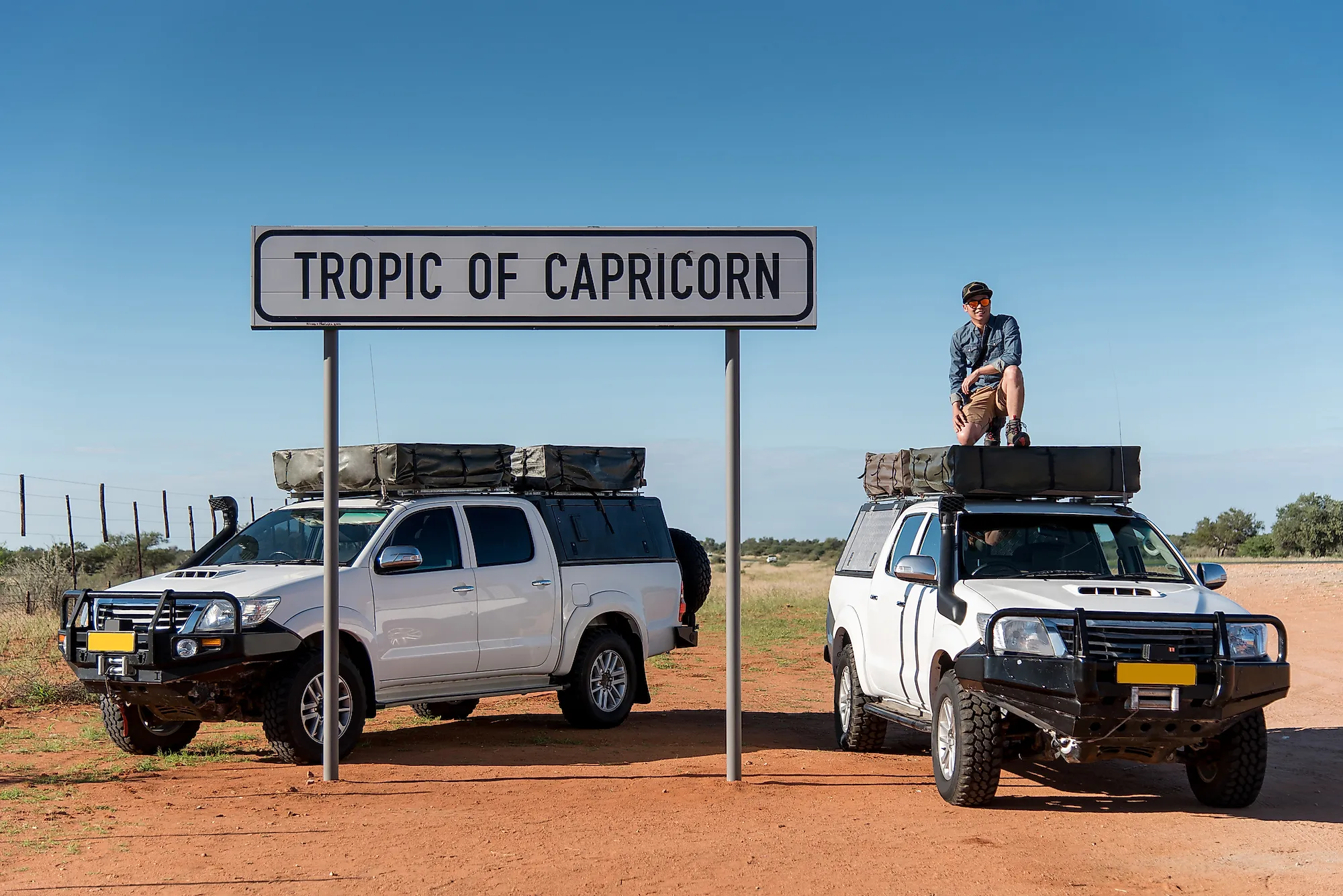
The Tropic of Capricorn is the southern equivalent of the Tropic of Cancer and marks the southern boundary of the tropical zone. It is the latitude at which the Sun reaches its highest point directly overhead at the December solstice, which usually falls on December 21 or 22. The naming convention parallels the northern Tropic: at the time the term was coined, the Sun lay in the direction of the constellation Capricornus, the Sea-Goat, at the December solstice. Precession has since shifted the solstice point into the constellation Sagittarius, but the name remains.
The Tropic of Capricorn passes through 10 sovereign land territories and a number of small Pacific island groups. In South America, the line crosses Chile (notably through the city of Antofagasta on the Atacama coast), Argentina (through the northern provinces), Paraguay, and Brazil (where São Paulo, the largest city in the southern hemisphere, sits almost exactly on the line at 23.55° south). In southern Africa, it crosses Namibia, Botswana, South Africa (just north of Pretoria), and Mozambique, then runs through Madagascar. In Oceania it crosses central Australia (passing close to Alice Springs in the Northern Territory) before extending across the South Pacific and clipping the Tubuai (Austral) Islands of French Polynesia. Because the southern hemisphere has substantially less land area, the Tropic of Capricorn passes over much more open ocean than the Tropic of Cancer.
The Tropics In The Modern Climate System
The astronomical definition of "the tropics" (the latitudes between the two named lines) does not perfectly match the climatic definition. The Köppen climate classification draws the tropical-zone boundary not by latitude but by mean monthly temperature, defining true tropical climates as those where the coldest month averages above 18°C. By this definition, much of the area between the two Tropics is genuinely tropical (the Amazon basin, central Africa, Indonesia, much of South and Southeast Asia), but parts of high-altitude land between the Tropics (the Andean altiplano, the Ethiopian highlands) have temperate or even cold climates despite their tropical latitude. The boundaries set by latitude and the boundaries set by climate diverge most strongly in mountainous regions.
The climatic tropics are also expanding. The Hadley circulation, the global atmospheric pattern that transports warm air poleward from the equatorial belt before it descends in the subtropics, has been widening for at least the past four decades. According to peer-reviewed observational studies including Grise and Davis (2020) and Studholme and Gulev (2018), the poleward edge of the Hadley cell has been shifting at approximately 0.1 to 0.5 degrees of latitude per decade, with some dynamical and chemical metrics suggesting trends greater than 1 degree per decade. The astronomical Tropics of Cancer and Capricorn themselves have not moved (because Earth's obliquity is decreasing rather than increasing), but the dry subtropical belt associated with the descending branch of the Hadley cell has moved poleward, drying out parts of the Mediterranean, southern Australia, and the southwestern United States. Tropical cyclone formation has also shifted toward higher latitudes over the same period, consistent with the Hadley expansion. The widening of the climatic tropics is one of the most clearly observed signatures of contemporary climate change.
Why The Two Lines Still Matter
The Tropic of Cancer and the Tropic of Capricorn remain useful both as practical reference points and as scientific anchors. They define the limits of the apparent annual motion of the Sun (and therefore the geometry of seasons across the planet), the limits of the doldrums and the trade-wind belts (which structured European maritime exploration from the 15th century onward), the geometry of solar-energy calculations for any given latitude, and the boundaries of the tropical biome where most of the world's species diversity is concentrated. They also continue to be useful in navigation, even in the satellite era: a sextant reading of the noon Sun on a solstice produces a position fix near one of the two Tropics that is independent of any clock or radio signal, which is one reason traditional celestial navigation training still includes the obliquity geometry. The two lines have shifted by a few metres a year for two thousand years, and the planet has continued to operate on the same fundamental geometry. They will remain useful for as long as Earth tips on its axis at all.