What Happened To Syria After Assad
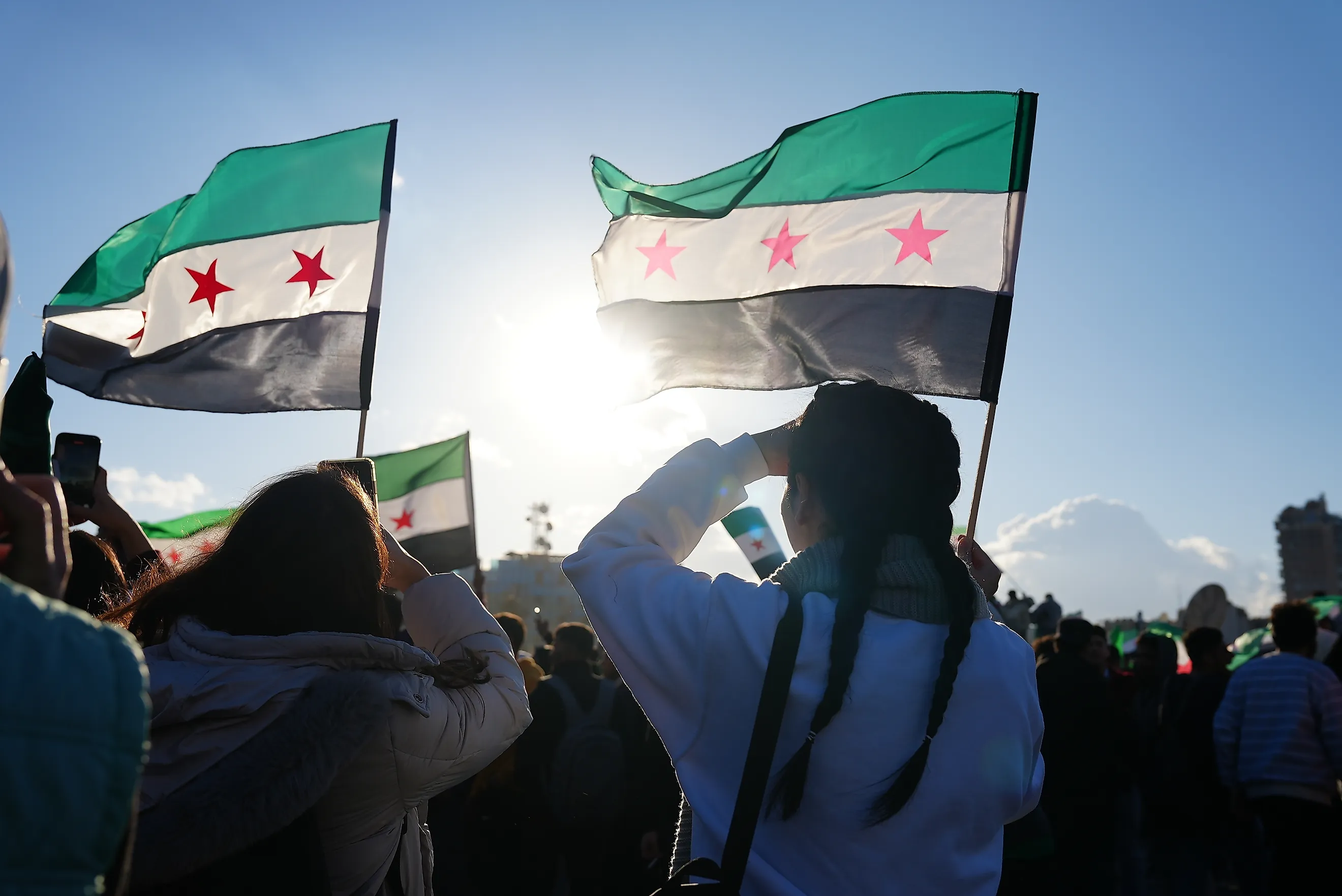
On the morning of December 8, 2024, opposition fighters walked into Damascus and found the presidential palace empty. Bashar al-Assad had taken off on an unmarked flight to Russia in the middle of the night, ending more than five decades of Assad family rule in a single weekend. The offensive that toppled him had begun only twelve days earlier, on November 27, when a coalition led by Hay'at Tahrir al-Sham (HTS) launched a probing attack at the front line between opposition-held Idlib and the neighboring Aleppo governorate. Aleppo fell in three days. Hama collapsed on December 5. Homs went on December 7. Damascus followed twenty-four hours later, and with it went the dynasty Hafez al-Assad had built when he seized power and became president in 1971. What has happened in the year and a half since is one of the most consequential political transitions in the modern Middle East.
Twelve Days That Ended A Dynasty

The December 2024 offensive was led mainly by Hay'at Tahrir al-Sham (HTS), alongside elements of the Turkish-backed Syrian National Army (SNA) and the Southern Operations Room (SOR), a coalition of southern rebel groups that pushed up through Daraa and Suwayda governorates while HTS drove south from Idlib. The Syrian Army melted away with almost no organized resistance. Russian and Iranian backing, which had kept the Assad government in place since 2015, evaporated almost overnight as Russia was preoccupied with Ukraine and Iran's regional proxies had been badly weakened by more than a year of Israeli strikes.
After Damascus fell, HTS leader Ahmed al-Sharaa (also known by his nom de guerre Abu Mohammad al-Julani) emerged as Syria's de facto leader. The outgoing Assad-era prime minister, Mohammad Ghazi al-Jalali, remained briefly in a caretaker capacity before transferring power to Mohammed al-Bashir, who had previously led the HTS-backed Syrian Salvation Government in Idlib. Al-Bashir's interim administration was announced on December 10, 2024, and was tasked with running day-to-day affairs until a new political framework could be established.
Building A New Government
On January 29, 2025, at the Syrian Revolution Victory Conference held at the Presidential Palace in Damascus, al-Sharaa was formally appointed interim president for the transitional period. The same gathering announced the dissolution of HTS itself along with the other armed factions of the anti-Assad coalition, the abolition of the 2012 Ba'athist constitution, and the dissolution of the former ruling Ba'ath Party, the previous legislature, and the Assad-era security services.
A seven-member legal drafting committee was appointed on March 2, 2025, and on March 13, al-Sharaa signed the Constitutional Declaration of the Syrian Arab Republic, a provisional constitution intended to govern a five-year transitional period running from 2025 to 2030. The declaration established a presidential system that concentrates executive power in the president, who appoints ministers directly, with no prime minister position. Article 3 names Islam as the religion of the president and Islamic jurisprudence as the principal source of legislation, and Arabic as the country's only official language. Two days earlier, on March 11, al-Sharaa had signed a separate agreement with Mazloum Abdi, commander of the Kurdish-led Syrian Democratic Forces (SDF), to integrate SDF-controlled institutions into the new state, with a target deadline of the end of 2025.
On March 29, 2025, al-Sharaa announced a 23-minister transitional government at a ceremony at the Presidential Palace. The cabinet was broadened to include Yarub Badr (an Alawite) as transport minister, Amgad Badr (a Druze) as agriculture minister, Hind Kabawat as minister of social affairs and labor (the first woman in a senior cabinet post under the new government), and Raed al-Saleh, the head of the White Helmets, as minister of emergency and disaster management. The cabinet's composition was a direct response to international and domestic pressure for inclusivity that intensified after sectarian violence broke out along the Alawite-majority coast earlier in March, when the UK-based Syrian Observatory for Human Rights reported the killing of more than 740 Alawite civilians. Further violence followed in July 2025 in the Druze-majority province of Suwayda, and in January 2026 the government forcibly reasserted control over several non-Kurdish areas previously under SDF authority, with a US-backed ceasefire eventually setting terms for SDF integration. Indirect elections for 119 of the 210 seats in a new People's Assembly were held on October 5, 2025, with al-Sharaa appointing the remaining 91.
Fourteen Governorates Before And After Assad

Before Assad's fall, territorial control in Syria's fourteen governorates was fragmented. The Assad government held Damascus, much of central and western Syria, the coast, and parts of the south, though Daraa and Suwayda had strong local armed networks and uneven regime authority. HTS's Syrian Salvation Government controlled Idlib, while Aleppo and parts of the north were divided among regime forces, HTS, Turkish-backed Syrian National Army factions, and the Kurdish-led Syrian Democratic Forces (SDF). In the northeast and east, the SDF and its civilian counterpart the Autonomous Administration of North and East Syria (AANES) controlled much of Hasakah and Raqqa governorates and parts of Deir ez-Zor and Aleppo, while the regime and Turkish-backed factions held other pockets.
After the regime collapsed, the transitional authorities took over most of the former Assad-held territory, including Damascus, Rif Dimashq, Hama, Homs, the coast, Idlib, and much of Aleppo, though their control was uneven on the ground. Daraa and Quneitra came under transitional-government influence while local armed groups remained important, and Israeli military activity increased near the Golan border after the Israeli military pushed into the demilitarized buffer zone in Quneitra governorate in the days after Damascus fell. Suwayda remained the clearest exception in the south, with Druze armed groups and local authorities retaining broad control. In the northeast, the SDF and AANES initially kept much of their territory, but by early 2026, transitional government control had expanded, leaving SDF authority concentrated mainly around Hasakah, Qamishli, and Kobane.
The World Recalibrates

After Assad fled Syria, Turkey remained the most influential external actor in the north. Ankara had long backed the Syrian National Army, and Turkish-backed factions continued to shape security in parts of northern Aleppo and other border areas. Turkey moved quickly to build ties with Syria's new leadership and signed a defense agreement in 2025 covering weapons, equipment, logistical support, training, and consultancy.
Outside Turkey, Syria's transition received cautious but significant support from Arab, Western, and international states. Qatar, Saudi Arabia, the UAE, Jordan, and other regional states welcomed the new government and moved to rebuild ties with Damascus. On April 27, 2025, Saudi Arabia and Qatar jointly announced that they would clear Syria's roughly $15.5 million in arrears to the World Bank Group, a step the World Bank confirmed as effective on May 12, 2025. The clearance restored Syria's eligibility for new World Bank operations for the first time in 14 years, with the first project focused on electricity infrastructure.
European engagement followed the same trajectory. On May 7, 2025, al-Sharaa met French President Emmanuel Macron in Paris on his first official visit to a Western country. Germany reopened its embassy in Damascus in March 2025, with German Chancellor Friedrich Merz later hosting al-Sharaa for talks on economic reconstruction, energy, and the return of Syrian refugees (Germany is home to roughly one million Syrians who arrived during the 2015 refugee influx). The United Kingdom formally re-established diplomatic relations with Syria in July 2025 after Foreign Secretary David Lammy visited Damascus, the first British ministerial visit in 14 years. Syria reopened its embassy in London on November 13, 2025, more than a decade after Britain shut it down following the 2012 Houla massacre. On January 9, 2026, European Commission President Ursula von der Leyen visited Damascus and announced a roughly €620 million EU support package for 2026 and 2027.
The most striking diplomatic moment came on November 10, 2025, when al-Sharaa met US President Donald Trump at the White House, the first visit by a Syrian president to the United States since Syrian independence in 1946. South Korea had established formal diplomatic relations with Damascus on April 10, 2025, when Foreign Minister Cho Tae-yul visited the city to sign the agreement; the move left North Korea as the only United Nations member state without ties to South Korea. By late 2025, the United Nations was treating al-Sharaa as Syria's head of state.
Normalization was not universal. Israel held only indirect talks with Damascus and continued military operations near the southern border and in the Quneitra buffer zone. Iran's foreign minister stated publicly that Tehran's relations with the new Syrian government had been severed and that Iran was in no hurry to restore them. North Korean embassy personnel were evacuated after Assad's fall, and the relationship between Pyongyang and Damascus remained uncertain into 2026.
Sanctions Begin To Lift

The sanctions architecture that the Assad regime had operated under for more than a decade came down quickly. On February 24, 2025, the European Union suspended a number of its economic sanctions targeting key Syrian sectors. The EU Foreign Affairs Council formally announced the political decision to lift sanctions on May 20, 2025, and the legal acts were adopted on May 28, taking effect on May 29. The EU kept measures tied to the former Assad regime and to security-related concerns, and in connection with the March 2025 coastal violence imposed new targeted sanctions on two individuals and three entities under its global human rights regime.
The United States moved through a sequence of escalating steps. On May 13, 2025, President Trump publicly announced his intention to lift sanctions on Syria. The Treasury's Office of Foreign Assets Control issued General License 25 on May 23, authorizing most previously prohibited transactions with the Syrian government, its central bank, and state-owned enterprises, and the State Department simultaneously issued a 180-day waiver of the Caesar Act's secondary sanctions. On June 30, 2025, Trump signed Executive Order 14312, "Providing for the Revocation of Syria Sanctions," which formally terminated the Syria sanctions program effective July 1. The order revoked six executive orders that had formed the legal basis of the sanctions program, removed 518 individuals and entities from the Office of Foreign Assets Control Specially Designated Nationals list, and ended the national emergency that had justified the program. Sanctions remained in place against 139 individuals and entities linked to Assad himself, Captagon drug traffickers, ISIS and al-Qaeda affiliates, Iranian proxies, and human rights abusers. On July 7, 2025, the State Department revoked the Foreign Terrorist Organization designation of Hay'at Tahrir al-Sham itself.
The United Kingdom began lifting sectoral sanctions in March 2025 and delisted government and media entities in April. Canada, Australia, Switzerland, Japan, and Norway have eased their broad economic restrictions on Syria but as of May 2026 continue to maintain sanctions focused on former Assad-regime figures, human rights abuses, destabilizing actors, military goods, and looted cultural property.
Syria In 2026

As of May 2026, Syria has moved out of regime collapse and into a transition that is still fragile and still contested. Al-Sharaa's government has consolidated control over much of the country, secured broad international engagement, benefited from major sanctions relief, and reopened the path to World Bank operations after Saudi Arabia and Qatar cleared Syria's arrears. Donor pledges totaling several billion euros have been announced. The new constitutional declaration has established at least the framework for civilian governance, including an independent judiciary on paper, the People's Assembly that began sitting in late 2025, and commissions for missing persons and transitional justice that al-Sharaa established by presidential decree in May 2025.
The new state, however, remains incomplete. The Kurdish-led northeast is still being absorbed under the terms negotiated in early 2026, and elements of the SDF retain significant local autonomy. Suwayda is still effectively self-governing. Israel remains militarily active near the south and has not opened diplomatic relations. The Islamic State recorded more than 100 attacks across central and eastern Syria in 2025 and has, according to UN monitors, embedded sleeper cells in urban centers including Damascus. Critics including Kurdish political bodies, parts of the Druze and Alawite communities, and Western human rights organizations continue to question the concentration of authority in the presidency, the role of Islamic jurisprudence in the new constitutional order, and the government's handling of sectarian violence. Syria is no longer ruled by the Assad family. Whether it becomes a settled, unified postwar state is the question the next several years will answer.