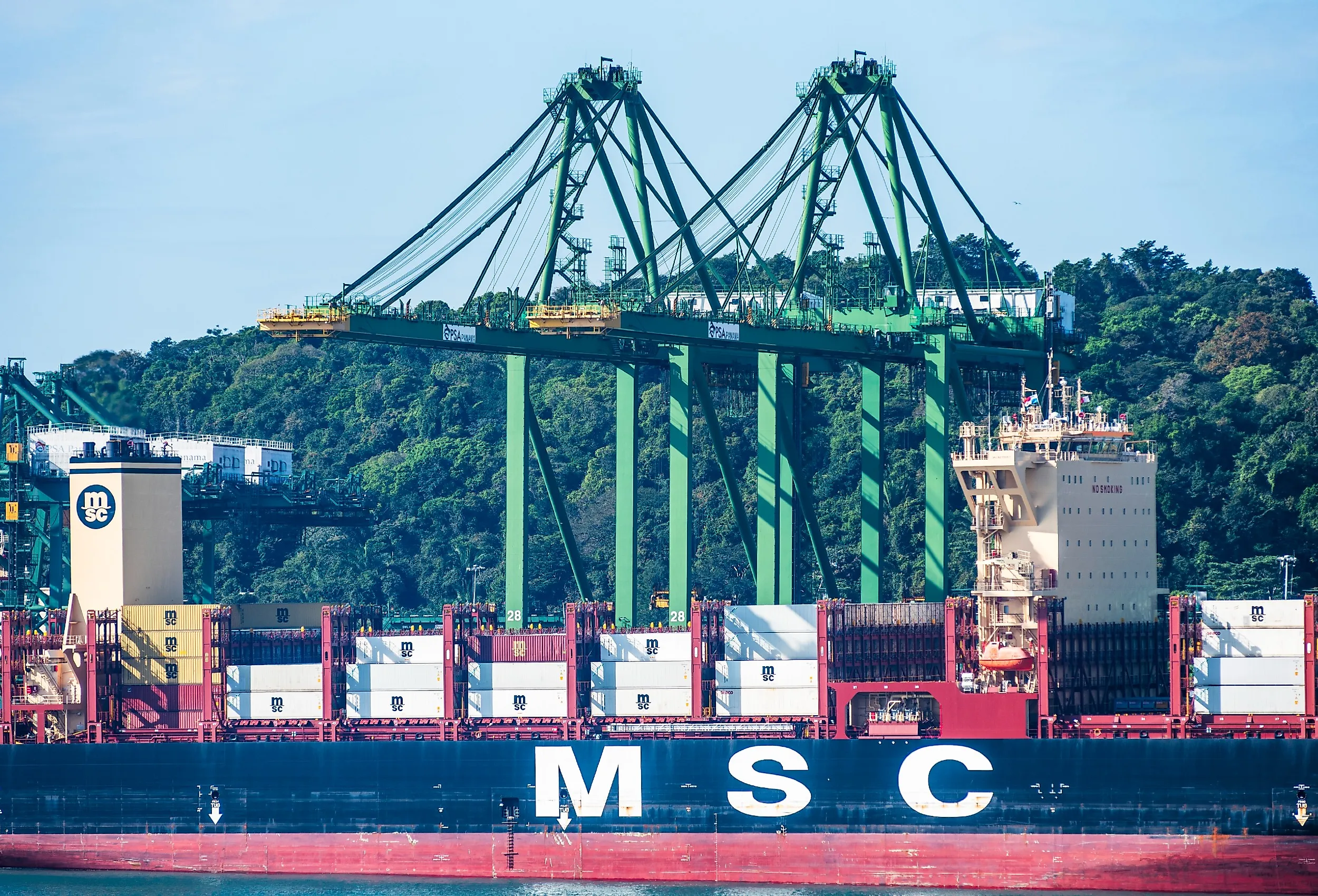
Who Controls The Panama Canal
The Panama Canal is a 50-mile (80 km) lock-and-dam waterway across the Isthmus of Panama, connecting the Atlantic and Pacific Oceans. Without it, ships traveling between the two oceans have to round Cape Horn at the southern tip of South America, a detour of roughly 8,000 nautical miles. The canal carries about five percent of all global maritime trade and roughly 40 percent of US container traffic, with more than 13,000 vessel transits per year. The Panama Canal Authority, an arm of the Panamanian government, has operated the canal since 1999. Before that, the United States built and ran it for most of the 20th century after acquiring the rights through a 1903 treaty with the newly independent Republic of Panama.
This article covers the canal's construction and political history, how the lock system works, and the dispute over its surrounding port concessions that flared up between Washington, Beijing, and Panama City in 2025 and 2026.
Early Efforts

For most of the 19th century, ships sailing between the US East Coast and the Pacific had to round Cape Horn or pass through the Strait of Magellan at the bottom of South America. By the mid-1800s, the United States was actively investigating possible routes for a canal across Central America. President Ulysses S. Grant ordered survey expeditions starting in 1869 to evaluate possible sites in Panama and Nicaragua. The Interoceanic Canal Commission preliminarily recommended a Nicaraguan route in 1876. Two decades later, the US Isthmian Canal Commission, working under President William McKinley from 1899 to 1901, again recommended Nicaragua.
While Americans were debating routes, the French were already building. The International Congress for the Study of an Interoceanic Canal endorsed a sea-level Panama route in May 1879, and Ferdinand de Lesseps, the engineer who had completed the Suez Canal a decade earlier, took charge of the project. The Compagnie universelle du canal interocéanique de Panama formed in 1880, and excavation at the Culebra Cut, the highest point along the route, began on January 22, 1881.
The French effort was a disaster. Yellow fever and malaria killed thousands of workers (estimates of total French-era deaths range from 22,000 to 25,000). The clay soil produced repeated landslides that swallowed earlier excavation. De Lesseps insisted on a sea-level canal in country where the Chagres River regularly flooded by twenty feet during the rainy season. By 1888 the Compagnie was bankrupt, and the formal liquidation followed in 1894. A successor firm, the New Panama Canal Company, took over the same year and began discussions with the United States about selling the project's assets in 1899.
The American Purchase

President Theodore Roosevelt initially favored the Nicaraguan route. Two factors changed his mind. First, engineer George Shattuck Morison wrote a December 1901 letter laying out the technical and economic advantages of Panama. Second, the New Panama Canal Company dropped its asking price for the French assets to $40 million, well below the cost of starting fresh in Nicaragua. The Panama lobby in Washington also worked aggressively: William Nelson Cromwell, an attorney with shares in the Panama Railroad Company, lobbied Congress, and Philippe Bunau-Varilla famously mailed every US senator a Nicaraguan postage stamp showing an erupting volcano, hinting that Nicaragua's geology was unstable.
The Spooner Act passed the US Senate on June 19, 1902, authorizing the Panama purchase. Panama was then a province of Colombia, and the next step was a treaty with the Colombian government. The Hay-Herrán Treaty, negotiated in early 1903, would have granted the United States rights to a canal zone in exchange for $10 million and an annual payment, but the Colombian Senate rejected it that August. Roosevelt then quietly supported a Panamanian independence movement; Panama declared independence on November 3, 1903, with US naval forces preventing Colombia from suppressing the rebellion. Fifteen days later, the Hay-Bunau-Varilla Treaty signed over a ten-mile-wide canal zone to the United States in perpetuity in exchange for $10 million plus an annual payment of $250,000. The US Senate ratified the treaty on February 23, 1904.
Building the Canal

Roosevelt established the Isthmian Canal Commission on March 3, 1904, with orders to "make the dirt fly." The deal with the New Panama Canal Company closed on May 4, 1904, transferring the French infrastructure to American control. Chief Engineer John Findley Wallace arrived at the end of June. Wallace lasted just over a year. Frustrated by a commission structure that required him to seek approval for nearly every decision, and demoralized by yellow fever outbreaks among the workforce, he resigned in June 1905.
His successor, John Stevens, took over in July 1905 and made two changes that proved decisive. First, he gave Dr. William Crawford Gorgas the resources to wage a comprehensive campaign against the mosquitoes that carried yellow fever and malaria; this involved fumigating buildings, draining standing water across the canal zone, and installing copper-mesh window screens in worker housing. Within two years, yellow fever was effectively eliminated in the canal zone. Second, Stevens lobbied successfully for a high-altitude lock canal rather than the sea-level scheme that had defeated the French. In June 1906, the Senate approved a lock design, with the House following on June 27.
Roosevelt visited the canal in November 1906, the first time a sitting US president had traveled outside the country while in office. He took a deep personal interest in the project, summarizing his approach later in a 1911 speech: "I took the Isthmus, started the Canal, and then left Congress not to debate the Canal, but to debate me." After Stevens unexpectedly resigned, Roosevelt appointed US Army engineer George Washington Goethals as chief engineer on February 26, 1907. Goethals would see the project through to completion. He divided the construction into three divisions (Atlantic, Central, and Pacific) and ran the operation with the firm authority of a military command.
Construction proceeded at scale. The Central Division, led by Major David du Bose Gaillard of the US Army Corps of Engineers, removed roughly 76 million cubic meters of earth and rock from the Culebra Cut alone, much of it dynamited. About 6,000 men worked the cut at any given time. By 1913, the project was approaching completion. Steam shovels broke through the Culebra Cut at canal-bottom level on May 20, 1913. The Gatun Dam was completed on June 27, 1913, impounding the Chagres River and creating Gatun Lake (at the time, the largest artificial lake in the world). On August 13, 1913, the dike separating the Pacific Ocean from the Miraflores Locks was demolished, allowing seawater to flood the lower lock chambers.
The defining moment of the canal's construction came on October 10, 1913. From his office in Washington, President Woodrow Wilson pressed a telegraph button that triggered an explosion at the Gamboa Dike in Panama, the last barrier separating Gatun Lake from the Culebra Cut. With the dike gone, water flooded into the cut and the Atlantic and Pacific oceans were connected by water for the first time. The first vessel to make a full transit, the French floating crane Alexandre La Valley, completed the journey on January 7, 1914. The canal officially opened on August 15, 1914, with a toll of 90 cents per Panama Canal net ton.
How the Lock System Works

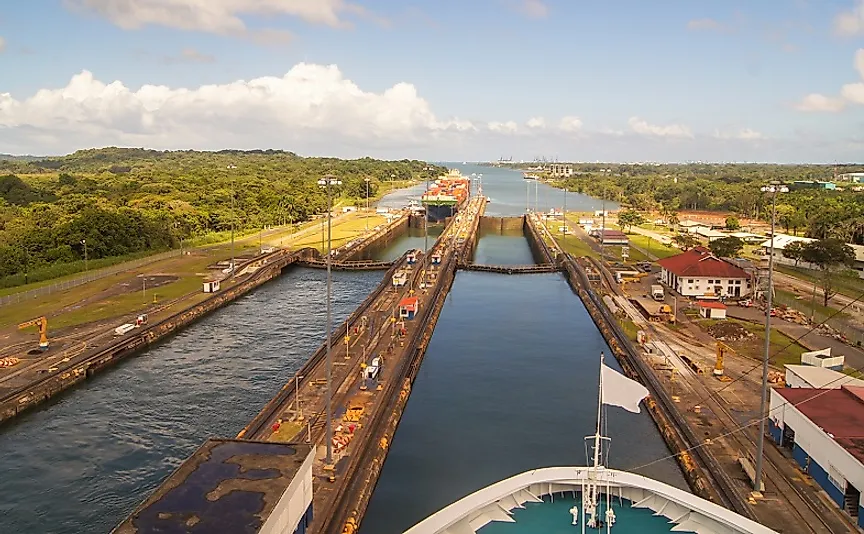
Because of the topography of the Isthmus of Panama, the canal does not run at sea level. Gatun Lake, which forms most of the canal's interior, sits 85 feet (26 m) above sea level, and ships have to be lifted up to that altitude on one side and lowered back down on the other. The mechanism that does the lifting is the lock system, and it works through gravity alone, using no pumps.
A ship entering from the Atlantic side enters the first chamber of the Gatun Locks at sea level. The chamber's gates close behind it. Water from Gatun Lake flows through underground culverts into the chamber, raising the ship roughly 28 feet. The forward gates then open, and the ship moves into the second chamber, where the process repeats. After three chambers, the ship is at the level of Gatun Lake. Each chamber takes about 8 to 10 minutes to fill, and the full ascent through the three Gatun Locks takes around an hour. The ship then crosses Gatun Lake and the Culebra Cut. On the Pacific side, the Pedro Miguel Locks lower it one chamber to Miraflores Lake, and the two-chamber Miraflores Locks lower it the rest of the way to sea level. Each transit consumes roughly 52 million gallons of fresh water from Gatun Lake (per lock chamber filling, the figure is 26.7 million gallons).

The original locks each have V-shaped miter gates, made of riveted steel and built to swing inward against the upstream water pressure. The locks have 46 such gates in total, each approximately 65 feet wide and 7 feet thick. Heights vary from about 47 to 82 feet, and individual gate weights range from roughly 350 to 730 tons. The gates are remarkably efficient: their wedge-shaped closing geometry means the more water pressure pushes against them, the tighter they seal.
The canal underwent two major upgrades after its first century. The Culebra Cut was widened beginning in November 2001 to allow two ships to transit the cut simultaneously. A much larger expansion, approved by Panamanian referendum in 2006 and completed on June 26, 2016, added a third lane parallel to the original locks. The new Agua Clara Locks (Atlantic side) and Cocoli Locks (Pacific side) accommodate Neopanamax vessels: ships up to 1,200 feet long, 160 feet wide, and 50 feet deep. The new locks are 70 feet wider and 18 feet deeper than the original, and they recycle roughly 60 percent of their water through three side basins per chamber, compared with no recycling in the original system. The new locks use 16 sliding rolling gates rather than swinging miter gates.

Traffic through the canal has held remarkably stable in raw transit numbers but increased dramatically in tonnage as ships have grown larger. The 1916 fiscal year recorded 807 transits; by the 1970s annual transits had climbed near 16,000, and they have stabilized between 12,000 and 14,000 ever since. Tonnage tells a different story: the canal carried 4.9 million long tons in fiscal 1915 and 489.1 million PC/UMS tons in fiscal 2025, with revenues that year reaching $5.7 billion.
The Transfer to Panama

Panamanian dissatisfaction with US control of the canal zone built steadily through the 20th century. The 1956 nationalization of the Suez Canal by Egypt, which precipitated the Suez Crisis, accelerated calls in Panama for the same kind of sovereignty over its own canal. Tensions came to a head on January 9, 1964, when Panamanian students attempting to fly the Panamanian flag at Balboa High School in the canal zone were confronted by American "Zonians" (US citizens living in the zone), and the resulting riots between Panamanian protesters and US military police left 22 Panamanians and four US soldiers dead. The day is observed in Panama as Martyrs' Day.
Negotiations stretched across three administrations. On September 7, 1977, US President Jimmy Carter and Panamanian leader Omar Torrijos signed the Torrijos-Carter Treaties, which superseded the 1903 agreement. The treaties had two parts. The first established a timeline under which the United States and Panama would jointly administer the canal until December 31, 1999, when full control would transfer to Panama. The second guaranteed the canal's permanent neutrality and gave both countries the right to defend that neutrality against any threat. The treaties survived Torrijos's death in a 1981 plane crash, the rule of Manuel Noriega in the 1980s, and the US invasion of Panama in December 1989 that removed Noriega from power. At noon on December 31, 1999, control of the canal formally transferred to the Panama Canal Authority.
The 2025-2026 Port Dispute

The Panama Canal Authority operates the canal itself, but the container ports at the canal's two entrances (Balboa on the Pacific side, Cristobal on the Atlantic side) have been operated separately under concession. From 1997 onward, that concession was held by Panama Ports Company, a subsidiary of Hong Kong-based CK Hutchison Holdings, controlled by Hong Kong businessman Li Ka-shing. The concession was extended in 2021 for another 25 years.
The arrangement became politically charged after Donald Trump's election in November 2024. In a December 2024 statement, Trump said the United States was "being ripped off" by Panama Canal fees and called for the canal to return to American control. He reiterated the claim at a January 7, 2025 press conference and again in his January 20 inaugural address, arguing that China was effectively "running" the canal through CK Hutchison's port concessions. (CK Hutchison is a Hong Kong-listed private company, not a Chinese government entity, and it operates the ports rather than the canal itself.)
On March 5, 2025, CK Hutchison announced it had reached an in-principle agreement to sell roughly 80 percent of its port operations worldwide, including the Panamanian terminals, to a consortium led by US asset manager BlackRock and including Global Infrastructure Partners and Mediterranean Shipping Company's Terminal Investment Limited. The deal, valued at roughly $23 billion, was endorsed by the Trump administration. Beijing publicly opposed the sale and Chinese regulators slow-walked the necessary approvals, leaving the deal in limbo.
While the BlackRock transaction stalled, Panama's own legal process moved forward. Panama's comptroller general had been auditing the original 1997 concession and challenged it in court, citing tax exemptions and the absence of a public tender for the 2021 extension. On January 30, 2026, the Supreme Court of Panama ruled that the underlying laws and the Panama Ports Company concession were unconstitutional. The ruling was published in the official gazette on February 23, 2026, making it final and not subject to appeal.
The Panamanian government formally took over the two ports on February 24, 2026 and announced an interim arrangement: APM Terminals, a subsidiary of Danish shipping giant A.P. Moller-Maersk, would temporarily operate Balboa, while MSC's Terminal Investment Limited would temporarily operate Cristobal. The government plans to award permanent concessions through a public tender within 18 months. CK Hutchison, which estimates it has invested $1.8 billion in the terminals across nearly three decades, has filed for international arbitration through the International Chamber of Commerce and disputes the legality of the takeover.
Why It Still Matters
A century after it opened, the Panama Canal remains one of the most strategically important pieces of infrastructure in the world. Roughly five percent of all global maritime trade passes through it, including some 40 percent of US container traffic. The 2025-2026 dispute over the port concessions makes clear that even with the canal itself firmly in Panamanian hands, control of the surrounding logistics infrastructure is a live geopolitical question. Who operates the cranes, terminals, and rail connections at either end of the waterway shapes which countries can move cargo through it efficiently and which cannot. The treaty Carter and Torrijos signed in 1977 settled the question of canal sovereignty. The question of port concessions is being settled now.