Every Country That Has Left ECOWAS
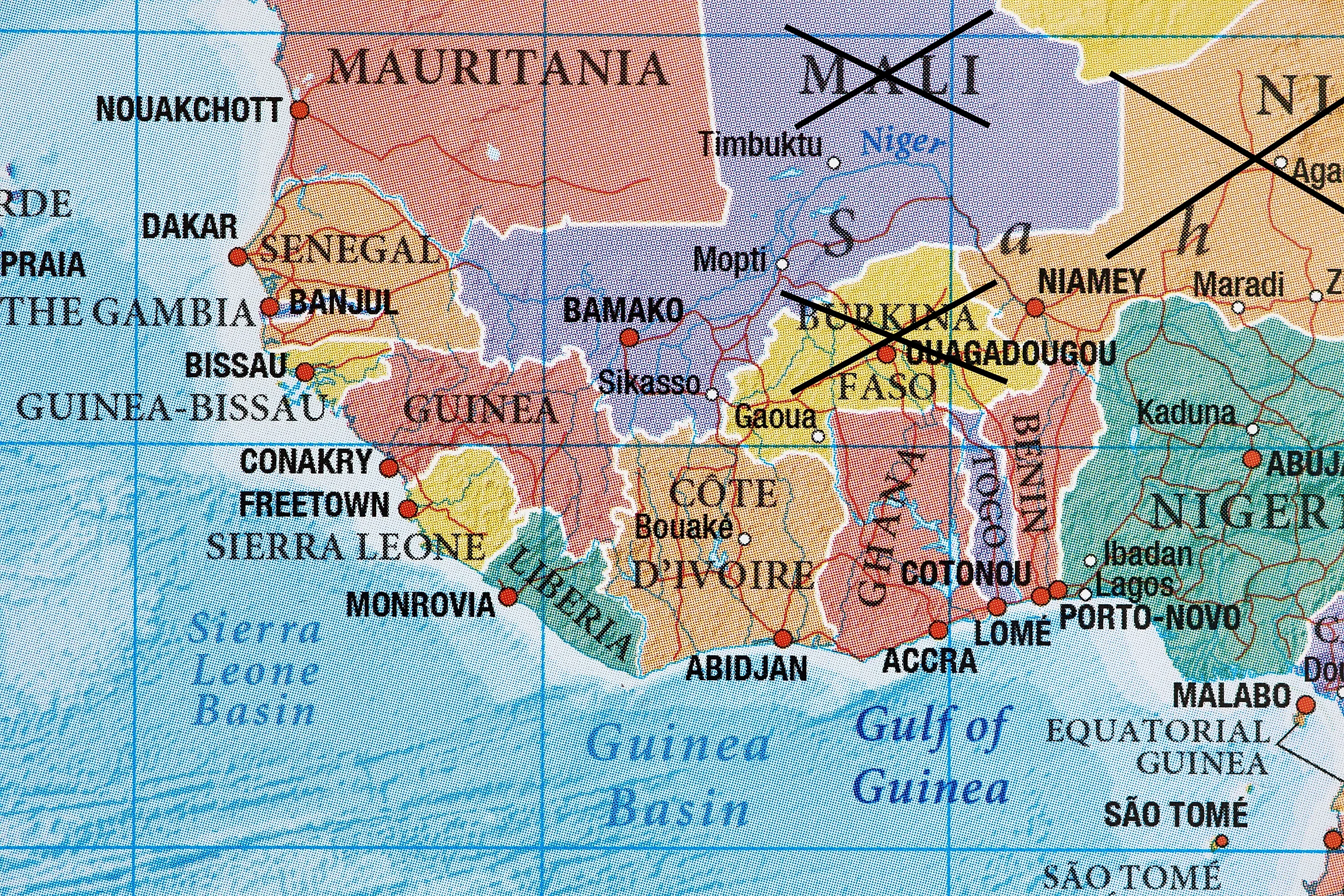
West Africa stretches from the Sahara in the north to the Atlantic coast in the west and the fertile lands of the south. The Economic Community of West African States (ECOWAS) was formed in 1975 to promote stability in the region. Among its fifteen members were Mali, Burkina Faso, and Niger.
These three landlocked Sahelian nations share borders with one another and lack the oceanic resources of their coastal neighbors. All three are led by military juntas that have reshaped relations with neighboring states. Recent conditions led these three countries to withdraw from ECOWAS in January 2024.
What Is ECOWAS?

ECOWAS is an organization based in Africa, created in May 1975 by the Treaty of Lagos by fifteen member states. Emerging out of a post-colonial context, the goal of this organization was to promote economic prosperity among member nations on the continent. Economic development and self-sustainability were promoted through the creation of a trading bloc that lowered trade barriers through multiple methods. Member nations created policies that encouraged trade and reduced barriers to such trade.
Another method of increasing trade is the use of a common currency called the “eco,” which six member states plan to launch in 2027. Citizens of member nations are also given free access to other member states, allowing them to cross borders with minimal difficulty.

In the summer of 2023, following a coup in Niger that toppled its democratically elected government, ECOWAS issued an ultimatum to the coup leadership, threatening military intervention if the new leadership did not step down. Military juntas in Burkina Faso and Mali offered their support to the Nigerien coup leaders. After tense negotiations, the three nations of Burkina Faso, Mali, and Niger announced their withdrawal in January 2024. The next month, ECOWAS announced that they were lifting sanctions against Niger for humanitarian reasons. Though ECOWAS offered these three nations a period during which they could reenter the union, in January 2025, the three nations formally exited.
Mali

Mali is a geographically diverse nation that ranges from subtropical to arid climates. There are three major geographic zones that characterize the country. The first major zone includes desert conditions in the Saharan regions of the north. Desert covers 30% of this nation. The second major zone is known as the Sahelian zone, which runs through the country’s center. The southern zone is fertile and cultivated with a savanna climate. Two primary rivers feed Mali. The first of these rivers is the Senegal River. The second river, the Niger River, forms a fertile inland delta where the Bani River joins it.
Burkina Faso

Burkina Faso is a Sahelian nation, so, as with central Mali, it is a semi-arid nation. Portions of the north are arid and covered in sandy desert. Progressing further south, the region becomes more fertile and transitions to tropical woodlands. The country is positioned on a plateau characterized by brush and scattered trees. It is also known for its exposure to the harmattan wind. This seasonal wind impacts Burkina Faso between March and May, but hotter temperatures persist until October. The cooler rainy season is comparatively short and runs only between May and September.
Niger

Niger’s geography is characterized almost entirely by Saharan and Sahelian conditions. The northern half of the country is arid desert, while its southern portion is a less hot but still semi-arid environment. The Niger River is an important waterway within southern Niger that supports life in its semi-arid lands. Sandy and rocky conditions can be found throughout the country. The Nigerien Sahara in the north is the best example of these sandy characteristics, but these conditions can also be found among the plateaus of the south, where large sandy valleys push up against rocky plateaus.
Outcomes Of Withdrawal

The three nations that departed ECOWAS have formed a new partnership known as the Alliance of Sahel States (AES). This new alliance intends to stop using the CFA franc, a form of currency backed by the French treasury. Pegged to the euro at 655.96 CFA francs per euro, this peg maintains monetary stability for the countries that use it. Politically, dropping the use of the CFA franc is an attempt to break from France’s influence. It is feared that these nations may also depart from the West African Economic and Monetary Union (WAEMU). Such continued breaks from the surrounding economic structure could result in total economic destabilization within their borders.
A second economic impact is the loss of regional trade. AES states rely on relations with coastal neighbors in order to conduct international trade, while landlocked AES states also contain portions of important land-based trade routes that impact ECOWAS nations. While members of ECOWAS have continued to maintain friendly policies toward the members of AES, they are not obligated to do so. Any future tensions could result in increased border controls and traffic that would be economically damaging to Mali, Burkina Faso, and Niger. For individuals, there is also the loss of free movement. In an attempt to smooth the transition, ECOWAS has continued to honor old travel documents. Members of the AES will need to develop their own travel materials. Honoring old passports is not required of ECOWAS members, and changes in relations between members of the AES and surrounding countries could make travel more difficult.
Changing Conditions In Africa
The departure of Mali, Burkina Faso, and Niger from ECOWAS signals a substantive shift in West African geopolitical relations. While junta leaders in these nations cite a desire to move away from the influence of European powers, as seen in the rejection of the CFA franc, these changes may put AES nations in a precarious position regionally and globally. While ECOWAS nations have maintained friendly relations with AES, these relationships are no longer part of a formal structure and may be subject to change.