What Is The Longest Country Name In The World?
The longest official country name in the world is that of the UK, also known as "The United Kingdom of Great Britain and Northern Ireland."
Similarly, several countries around the world have surprisingly long official names that are rarely used in full, including the Democratic Republic of São Tomé and Príncipe, the Democratic Socialist Republic of Sri Lanka, the Federation of Saint Christopher and Nevis, and the Federal Democratic Republic of Ethiopia. This list only includes fully sovereign countries; overseas territories, dependent regions, and subnational entities have not been considered, even though some have longer official names.
This list focuses on the ten countries in the world with the longest names based on the number of letters, as well as the length of these names. Moreover, each country has a unique character to share, with everything from tourist hotspots to economic centers. (Letter counts exclude spaces and punctuation, with accented characters counted as single letters.)
Countries With The Longest Names In The World (Number Of Letters)
| Rank | Common Name | Official Name | Number of Letters |
|---|---|---|---|
| 1 | United Kingdom | United Kingdom of Great Britain and Northern Ireland | 45 |
| 2 | São Tomé and Príncipe | Democratic Republic of São Tomé and Príncipe | 38 |
| 3 | Sri Lanka | Democratic Socialist Republic of Sri Lanka | 37 |
| 4 | Saint Kitts and Nevis | Federation of Saint Christopher and Nevis | 36 |
| 5 | Ethiopia | Federal Democratic Republic of Ethiopia | 35 |
| 6 | Algeria | People’s Democratic Republic of Algeria | 34 |
| 7 (tied) | Papua New Guinea | Independent State of Papua New Guinea | 32 |
| 7 (tied) | Nepal | Federal Democratic Republic of Nepal | 32 |
| 7 (tied) | North Korea | Democratic People’s Republic of Korea | 32 |
| 10 | Timor-Leste | Democratic Republic of Timor-Leste | 30 |
1. United Kingdom of Great Britain and Northern Ireland (45 Letters)

The United Kingdom of Great Britain and Northern Ireland is the longest country name in the world, comprising 45 letters. Commonly known as the United Kingdom, few people are aware of the country’s official name, which signifies the individual kingdoms and territories united under the same banner. Back in the 18th century, the name was shorter as the Kingdom of England (which included Wales) and the Kingdom of Scotland were united to form the Kingdom of Great Britain. The current name originated in 1927, following the independence of the Irish Free State.
The United Kingdom operates as a constitutional monarchy with a parliamentary system of government, a structure that has heavily influenced many modern democracies around the world. The country itself is home to approximately 67 million people and comprises four constituent nations: England, Scotland, Wales, and Northern Ireland. It remains one of the world’s largest economies, a permanent member of the United Nations Security Council, and a leading destination for international tourism, higher education, and global finance.
2. Democratic Republic of São Tomé and Príncipe (38 Letters)

São Tomé and Príncipe has quite a long common name already, but its official name is the second-longest in the world. Officially known as the Democratic Republic of São Tomé and Príncipe, the complete name spans 38 letters. The name originates from Portuguese roots, as sailors arrived on São Tomé Island on December 21, 1471, and on S. Antão Island on January 17, 1492. In 1500, S. Antão Island was renamed Príncipe Island, and the two names were combined to form the current name. However, São Tomé and Príncipe is still divided into two provinces, Príncipe and São Tomé.
The country is located on an island off the Gulf of Guinea in Central Africa. According to recent figures, it is home to over 220,000 residents, and Portuguese is the official language due to its historical links with the nation. As of 2025, agriculture and fishing are the primary pillars of the economy, with cocoa accounting for a majority of total exports. Along with this, São Tomé and Príncipe’s island scenery makes it a hotspot for tourism, with around 30,000 visitors a year.
3. Democratic Socialist Republic of Sri Lanka (37 Letters)

Sri Lanka’s official name, the Democratic Socialist Republic of Sri Lanka, is 37 letters long and reflects the country’s history and journey towards independence. The name was formally adopted in the 1970s, replacing the previous name, “Ceylon.” This change occurred as the nation transitioned to a republic, removing its status as a British dominion. The inclusion of “Democratic Socialist” highlights the constitutional framework introduced at the time, which emphasized state involvement in key sectors while maintaining a democratic system of governance. In everyday use, however, the country is almost always referred to simply as Sri Lanka.
Located in South Asia, just off the southeastern coast of India, Sri Lanka is home to approximately 22 million people. The island nation has a diverse cultural and religious makeup, with Buddhism, Hinduism, Islam, and Christianity all playing significant roles in daily life. Sri Lanka’s economy is supported by agriculture, manufacturing, and services, with tea, rubber, and apparel among its most notable exports.
4. Federation of Saint Christopher and Nevis (36 Letters)
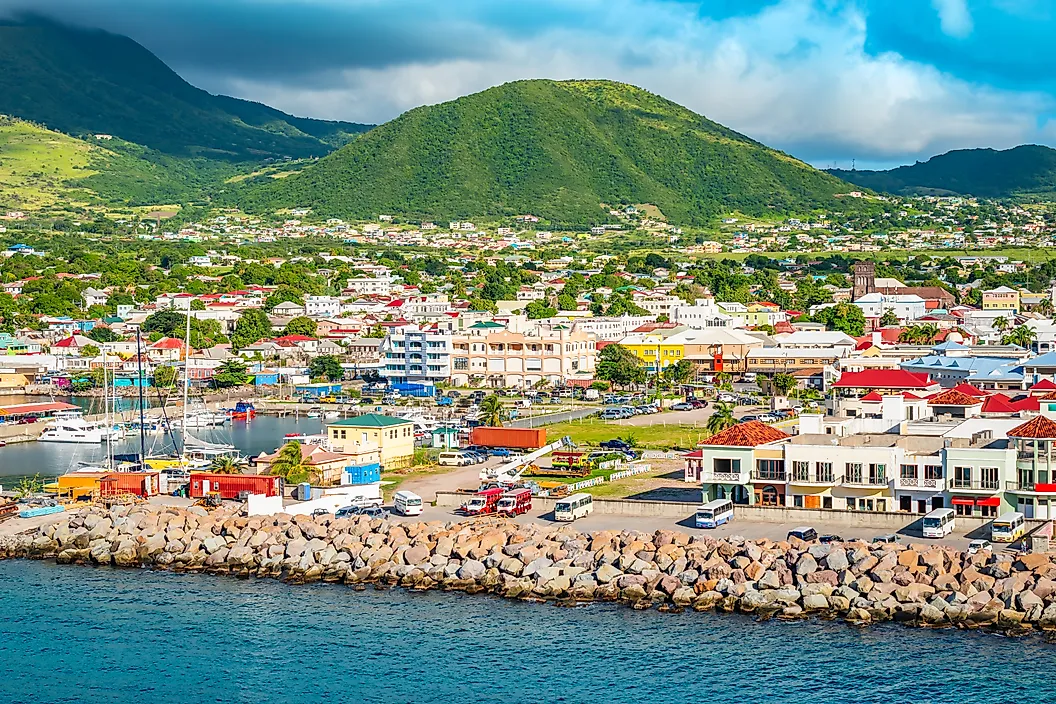
Saint Kitts and Nevis is an island country in the eastern Caribbean whose official name differs noticeably from its commonly used form. While the country is widely referred to as Saint Kitts and Nevis, its constitutional name is the Federation of Saint Christopher and Nevis, which totals 36 letters when spaces and punctuation are excluded. “Saint Christopher” is the formal name of the island commonly known as Saint Kitts, and the longer version reflects historical naming conventions rather than everyday usage.
The country gained independence from the United Kingdom in 1983 and operates as a federal parliamentary democracy and constitutional monarchy, with Saint Kitts and Nevis functioning as two autonomous islands within a single sovereign state. It is one of the smallest countries in the Western Hemisphere, both in terms of land area and population, with approximately 55,000 residents. Tourism, offshore financial services, and light manufacturing form the backbone of the economy, with beach tourism and cruise arrivals playing a particularly significant role.
Note: “Federation of Saint Christopher and Nevis” is a constitutionally recognized formal style of the country’s name. However, international organizations and most official listings primarily use “Federation of Saint Kitts and Nevis.”
5. Federal Democratic Republic of Ethiopia (35 Letters)

Ethiopia is an African nation located in the Horn of Africa, and its common name is quite short, with just eight letters. However, the nation’s official name is the Federal Democratic Republic of Ethiopia, which is 35 letters long, making it the fifth-longest country name in the world. The name originates from the ancient Greek word Αἰθιοπία (Aithiopia), meaning "burnt face." The name was historically used to describe lands south of Egypt. It gradually became associated specifically with the territory of modern Ethiopia, one of the few African countries never formally colonized and a state with a long, continuous national identity.
Beyond its name, Ethiopia is a landlocked country home to over 130 million people, making it the most populous nation in Africa after Nigeria. Historically, the country was widely known as Abyssinia, a name commonly used in international records until the mid-20th century. Moreover, Ethiopia is the seat of the African Union, uses its own unique calendar system, and is one of the world's oldest continuously inhabited countries, with roots stretching back thousands of years.
6. People's Democratic Republic of Algeria (34 Letters)

Another African nation, Algeria, also ranks fifth among countries with the longest official names in the world. The nation’s full constitutional title, the People’s Democratic Republic of Algeria, is 34 letters long. The name “Algeria” itself derives from Algiers, which is from the Arabic al-Jazāʾir, meaning “the islands,” a reference to the small islands that once lay off the city’s coast. The modern national name became firmly established during the Ottoman period, when the Regency of Algiers functioned as a centralized political entity and laid the foundations of Algeria’s territorial and state identity.
Along with having one of the longest names in Africa, Algeria is also the largest country on the continent. It has a total area of nearly 2,381,741 square kilometres (919,595 sq mi) and is home to around 47 million people according to estimates from 2025. The nation is primarily Islamic, has a semi-presidential system, and is one of the largest economies on the continent. Most people live in the capital, Algiers, whose name shares the same roots as the country’s name.
7. Independent State of Papua New Guinea (32 Letters)*

Papua New Guinea’s official name, the Independent State of Papua New Guinea, contains 32 letters and reflects the country’s post-colonial status. The name combines “Papua,” possibly derived from a Malay word referring to curly hair, and “New Guinea,” a term applied by European explorers who believed the island’s inhabitants resembled those of Guinea in Africa. The full official name was adopted in 1975, when the country gained independence from Australia. However, due to the length of both the official and common names, Papua New Guinea is also referred to as “PNG” in some informal situations.
Located in the southwestern Pacific Ocean, Papua New Guinea occupies the eastern half of the island of New Guinea and is home to more than ten million people. It is one of the most culturally diverse countries in the world, with over 800 spoken languages. The economy relies heavily on natural resources, including gold, copper, oil, and natural gas, while a large portion of the population continues to live in rural and subsistence-based communities.
7. Federal Democratic Republic of Nepal (32 Letters)*

Nepal, a small nation in South Asia, is landlocked between India and China, and has the seventh-longest name in the world. While its common name is only five letters long, the official name is the Federal Democratic Republic of Nepal, which is 32 letters long excluding spaces. The name “Nepal” dates back to the Vedic period, and the term first appeared in ancient Indian texts around 400 AD. Hindu mythology associates the name with a Hindu sage known as Ne or Ne Muni, and it was subsequently used to refer to the broader Kathmandu Valley. When the nation was unified in 1786, it officially took the name Nepal.
Although the origin of the name is still debated, the Federal Democratic Republic of Nepal has seen prominent growth since its formation. It is one of the most geographically unique areas in the world, with the greatest altitude change of any location on Earth. The elevation change is due to the Himalaya Mountain Range, and Nepal boasts eight of the 14 highest mountains in the world, including Mount Everest. Apart from its 75% mountainous terrain, the nation boasts a rich culture and is home to over 30 million people. Kathmandu, the capital and largest city, is a popular destination for tourists from Asian countries.
7. Democratic People's Republic of Korea (32 Letters)*

North Korea is a country in East Asia that defines itself as an independent socialist state with a highly centralized system of government. The nation was formerly part of a larger Korea, but after the country's division, the northern side adopted the name North Korea. Apart from its many unique facts, North Korea also has one of the longest official names in the world: Democratic People’s Republic of Korea. The name is 32 letters long, excluding spaces and punctuation, emphasizing “democratic” and “people’s” governance, reflecting socialist ideology rather than the country’s political reality. It was adopted in 1948, but most locals refer to it simply as “the Republic.”
North Korea has an estimated population of around 26 million people and is governed under a single-party system led by the Workers’ Party of Korea. Pyongyang serves as the capital and main political center, while much of the country remains largely closed off to international travel and trade. The nation’s economy is centrally planned, and its long official name is most commonly used in formal state documents, international treaties, and diplomatic contexts rather than in everyday global discourse.
10. Democratic Republic of Timor-Leste (30 Letters)

Commonly referred to as Timor-Leste or East Timor, this nation’s official name is the Democratic Republic of Timor-Leste. Excluding spaces and punctuation, the name is 30 letters long, which makes it the tenth-longest in the world. It is derived from the Malay words “timur,” meaning “east,” and “Leste,” which have the same meaning. Thus, the name translates to “East East,” which indicates its location on the eastern half of Timor Island.
The nation has significant Portuguese influence, as it was under Portuguese rule in the 16th century and remained a colony until the 1970s. To this end, Portuguese is the official language, and the majority of the 1.35 million locals are Christian. However, the nation also has historic roots in Papuan and Austronesian cultures, as these groups inhabited the region before Western influence. Although it has one of the longest names in the world, the nation is relatively small, with a total land area of just 14,950 square kilometres (5,770 sq mi) on the island of Timor.
Longest Country Names In The World
These ten countries have the longest official names in the world, with each exceeding 30 letters in length. The United Kingdom has the longest name, with 45 letters, as its roots lie in the many colonies united under the nation. Similarly, each country’s name, whether the official or common variant, has a rich history, whether linking to previous kingdoms or even simple geographical descriptions. Beyond their sheer length, these official country names offer insight into each nation’s constitutional identity, political evolution, and historical influences, explaining why such formal titles persist alongside far shorter everyday names.
*Countries marked with an asterisk are tied, each having official names consisting of 32 letters when spaces and punctuation are excluded.