The 10 Least Populated Countries In Europe
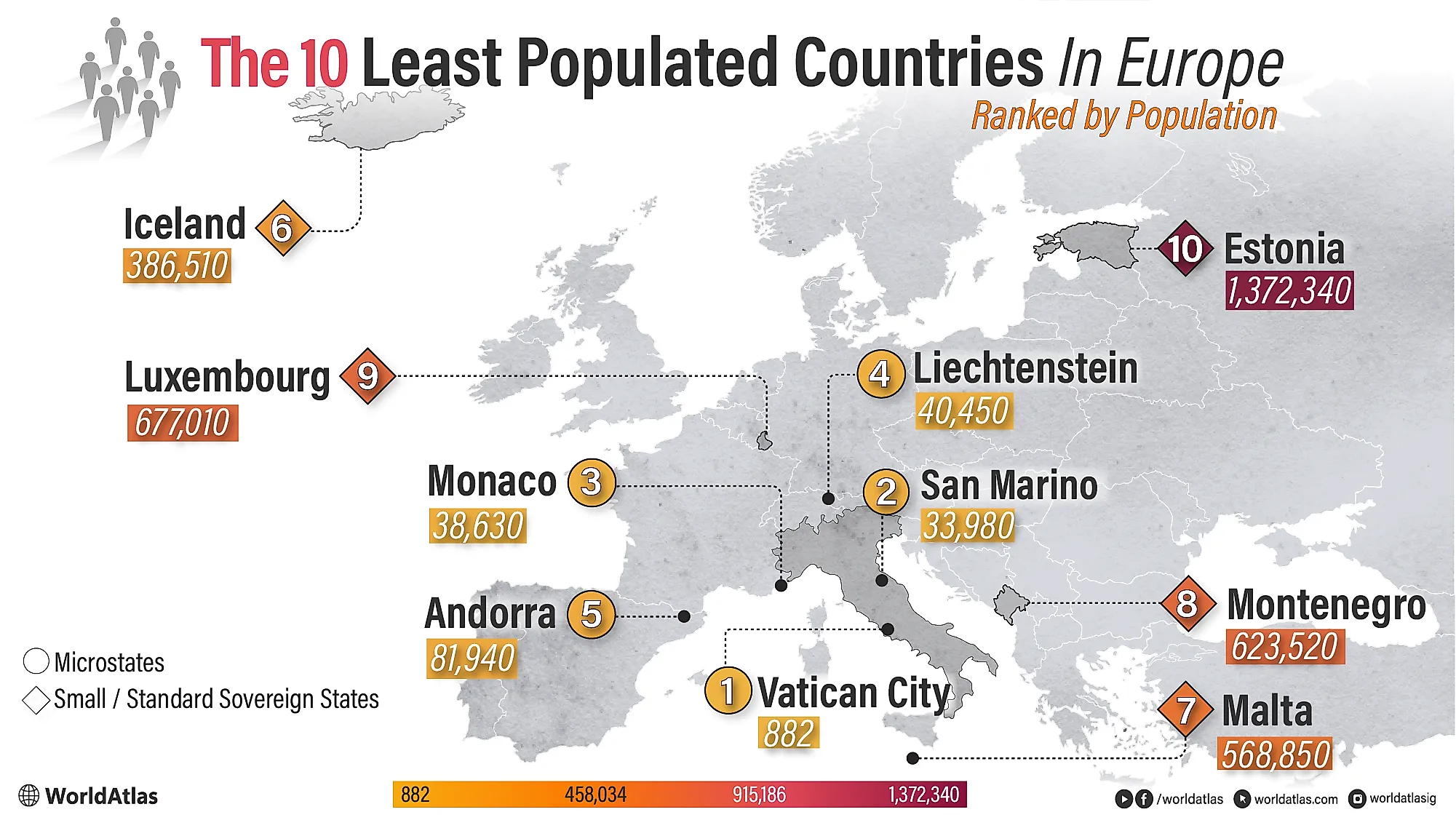
Europe may be the second-smallest continent in the world, but it is home to 44 countries, along with several others that are partly located within its borders. Despite this number, the continent’s total population of around 750 million is still far smaller than that of nations like India or China. Within this compact region are several countries that are small not only in land area but also in population, with some home to fewer than 100,000 residents. These include Vatican City, San Marino, Monaco, Liechtenstein, Andorra, Iceland, Malta, Montenegro, Luxembourg, and Estonia.
Ranging from Vatican City, with fewer than 1,000 residents, to Estonia, with a population of just over 1.3 million, these countries represent Europe’s least populated nations. This article explores each of them, highlighting their size, population, and what makes them unique despite their smaller numbers.
The Ten Least Populated Countries In Europe
| Rank | Country | Population |
|---|---|---|
| 1 | Vatican City | 882 |
| 2 | San Marino | 33,980 |
| 3 | Monaco | 38,630 |
| 4 | Liechtenstein | 40,450 |
| 5 | Andorra | 81,940 |
| 6 | Iceland | 386,510 |
| 7 | Malta | 568,850 |
| 8 | Montenegro | 623,520 |
| 9 | Luxembourg | 677,010 |
| 10 | Estonia | 1,372,340 |
1. Vatican City (882)
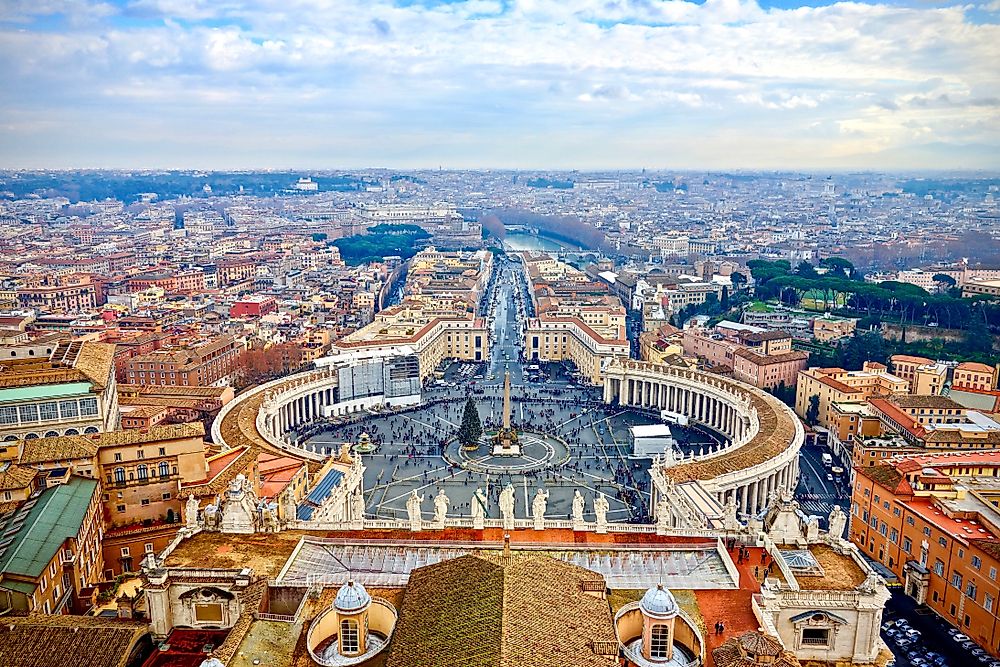
The Vatican City is a landlocked city-state in Southern Europe, surrounded by Rome, Italy. It is home to fewer than 900 people, with recent estimates from 2024 indicating a population of 882, significantly lower than that of any other country on this list. Along with being the least populated on the continent and in the world, the Vatican City is also the smallest sovereign state in the world, with an area of just 0.49 square kilometres (0.19 square miles).
This small area is due to the fact that the Vatican City is traditionally a part of Rome, but was created as a separate nation to ensure the Catholic Church’s independence. It is home to the Pope and provides sufficient space for them to govern, administer, and fulfill their religious responsibilities. Beyond its population size, Vatican City holds immense global significance. It is the spiritual center of the Roman Catholic Church, home to St. Peter’s Basilica, the Sistine Chapel, and priceless Renaissance art that draws millions of visitors annually.
2. San Marino (33,980)

San Marino is one of Europe’s smallest countries and the second least populated, with a population of 33,980 people. Its population remains relatively small, largely due to its compact land area, the absence of large urban centers, and its carefully preserved historic nature. Most residents in San Marino reside in small communities along the nation’s prevalent hills, with San Marino City serving as the cultural and administrative heart of the country.
Despite its limited size and population, it holds a remarkable distinction as one of the world’s oldest republics, tracing its origins back to the year 301 AD. The country covers only about 61 square kilometers (24 square miles), meaning its entire population is comparable to that of a small town in many larger nations. Located within northern Italy, San Marino sits atop the Apennine Mountains and is completely landlocked, surrounded by Italian territory.
3. Monaco (38,630)

Monaco is the third least populated country in Europe, with an estimated population of around 38,630 people. Despite having a relatively small population, it is one of the most densely populated places on the planet, given its small size of just 2.02 square kilometers (0.78 square miles). The country is mainly urban, with most residents residing in high-rise apartments along the Mediterranean coastline. Monte Carlo is the most famous district, known for its luxury lifestyle, casinos, and grand architecture, while Monaco-Ville serves as the historic and administrative heart of the principality.
Monaco’s low population is primarily attributed to its limited land area, strict residency rules, and extremely high cost of living, which naturally restricts the number of people who can reside there. Many of its residents are wealthy foreigners who are drawn by its tax advantages, security, and glamorous quality of life. Even with its small population, Monaco has a strong international identity and continues to attract millions of tourists each year who come to experience its yachts, Formula One Grand Prix, luxury boutiques, and scenic harbor views.
4. Liechtenstein (40,450)

Liechtenstein is Europe’s fourth least populous country, with a population of about 40,450 people. The nation is doubly landlocked in the Central European Alps and is also the continent's fourth-smallest country. It covers around 160 square kilometers (62 sq mi), which is one of the primary reasons for its low population. In addition to its small size, much of Liechtenstein is mountainous, meaning that only limited areas are suitable for settlement; most people reside in small valleys and compact towns. The largest population center is Schaan, followed closely by the capital Vaduz, where much of daily life and administration is concentrated. Adding to this, citizenship is difficult to obtain, often requiring many years of residence and strict local approval, which naturally limits population growth.
While various reasons lead to a low population in Liechtenstein, they also bolster the nation’s economy. The strict guidelines on citizenship and a strong financial sector make it a hub for billionaires, and the country was once known as a billionaire tax haven. The mountainous terrain also promotes winter sports, with activities like skiing and ice hockey prevalent throughout the region.
5. Andorra (81,940)

With a population of 81,940 as of 2024, Andorra is the fifth-least populous country in Europe. Similar to other nations on this list, it is also relatively small, with an area of 468 square kilometres (181 sq mi), making it the sixth-smallest on the continent. The nation is located in southwestern Europe, bordering Spain and France, and a large share of its residents are foreign nationals, particularly from Spain, Portugal, and France. Moreover, rugged mountains primarily characterize Andorra’s geography, and the country has a high average elevation of 1,996 meters (6,549 feet). To this end, approximately one-fourth of the population resides in Andorra la Vella, the capital and largest city in the nation.
Along with the terrain, another factor is that many people working in Andorra commute from Spain or France, rather than living permanently in the country, which helps keep its population numbers smaller. Despite this, tourism attracts millions of visitors each year, particularly for skiing and shopping, making the country often feel busier than its official population suggests.
6. Iceland (386,510)

Iceland is a Nordic island country in the Mid-Atlantic Ridge between North America and Europe. It is home to a population of 386,510 people as of 2024, making it the sixth least-populated in Europe. However, unlike many other nations on this list, Iceland is also one of the largest, with an area of 103,000 square kilometres (39,600 sq. mi.). Due to this, it is the most sparsely populated country in the region, with less than four people per square kilometer. The majority of people live in larger cities, such as the coastal capital, Reykjavík, as most of the country has a harsh environment with freezing winters, frequent storms, and limited arable land. Historically, Iceland was also settled relatively late compared to most European regions and remained isolated for centuries due to its remote location.
While the majority of the island is covered in glaciers and barren land, the southern coast sees milder weather, making it suitable for living. This area is also popular with tourists, as its untouched landscape is ideal for ecotourism, offering activities such as skiing and whale-watching. Today, tourism is one of the nation’s top sectors, along with fishing and aluminum exports.
7. Malta (568,850)

Malta is one of Europe’s least populous countries, with a population of around 568,850 people. Yet, it remains one of the most densely populated nations in the world, despite its very small size of just 316 square kilometres (122 sq mi). Most residents live on the main island, especially around Valletta, Sliema, and St. Julian’s, while the smaller islands of Gozo and Comino are far more lightly populated. The country’s modest population is closely tied to its geography. As a small island nation in the central Mediterranean, Malta has limited land available for expansion, and space must be carefully shared between residential areas, tourism, infrastructure, and preserved historic landscapes.
Despite its size, Malta remains highly influential. Its capital, Valletta, is a UNESCO World Heritage Site, while landmarks such as Mdina, the Ħal Saflieni Hypogeum, and the Ġgantija Temples highlight its rich historical roots. Malta also has a strong modern identity, with key industries such as tourism, financial services, film production, and online gaming contributing to its economy, helping the country maintain a vibrant and active population despite its small scale.
8. Montenegro (623,520)

Montenegro lies in Southeastern Europe, just south of Serbia, with a population of 623,520 people. This makes it the eighth least populous country in Europe, with its population divided among various ethnicities, making it a multi-ethnic state. Montenegro has also experienced a slow growth rate over the past few decades, reaching a population of around 615,000 in 1991, and has since stagnated. Much of Montenegro is mountainous, with many peaks rising over 2,000 metres (6,600 feet), making various areas uninhabitable. To this end, most people live near the southern coast in cities like Podgorica, the capital and largest city. This city alone is home to around 180,000 people, about a third of the country’s total population.
Montenegro’s population is also shaped by migration trends, with many young people moving abroad for education or employment, particularly to Western Europe, contributing to slower long-term growth. Meanwhile, the country attracts seasonal workers and tourists, especially along the Adriatic coast in places like Kotor and Budva, meaning its population often feels larger than official figures suggest.
9. Luxembourg (677,010)

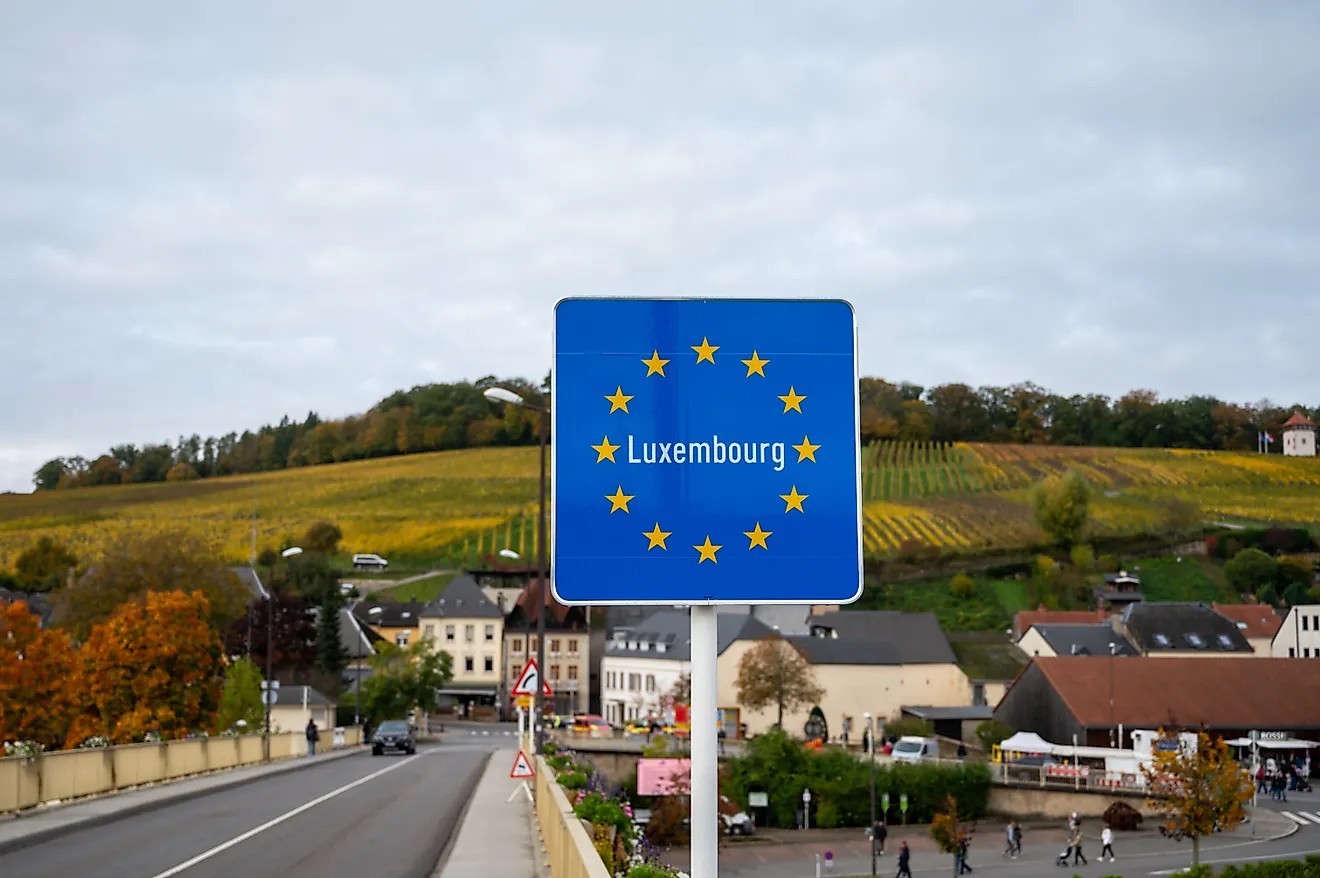
Luxembourg, officially known as the Grand Duchy of Luxembourg, is a small, landlocked country in Western Europe and the ninth least populous nation on the continent, with approximately 677,010 residents. Despite its relatively small population, it has one of the fastest-growing populations in Europe. As of 2023, Luxembourg experienced an average population growth rate of 2%, primarily driven by immigration and strong economic opportunities. Foreign nationals actually make up more than 45% of its residents, one of the highest proportions in the EU.
Luxembourg covers just 2,586 square kilometres (998 sq mi), so although its overall population is relatively small, the country still feels lively due to its high economic activity and high standard of living. Much of the population is concentrated around Luxembourg City, the capital, which serves as a significant financial and administrative hub for the European Union. Strong job prospects, high wages, political stability, and quality public services continue to attract workers from neighbouring France, Belgium, and Germany, helping Luxembourg maintain steady population growth despite its small overall size.
10. Estonia (1,372,340)

In tenth place among Europe’s least populated countries is Estonia, home to 1,372,340 people. This is the only country on this list with more than a million residents, and the population is divided between the mainland and over 2,300 other islands. However, during the 1990s, Estonia had over 1.5 million residents, and low birth rates combined with high emigration rates led to a constant decline. Similar to its overall population, Estonia has the most populous capital city on this list. Tallinn, the capital, is home to over 450,000 people, more than the population of Iceland.
In recent years, the country has slowly stabilized through improvements in living standards, a strong digital infrastructure, and government policies that encourage families and return migration. Estonia is also one of Europe’s most technologically advanced nations, known for its e-governance, digital ID system, and thriving tech scene.
The Ten Least Populated Countries In Europe
Europe is a continent rich in history, culture, and scenery, offering a diverse range of attractions, from the Amalfi Coast to Medieval castles. These ten countries, while some of the least populated in the region, are full of surprising charm. Whether it is the immense religious significance of the Vatican City or the luxurious lifestyle of Monaco, each region is unique and has a history behind its small population.
Population Of Countries In Europe (Least To Most Populated)
| Rank | Country | Population |
|---|---|---|
| 1 | Vatican City | 882 |
| 2 | San Marino | 33,980 |
| 3 | Monaco | 38,630 |
| 4 | Liechtenstein | 40,450 |
| 5 | Faroe Islands | 50,000 |
| 6 | Andorra | 81,940 |
| 7 | Iceland | 386,510 |
| 8 | Malta | 568,850 |
| 9 | Montenegro | 623,520 |
| 10 | Luxembourg | 677,010 |
| 11 | Cyprus | 980,000 |
| 12 | Estonia | 1,372,340 |
| 13 | Kosovo | 1,590,000 |
| 14 | North Macedonia | 1,820,000 |
| 15 | Latvia | 1,870,000 |
| 16 | Slovenia | 2,120,000 |
| 17 | Albania | 2,360,000 |
| 18 | Moldova | 2,420,000 |
| 19 | Lithuania | 2,890,000 |
| 20 | Bosnia and Herzegovina | 3,410,000 |
| 21 | Croatia | 3,860,000 |
| 22 | Slovakia | 5,420,000 |
| 23 | Ireland | 5,440,000 |
| 24 | Norway | 5,550,000 |
| 25 | Finland | 5,600,000 |
| 26 | Denmark | 5,960,000 |
| 27 | Bulgaria | 6,440,000 |
| 28 | Serbia | 6,570,000 |
| 29 | Switzerland | 9,050,000 |
| 30 | Belarus | 9,110,000 |
| 31 | Austria | 9,200,000 |
| 32 | Hungary | 9,580,000 |
| 33 | Greece | 10,410,000 |
| 34 | Sweden | 10,590,000 |
| 35 | Portugal | 10,750,000 |
| 36 | Czech Republic | 10,890,000 |
| 37 | Belgium | 11,900,000 |
| 38 | Netherlands | 18,040,000 |
| 39 | Romania | 19,040,000 |
| 40 | Poland | 36,500,000 |
| 41 | Ukraine | 37,860,000 |
| 42 | Spain | 49,080,000 |
| 43 | Italy | 58,930,000 |
| 44 | France | 68,440,000 |
| 45 | United Kingdom | 69,280,000 |
| 46 | Germany | 83,580,000 |
| 47 | Turkey | 85,670,000 |
| 48 | Russia | 146,000,000 |