The County Seats That Aren't The Biggest Town
Upper Marlboro, Maryland, has 652 residents. The county it governs has nearly a million. Legislatures fixed county seats early in American history, and courthouses have almost never moved since. Railroads, highways, and subdivisions proved far less loyal. The nine towns below never gave up their county's courthouse, and a larger nearby place absorbed their population instead. Some of those gaps are enormous, and a few are razor-thin. Every figure here is based on a 2020 census count, noting that the census counts communities that no state has ever incorporated alongside the ones it has.
Upper Marlboro, Maryland

Upper Marlboro is perhaps the most surprising entry on this list. Its 652 residents administer nothing beyond their own town limits, yet Prince George's County reported 967,201 people, second only to Montgomery among Maryland counties. Bowie leads the county's municipalities at 58,329, and no unincorporated community here approaches that figure either. Maryland granted the town its charter in 1870, more than 170 years after the county was erected from Calvert and Charles in 1695. Prince George of Denmark, husband of Queen Anne, supplied the name.
A five-member Board of Commissioners runs the town, and the commissioners choose their mayor from among themselves. Roughly 1,500 times as many people fall under the government that works out of the County Administration Building on Gov. Oden Bowie Drive. Upper Marlboro also keeps the circuit court and the official county address. Bowie has the residents, a municipal government of its own, and no claim on any of that.
Bridgeport, California

Bridgeport kept the Mono County courthouse, and very little besides. The census found only 553 people there, and the community has never been incorporated, so no town government exists at all. Mammoth Lakes returned 7,191, making it both the biggest community in Mono County and its only incorporated town. The county total came to 13,195, the fourth-lowest among counties in California.
By the county's own account, the original Mono County Courthouse at Bridgeport is the second-oldest courthouse in continuous use statewide. Roughly 94% of Mono County is public or quasi-public land, which leaves very little of it available to anybody. Mammoth Lakes went a different way entirely, incorporated in 1984 at the foot of Mammoth Mountain Ski Area. One town has a ski resort and 13 times the people. Bridgeport has the courthouse where Mono County records every deed.
Coupeville, Washington

Coupeville fronts Penn Cove on Whidbey Island with 1,942 residents. Oak Harbor, at the north end of that same island, reached 24,622 and leads every municipality in Island County, which returned 86,857 overall. The Oregon Territory legislature carved Island County out of Thurston County in 1852, making it one of the oldest in Washington.
Naval Air Station Whidbey Island operates just north of Oak Harbor and employs more people than any other outfit in the county. Coupeville never acquired an engine of that kind. What surrounds it instead is Ebey's Landing National Historical Reserve, which preserves the historic farmland and shoreline surrounding Coupeville. The courthouse, the clerk, and the assessor stay put in the smaller town regardless. Langley, the third of the county's three towns, returned 1,147.
Charlotte, Tennessee

Charlotte watched a place named for its own county grow nearly 10 times larger. The seat returned 1,656 people in the 2020 census. Dickson returned 16,058 and is far and away the largest municipality in Dickson County, home to 54,315 residents. William Dickson, a physician and congressman, lent his name to the county itself and to that larger city. The seat instead carries the name of Charlotte Reeves Robertson.
Six incorporated towns exist within the county, and a railroad line that was pushed through during the 1800s created several of them. Charlotte dates to the early 1800s, decades ahead of that line. The town retains the Dickson County Courthouse, which the county describes as the oldest working courthouse in Tennessee. Charlotte once drew consideration as a candidate for the state capital, a distinction that reads oddly given its population of fewer than 1,700 today.
Newfane, Vermont

Newfane carries a title almost no other state uses. Vermont calls its county seats shire towns, and Newfane has served as the shire town of Windham County for more than two centuries. The town returned 1,645 people against a county total of 45,905. Brattleboro reached 12,184, more than seven times that figure, and outranks every other municipality in Windham County.
Inside the town line, the numbers get stranger. Newfane village, the incorporated settlement around the courthouse, returned 87 residents. Those 87 live around a green listed on the National Register of Historic Places, within a district of more than 60 buildings dominated by Greek Revival architecture. The Windham County Courthouse went up there in 1825, after the original hilltop village came down to the flatland because of winter travel difficulties. Superior court, the sheriff, and the county clerk still work from the Newfane green.
Hillsboro, Missouri

Hillsboro answers to a name it never chose. Planners picked Monticello in 1839, after Thomas Jefferson's home, for a new town in a county already named for Jefferson. Another Missouri community held that name already, so the place took Hillsboro instead, a loose English translation of it. Hillsboro grew from 2,821 residents a decade earlier to 3,473 by 2020.
Jefferson County reported 226,739 people, the sixth most populous in the state, and Arnold leads its municipalities at 20,858. Jefferson College, the public two-year school, shares the town with the county government. The county was organized in 1818 around Herculaneum on the Mississippi, then went hunting for somewhere more central. Voters and the Missouri General Assembly settled on Hillsboro in February 1839, and the Jefferson County Courthouse has not moved since.
Amite City, Louisiana

Amite City took its courthouse in a state with no counties at all. Louisiana divides itself into parishes, which makes this a parish seat rather than a county seat. Amite City has served in that role since Tangipahoa Parish was organized in March 1869. The seat came in at 4,005 residents against a parish total of 133,157.
Hammond, at 19,584, is the largest city in the parish and home to Southeastern Louisiana University. Amite City was incorporated eight years before the parish even existed, in March 1861, and has housed the Tangipahoa Parish Courthouse ever since. An oyster festival draws crowds to Amite City each March, a nod to the oyster-processing trade the town has worked in since the 1940s.
Linden, Texas

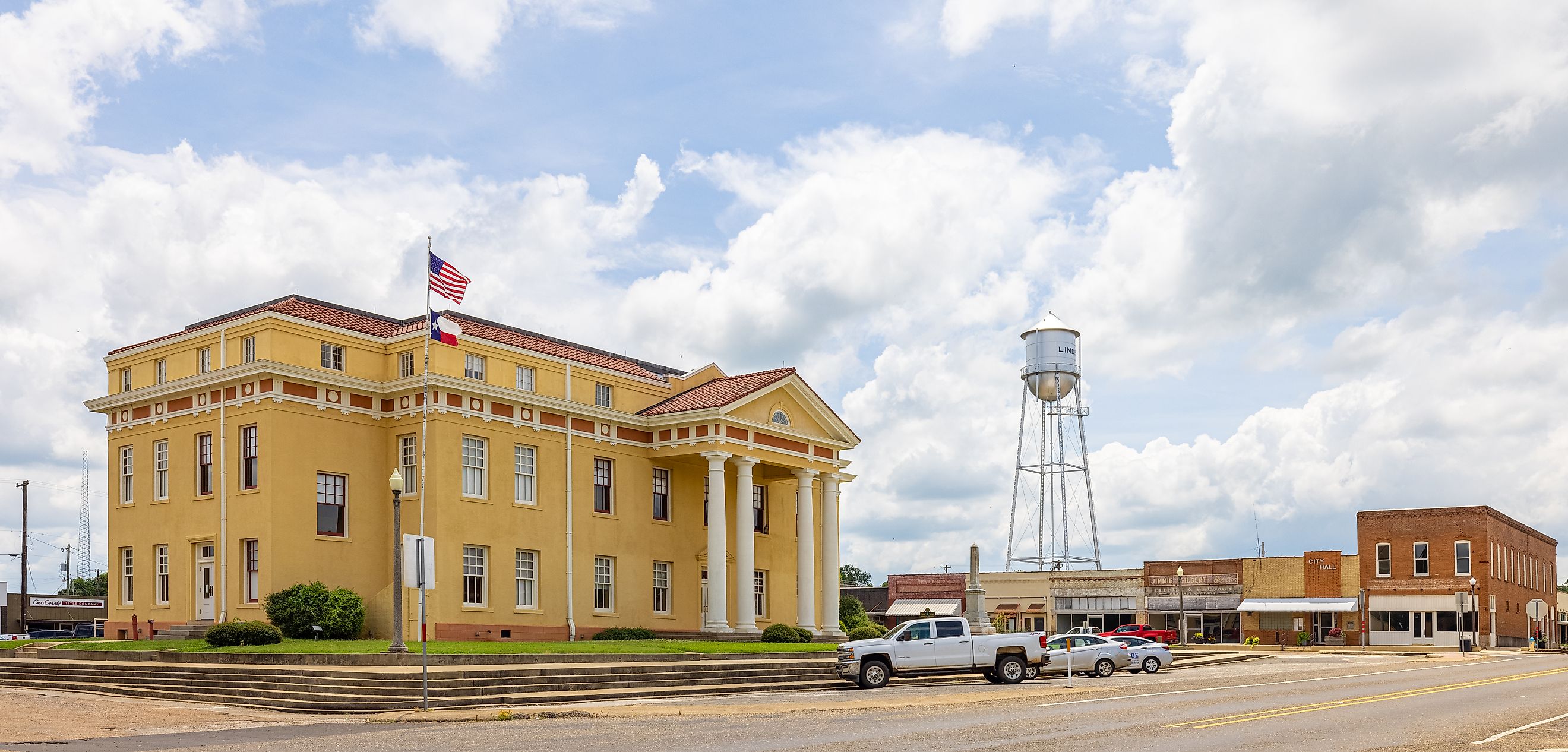
Linden administers Cass County from a town of 1,825 residents, while the largest place in that county answers to the name Atlanta. Atlanta, Texas, returned 5,433 residents and lies 14 miles northeast of the courthouse along US Highway 59. Cass County reported 28,454 people across 960 square miles of pine country in the far northeastern corner of Texas.
Texas created the county in 1846 and named it for Lewis Cass, a Michigan senator who had pushed hard for annexing Texas. The seat drew its name from Linden, Tennessee, which happens to be the seat of Perry County. Two rail lines eventually crossed Cass County, and US 59 now strings Linden, Atlanta, and Queen City together. The Cass County Courthouse still commands the Linden town square, and Atlanta has the people.
Palmer, Alaska

Palmer heads a jurisdiction that is not technically a county and never was. Alaska has none. It runs on boroughs and census areas instead, and Palmer is the borough seat of Matanuska-Susitna, which returned 107,081 residents. Just 5,888 of them live in Palmer. Wasilla, the largest incorporated city there, counted 9,054.
Neither is the borough's biggest community. That title goes to Knik-Fairview, 19,297 people, and the most populous census-designated place in Alaska. The census measures it as a place; the state governs it as nothing in particular. By the borough's own reckoning, Knik-Fairview runs about twice the size of Wasilla. Matanuska-Susitna therefore has a seat of 5,888, the largest city of 9,054, and the largest community that elects no mayor at all.
Where The Courthouse Stayed Put
Nine towns arrived at the same result by several different routes. A rail line ran somewhere else. A military airfield opened at the far end of an island. A ski mountain filled a valley, and an unincorporated area outgrew every neighboring city. In each instance, the courthouse remained exactly where a legislature first placed it. That durability is the whole character of a courthouse town. Populations move. Deed books do not.