Why Alaska Doesn't Have Counties
There are only two states in the US that do not have counties. These are Louisiana, which is organized around parishes per its Catholic heritage, and Alaska, which uses boroughs. The reasons Alaska does not have counties come down to history and population density, along with the values of the delegates who created Alaska's only state constitution in 1956. This constitution was signed three years before Alaska became a state and enshrined the state's commitment to keeping power at the local level.
Alaska Under Russia

Alaska has been inhabited by Native peoples for at least 12,000 years, with large groups traversing a land bridge between Siberia and Alaska. The territory remained distant and undiscovered by Europeans up until the 18th century, when Peter I of Russia sent an expedition led by Danish sailor Vitus Bering to explore the land to the east of Siberia. He failed to find anything in his first expedition due to fog in 1728, but in 1741, he successfully made landfall near Mount St. Elias. The strait separating Siberia from Alaska was named the Bering Strait after him. The first official Russian settlement was set up at Three Saints Bay in 1784, followed by Sitka in 1804.
The Russians maintained a small presence here until 1867, when, under pressure from decreasing populations of sea otters and the Crimean War, Russia sold Alaska to the US. The treaty was negotiated by Secretary of State William H. Seward. For the first decade, the U.S. Army governed the territory directly, beginning under Brevet Major General Jefferson C. Davis (not to be confused with the Confederate president Jefferson Davis).
Growth in the Alaska Territory

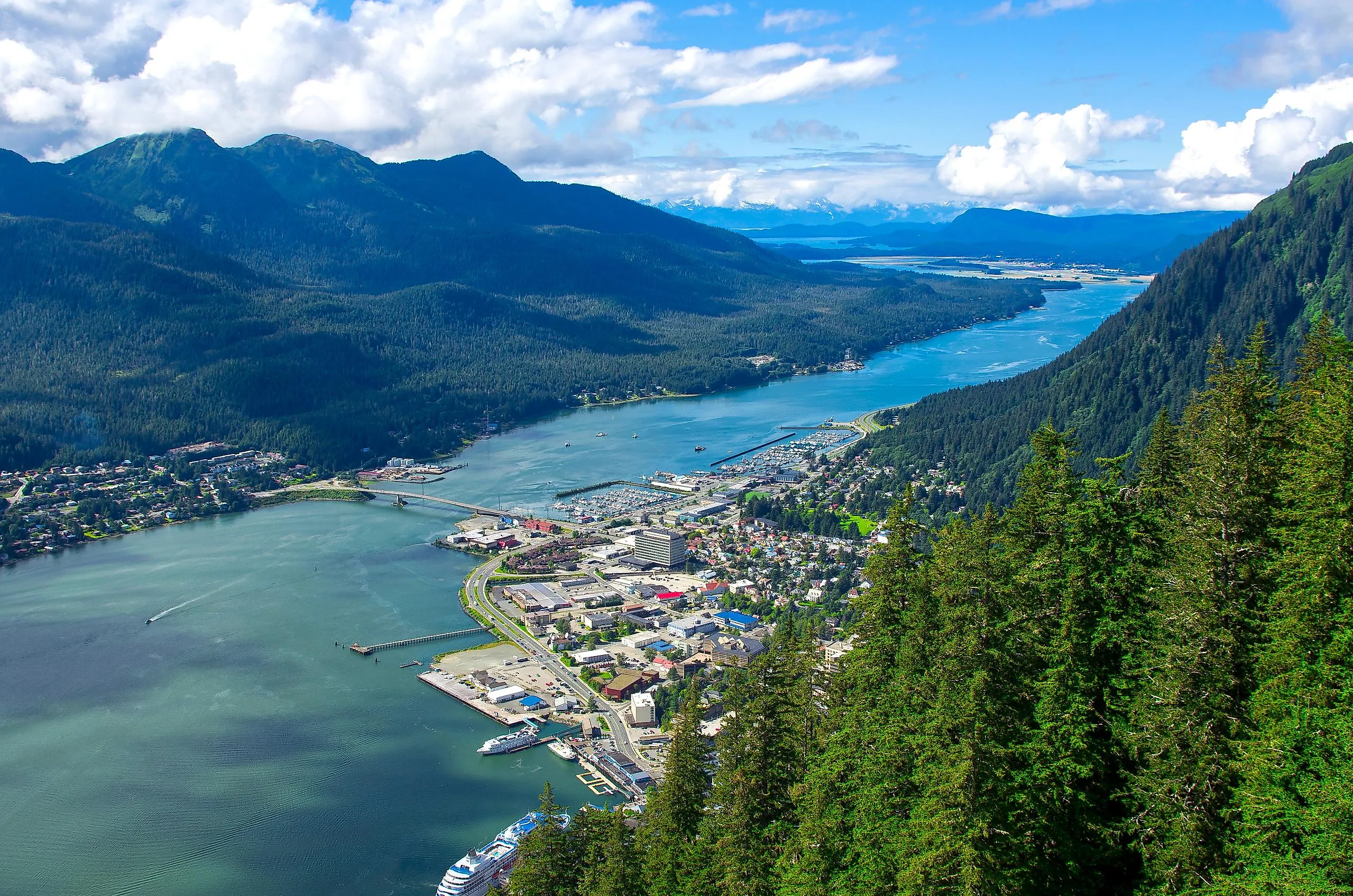
In the early decades of the Alaska Territory, gold rushes were what gave big boosts to the population, such as Joe Juneau and Richard Harris' discovery of gold on the Gastineau Channel near modern-day Juneau in 1880, and the Klondike Gold Rush of 1896. A different type of treasure also attracted investment and settlers: oil. Drilling began around 1901 near the seeps at Katalla, on the Gulf of Alaska coast southeast of present-day Cordova, and the territory's first commercial production followed in 1902.
The Alaska territory was not free of conflict, as Japan bombed Dutch Harbor and invaded the Aleutian Islands in 1942 during World War II, but they were reclaimed by the U.S. Army the following year. Military buildup during the war dramatically increased the population of the territory. The 1940 census counted 72,524 residents in Alaska, and the 1950 count reached 128,643. After World War II, Alaskans voted in favor of statehood, and in 1955, the stage was set for a constitutional convention that would determine Alaska's current administrative practices.
Alaska's constitution

The constitutional convention was held at the University of Alaska Fairbanks and was attended by 55 delegates. These were a group of elected officials, including 49 men and 6 women, who came from a wide range of professions, such as fishermen, lawyers, miners, and homesteaders. The delegates selected a university setting to make the constitution more of an academic endeavor and less motivated by political concerns. They also worked to include their constituencies, recessing in December 1955 and returning home to hold town meetings across the territory. Residents' contributions went back to Fairbanks with them and into the final document, signed on February 5, 1956. The Constitution has proved durable in the decades since it took effect, drawing 28 amendments in all.
One key topic was whether to organize the state into counties or boroughs. The representatives ultimately favored boroughs in part due to tax concerns. They especially did not want to have duplicate government entities that both had the power to tax. Another element was allowing individual regions to decide their own styles of governance, and not creating a large bureaucracy with large numbers of local elected officials. One delegate, Victor Fischer, said in the State Court Report that the goal of the borough system was "to provide for maximum local self-government with a minimum of local government units, and to prevent duplication of tax-levying jurisdictions."

Article X of the Alaska Constitution officially establishes boroughs and cities as the primary local government bodies. It further divides boroughs into organized and unorganized, and grants administrative authority only to organized boroughs and cities. Section 3 adds, "The entire State shall be divided into boroughs, organized or unorganized. They shall be established in a manner and according to standards provided by law. The standards shall include population, geography, economy, transportation, and other factors. Each borough shall embrace an area and population with common interests to the maximum degree possible. The legislature shall classify boroughs and prescribe their powers and functions. Methods by which boroughs may be organized, incorporated, merged, consolidated, reclassified, or dissolved shall be prescribed by law." One reason behind this section was the sheer variety of economies and towns in Alaska. Some communities had no cash economies or were subsistence farming/hunting communities.
The Borough Act

Within a few years, there were still large groups of unincorporated areas that had yet to incorporate as boroughs. To address this situation, Alaska lawmakers passed the Borough Act of 1961, which required several areas to establish themselves as boroughs to provide education, taxation, and planning services. However, due to the size of Alaska, adoption was slow, and thus lawmakers passed the Mandatory Borough Act of 1963, which required Ketchikan, Juneau, Sitka, Kodiak Island, Kenai Peninsula, Anchorage, the Matanuska-Susitna Valleys, and Fairbanks to all form boroughs. The rest of Alaska, which was too remote and sparsely populated, was to be managed directly by the state as part of the Unorganized Borough.
Over time, many boroughs were added, and today there are 19 boroughs in Alaska, with the most recent being the Petersburg Borough added in 2013. Six of them are consolidated city-boroughs, which fold a city and a borough into a single government: Anchorage, Juneau, Sitka, Skagway, Wrangell, and Yakutat. The remaining 13 are organized boroughs governed separately from the cities within them.
The Unorganized Borough

The Unorganized Borough takes in by far the largest share of land in Alaska, roughly 323,000 square miles, or more than half the state's land area. Its population is very small, about 77,000 at the 2020 census, which works out to around a tenth of everyone in Alaska. It does contain incorporated cities, among them the home rule city of Unalaska and dozens of second-class cities such as Fort Yukon.
According to the Alaska Department of Commerce, Community, and Economic Development, a home rule municipality "can exercise any power not specifically prohibited by law or the municipality's charter. First and second class boroughs and first class cities may adopt a home rule charter, which defines their powers and duties. (AS 29.10.010). AS 29.10.200 contains a list of state laws that limit certain things that a home-rule charter can legislate on. A community must have at least 400 permanent residents to form a home rule city. Unincorporated regions of the state may incorporate directly as a Home Rule borough."
Furthermore, Section 6 of Article X of the Alaska Constitution gives the legislature the responsibility to "provide for the performance of services it deems necessary or advisable in unorganized boroughs, allowing for maximum local participation and responsibility. It may exercise any power or function in an unorganized borough which the assembly may exercise in an organized borough." The Unorganized Borough is broken down into 11 census areas, which exist not as government entities but as units for collecting census data.
The Legacy of the Boroughs

Alaska's boroughs reflect many values and practical realities of the state. For one, they showcase a desire for independence and less complex overlapping government authorities. For another, they reflect the reality of life in Alaska. Alaska's population stands at roughly 740,000, according to Census Bureau estimates for 2024. The vast majority live in the Southcentral region and the southeast panhandle, with the Municipality of Anchorage alone accounting for about 290,000 of them. In order to accommodate the sparse population with an average density of 1.3 people per square mile in the 570,641 square miles of Alaska, the state utilizes the borough system for local flexibility and delivery of state services to the Unorganized Borough.